
AMD Radeon HD 7750 & Radeon HD 7770 GHz Edition Review: Evading The Price/Performance Curve
- Posted in
- GPUs
- AMD
- HTPC
- GCN
- Radeon HD 7000
Metro: 2033
Paired with Crysis as our second behemoth FPS is Metro: 2033. Metro gives up Crysis’ lush tropics and frozen wastelands for an underground experience, but even underground it can be quite brutal on GPUs, which is why it’s also our new benchmark of choice for looking at power/temperature/noise during a game. If its sequel due this year is anywhere near as GPU intensive then a single GPU may not be enough to run the game with every quality feature turned up.
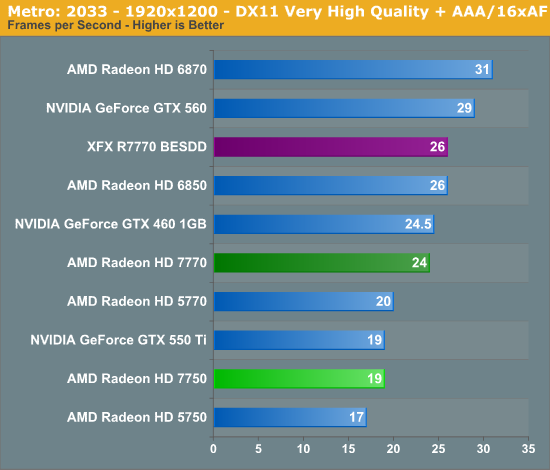
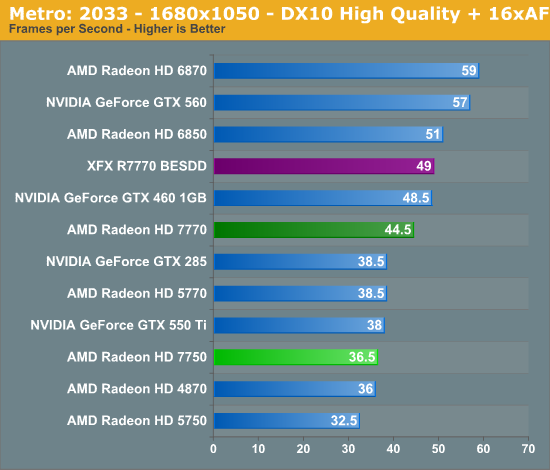
Things get better for AMD under Metro. Metro is extremely shader bound, which helps prop up performance in some areas and drives it farther apart in others. For the 7770, this means it still trails the 6850, but now only by 15%. Meanwhile XFX’s factory overclock helps to close that gap.
Given the shader-heavy nature of Metro, it’s interesting to note just how well the 7770 is doing versus the 5770, even though the 7770 only has 94% of the theoretical shader performance. Although the launch of the 7900 series didn’t give us a lot of data to work with regarding the efficiency of GCN shaders in games, the 7700 provides the first piece of solid data that GCN shaders are actually more efficient than VLIW5 shaders in at least some cases. Considering the die space penalty for implementing GCN functionality, this is very good news for AMD.
Of course as Metro is so shader heavy, it means it drives a wedge between the 7770 and 7750. The 7770 is now 21% ahead of the 7750, which compared to the 45% price premium is quite good, but it means the 7750 won’t be performing so close to the 7770 all of the time. And much like Crysis it’s slightly trailing the 5770.
Originally published at https://www.anandtech.com/show/5541/amd-radeon-hd-7750-radeon-hd-7770-ghz-edition-review (Wayback Machine).