
Intel SSD 520 Review: Cherryville Brings Reliability to SandForce
Random Read/Write Speed
The four corners of SSD performance are as follows: random read, random write, sequential read and sequential write speed. Random accesses are generally small in size, while sequential accesses tend to be larger and thus we have the four Iometer tests we use in all of our reviews.
Our first test writes 4KB in a completely random pattern over an 8GB space of the drive to simulate the sort of random access that you'd see on an OS drive (even this is more stressful than a normal desktop user would see). I perform three concurrent IOs and run the test for 3 minutes. The results reported are in average MB/s over the entire time. We use both standard pseudo randomly generated data for each write as well as fully random data to show you both the maximum and minimum performance offered by SandForce based drives in these tests. The average performance of SF drives will likely be somewhere in between the two values for each drive you see in the graphs. For an understanding of why this matters, read our original SandForce article.
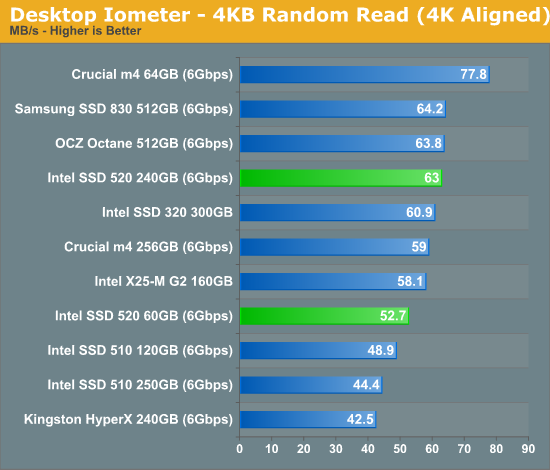
Random read performance seems to have topped out around 60MB/s for most drives and the 520 is no different here.
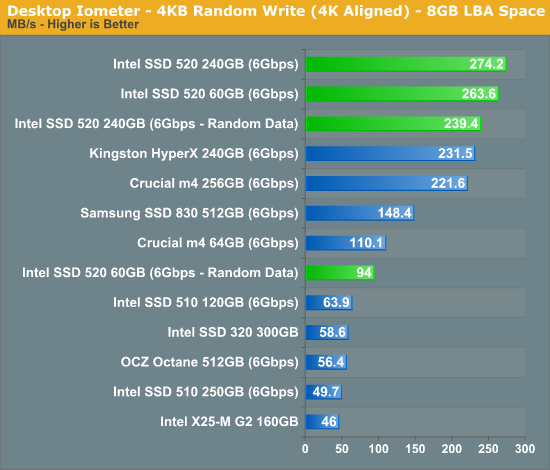
Random write performance, especially with highly compressible data sets the 520 performs beautifully - even outpacing the SF-2281 based Kingston HyperX.
Many of you have asked for random write performance at higher queue depths. What I have below is our 4KB random write test performed at a queue depth of 32 instead of 3. While the vast majority of desktop usage models experience queue depths of 0 - 5, higher depths are possible in heavy I/O (and multi-user) workloads:
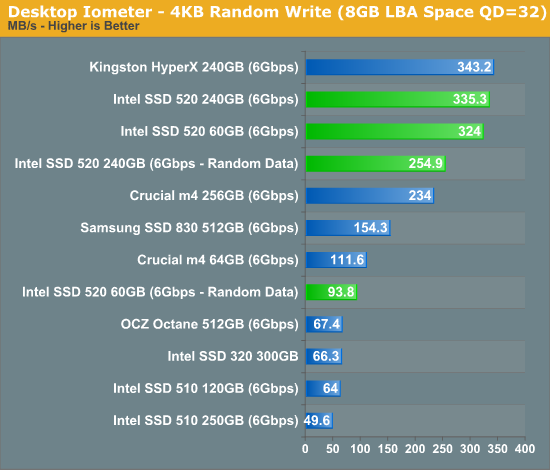
At higher queue depths the HyperX catches up to and surpassed the 520, perhaps indicating that Intel has done some work to optimize low queue depth performance on the 520 (likely what most end users will encounter).
Sequential Read/Write Speed
To measure sequential performance I ran a 1 minute long 128KB sequential test over the entire span of the drive at a queue depth of 1. The results reported are in average MB/s over the entire test length.
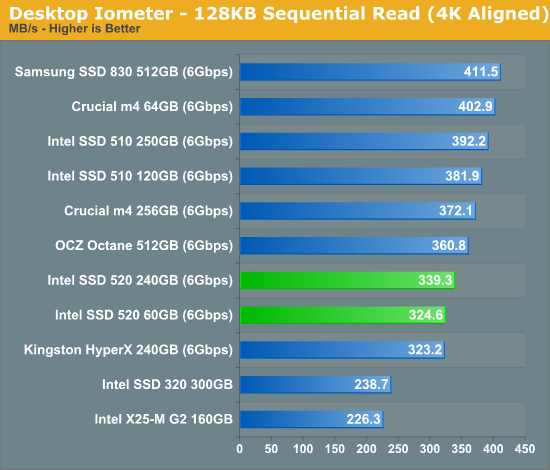
Sequential read performance is actually a bit lower than Intel's 510, but still higher than a standard SF-2281 drive.
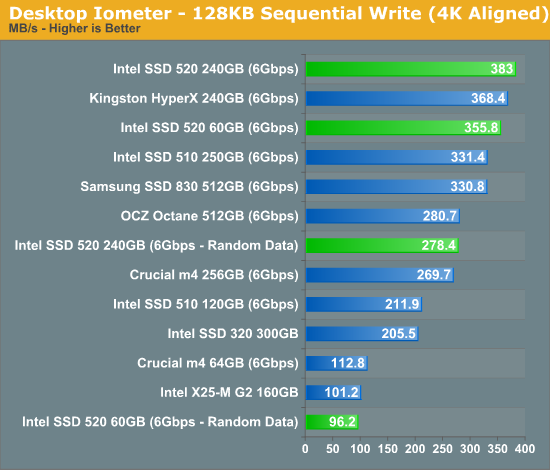
It's important to note just how close the 520's peak random write performance is to its sequential write performance. A big part of this is obviously that the SF-2281 is throwing away a lot of the data it has to write, but even if we compare incompressible 4KB random write to highly compressible 128KB sequential write we see a good ratio. The closer those two values are the more optimal the controller/firmware design is as, in theory, smaller random writes should be grouped to effectively become large sequential writes from the perspective of the NAND.
Originally published at https://www.anandtech.com/show/5508/intel-ssd-520-review-cherryville-brings-reliability-to-sandforce (Wayback Machine).