
AMD Radeon HD 7950 Review Feat. Sapphire & XFX: Sewing Up The High-End Market
Civilization V
Our final game, Civilization 5, gives us an interesting look at things that other RTSes cannot match, with a much weaker focus on shading in the game world, and a much greater focus on creating the geometry needed to bring such a world to life. In doing so it uses a slew of DirectX 11 technologies, including tessellation for said geometry, driver command lists for reducing CPU overhead, and compute shaders for on-the-fly texture decompression.
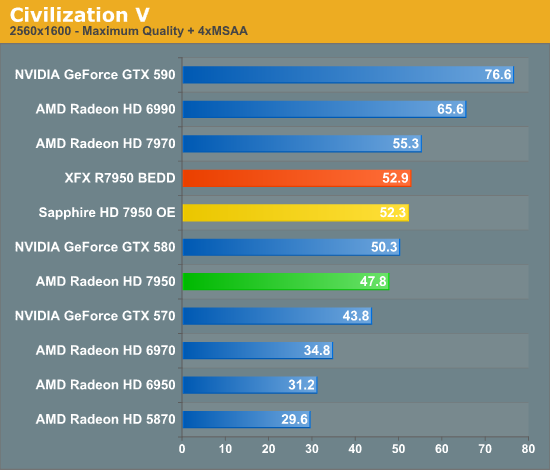
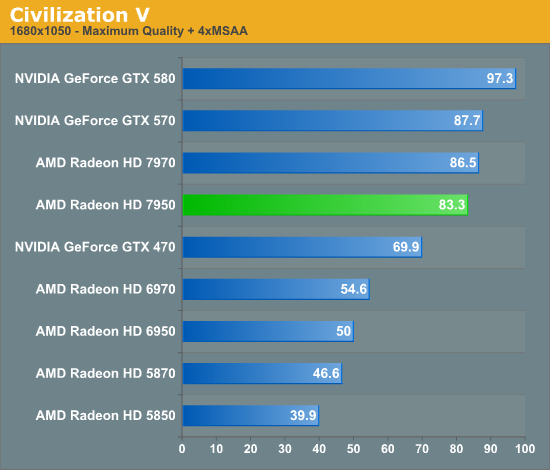
As we saw in our 7970 review, Tahiti’s performance under Civ V is quite interesting—it’s well ahead of the 6000 series, more so than we would have expected. The 7950 continues this trend, keeping it relatively competitive with the GTX 580, trailing by only 5% at 2560. AMD has continued to stay mum on why their Civilization V performance on Tahiti is so good, and in light of the 14% gap between the 7970 and 7950, it looks like shader performance—particularly compute shader performance—seems to be the deciding factor. Meanwhile the factory overclocked XFX and Sapphire cards once more tilt the results in the 7950’s favor, with their performance turning the tables on the GTX 580 to take a 4-5% lead.
Originally published at https://www.anandtech.com/show/5476/amd-radeon-7950-review (Wayback Machine).