
ASRock X79 Extreme9 Review - Price For Performance?
- Posted in
- Motherboards
- ASRock
- X79
When I first heard that ASRock were producing an X79 Extreme9, I was a little confused - previously they've not gone above Extreme7, and their Fatal1ty range caters for the gaming crowd. Their lower end models tend to be some of the cheapest around (e.g. Extreme3/4), and their Extreme7 sat nicely in the midrange. With a jump into the high end (with the X79 high-end being even more exclusive), they would need to offer something different compared to the other motherboard manufacturers who typically compete in this price range - ASUS, Gigabyte, MSI and EVGA for example. Then they would also need to show that the jump from the Extreme4 or Extreme7 to the Extreme9 would be worth the extra outlay.
So as I wrote in the review, it's hard to place the X79 Extreme9. I have reviewed the Extreme4 and Extreme4-M, both of which were good X79 budget boards for consumers or enthusiasts who wanted to jump into Sandy Bridge-E as cheaply as possible. The X79 Extreme9 comes in around +50% more than those boards ($360 vs. ~$240), meaning I would expect 50% more when it came to the Extreme9.
When we compare the Extreme9 to the Extreme4: power delivery has increased from a 6+2 to a 16+2 phase; we have the full complement of 8 DIMMs for X79 (two per channel); 5 PCIe (but still limited to 3-way SLI/CFX unless dual GPU cards are used); a dedicated audio processor, dual gigabit connections (which can be teamed) rather than a single; more SATA ports (8+4 rather than 5+4); more USB (8+12 rather than 4+12); and a lot more in terms of extras in the box (cables, USB 3.0 back panel). So in terms of functionality, we've got a lot of upgrades here for our extra 50%.
Performance wise, we're not seeing much special, except in the manual overclock area, where at 1.4 V I was able to achieve 4.7 GHz without issue (4.8 GHz booted, and survived a few minutes with a stress test before BSODing, so probably only needs a little boost in voltage to be stable). This is despite the auto-overclocking not working as well as hoped, being very temperamental on the 4.6 GHz setting. In the land of ASRock software, while the XFast LAN and XFast RAM are good additions, the fan controls are a bit geriatric for 2012 compared to the best of their competitors, and a good OS overclocking tool is needed.
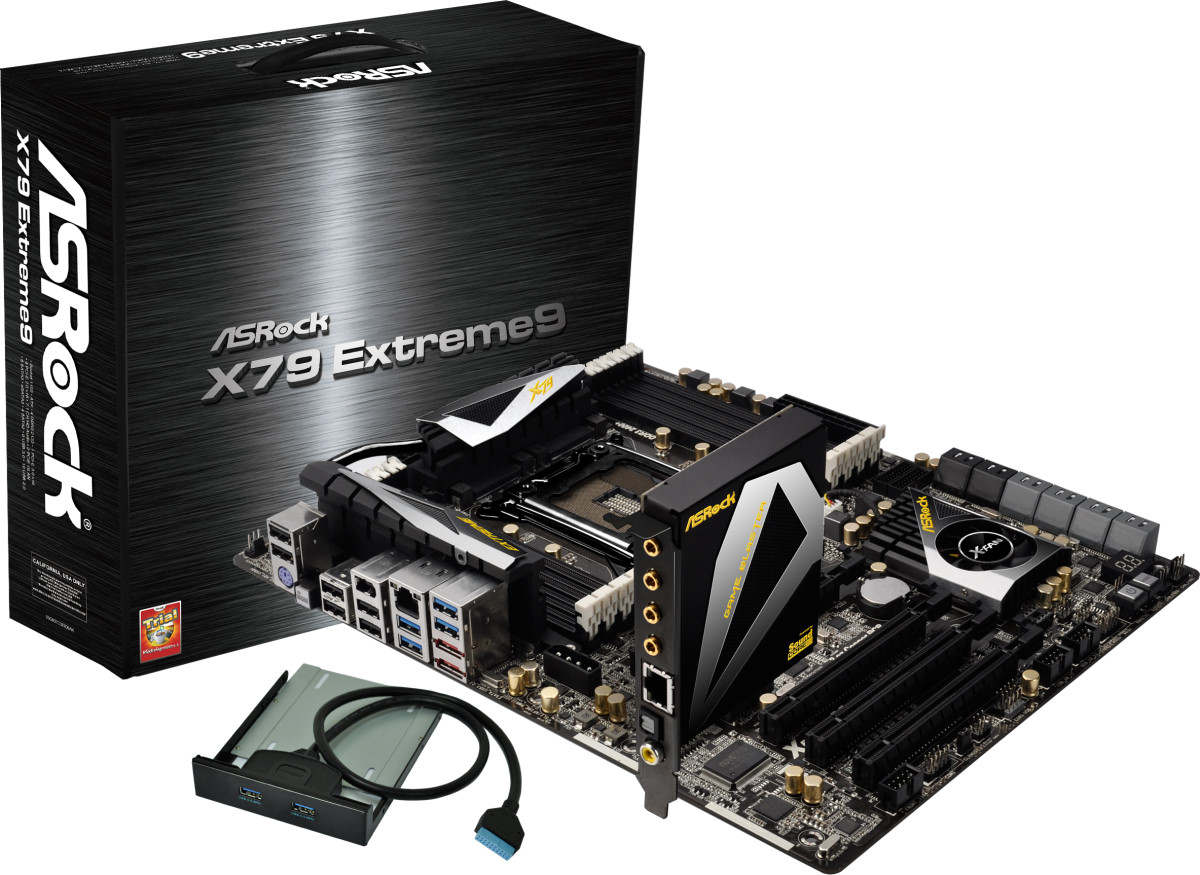
ASRock's foray into the high end with their X79 Extreme9 is a case of mix and match. The hardware is almost there, breezing through my benchmarking suite without a hitch, and showcasing 12 SATA ports, upgraded audio, dual teamed NICs as well as a USB 3.0 front panel in the box. The software needs work - it's all very well getting licensed software in, but it has to integrate nicely. Manual overclocking is indicative of a higher end board - I'm tempted to push it on my water cooling system to see if it can beat my 5125 MHz record with the i7-3960X on the P9X79 Pro. The MSRP of $360 does seem a little high to me, but that all depends on what you want from an X79 motherboard.
Originally published at https://www.anandtech.com/show/5434/asrock-x79-extreme9-review-price-for-performance (Wayback Machine).