
NVIDIA's GeForce GTX 560 Ti w/448 Cores: GTX 570 On A Budget
The Test, Crysis, BattleForge, & Metro 2033
Yesterday NVIDIA launched their first 290 series beta driver - this was intended to be the launch driver for the GTX 560-448, but QA kept it held up longer than expected. In lieu of that we are using 285.62, the WHQL 285 series driver for the GTX 560-448.
For our look at performance we’ll be taking a look at our Zotac card both at NVIDIA’s stock speeds and at Zotac’s factory overclock. For power/temp/noise we’ll only be looking at Zotac’s card – the lack of a reference design means that temperatures and noise can’t be extrapolated for other partners’ cards.
| CPU: | Intel Core i7-920 @ 3.33GHz |
| Motherboard: | Asus Rampage II Extreme |
| Chipset Drivers: | Intel 9.1.1.1015 (Intel) |
| Hard Disk: | OCZ Summit (120GB) |
| Memory: | Patriot Viper DDR3-1333 3x2GB (7-7-7-20) |
| Video Cards: |
AMD Radeon HD 6870 AMD Radeon HD 6970 AMD Radeon HD 6950 NVIDIA GeForce GTX 580 NVIDIA GeForce GTX 570 NVIDIA GeForce GTX 560 Ti Zotac GeForce GTX 560 Ti 448 Cores Limited Edition |
| Video Drivers: |
NVIDIA GeForce Driver 285.62 AMD Catalyst 11.11a |
| OS: | Windows 7 Ultimate 64-bit |
As this is not a new architecture, we’ll keep the commentary thinner than usual. The near-GTX 570 specifications mean there aren’t any surprises with game performance.
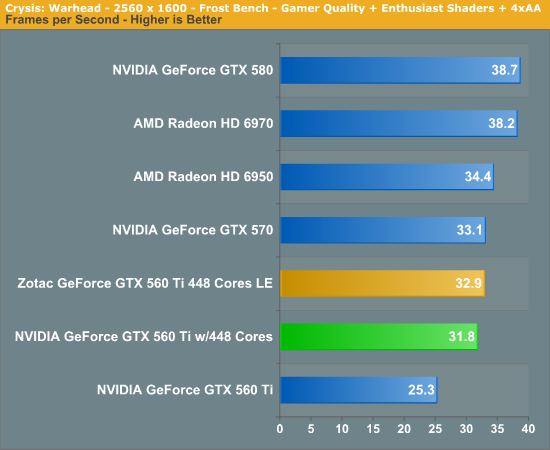
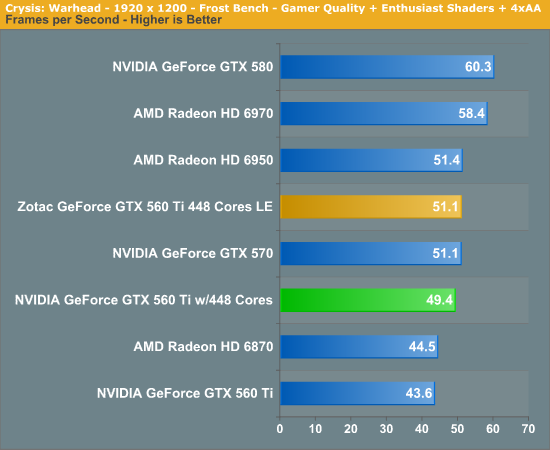
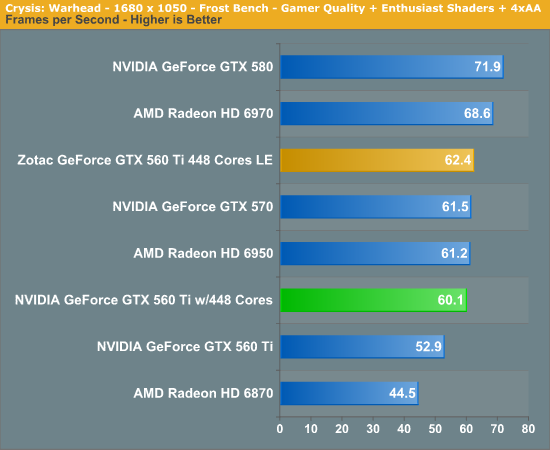
Starting as always with Crysis, at 2560 we can see that while GF100 cards perform decently at 2560, it’s really only the GTX 580 that stands a chance in any shader-heavy game. The GTX 560-448 in that respect is a lot like the GTX 560 Ti: it’s best suited for 1920 and below.
At 1920 and 1680 the GTX 560-448 is well ahead of its GF114-based namesake. As with the specs and architecture, the GTX 560-448 has more in common with the GTX 570 than it does the GTX 560 Ti. The end result is that the GTX 560-448 is just shy of 50fps at 1920, only a few percent off of the GTX 570. With Zotac’s overclock that closes the gap exactly, delivering the same 51.1fps performance. This goes to show just how close the GTX 560-448 and GTX 570 really are. NVIDIA may not want to call it a GTX 570 LE, but that’s really what it is.
Meanwhile compared to AMD’s lineup things are a little less rosy. The GTX 570 at launch was closer to competition for the Radeon HD 6970, but here the GTX 570 and GTX 560-448 are tied by or beaten by AMD’s cheaper 6950.
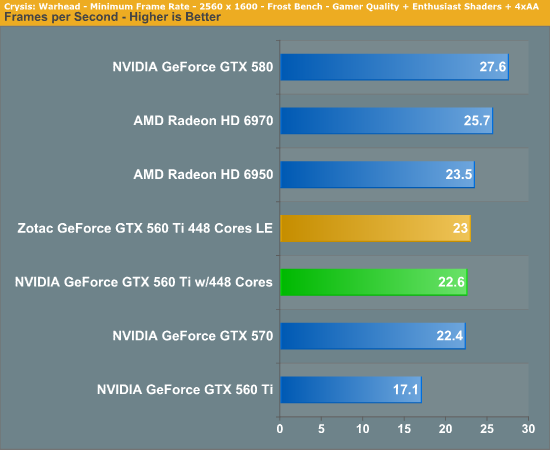
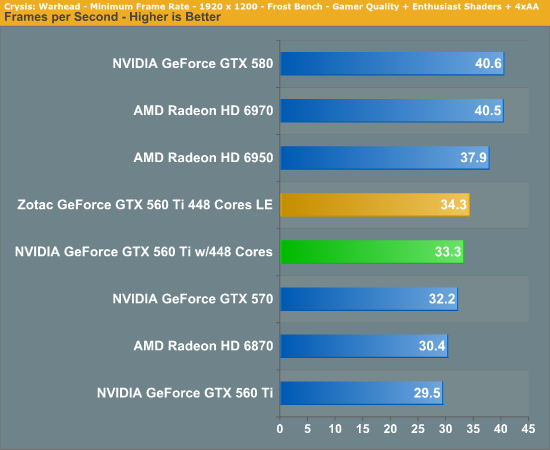
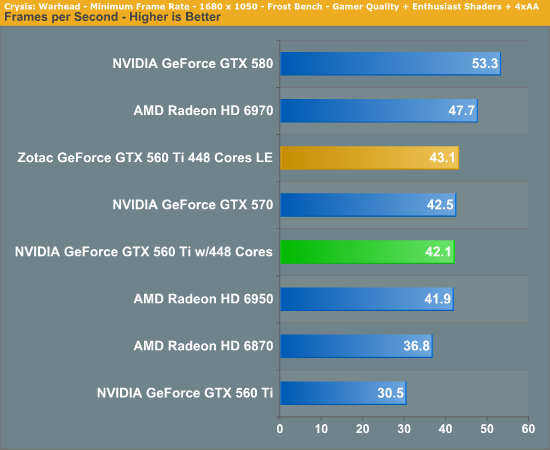
Looking at the minimum framerates we see the same trends. The GTX 560-448 is well above the GTX 560 Ti – by 13% at 1920 – but the 6950 is once again the victor.
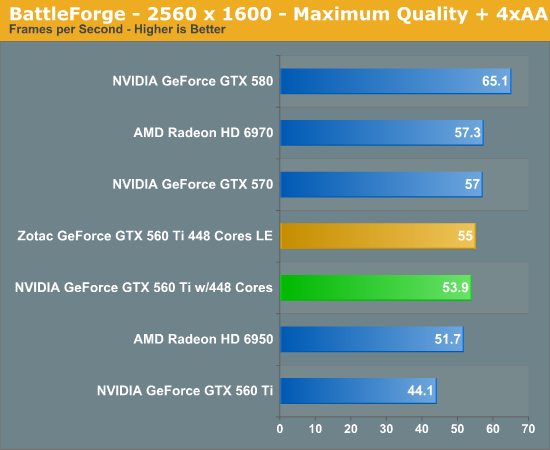
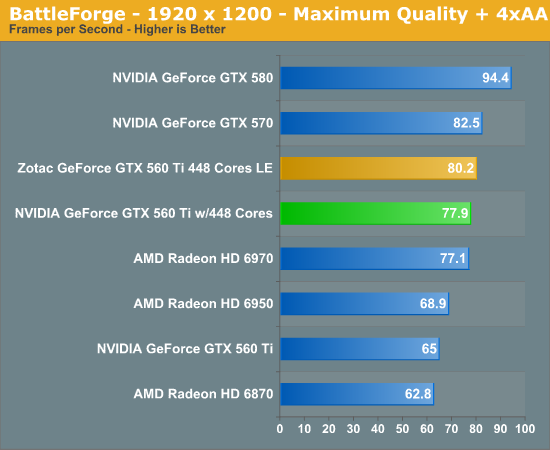
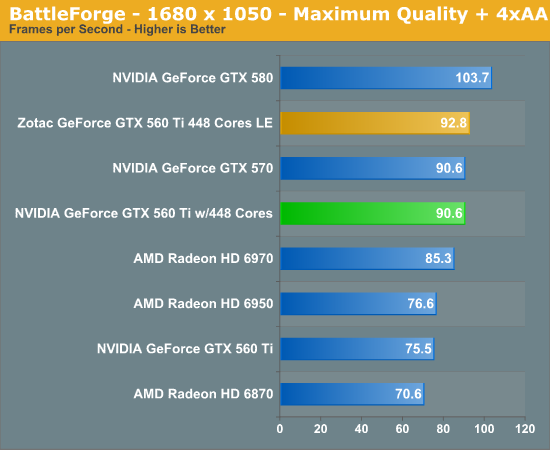
Moving on to BattleForge, we see the emergence of AMD and NVIDIA switching places based on the game being tested. BattleForge favors NVIDIA cards, and as a result the GTX 560-448 does quite well here, tying AMD’s more expensive 6970 at 1920. Zotac’s overclock further improves thing, but as BattleForge likes memory bandwidth, it can’t overcome the GTX 570’s 5% memory bandwidth advantage.
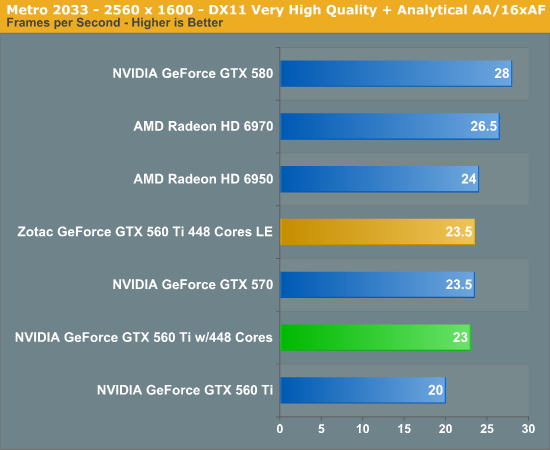
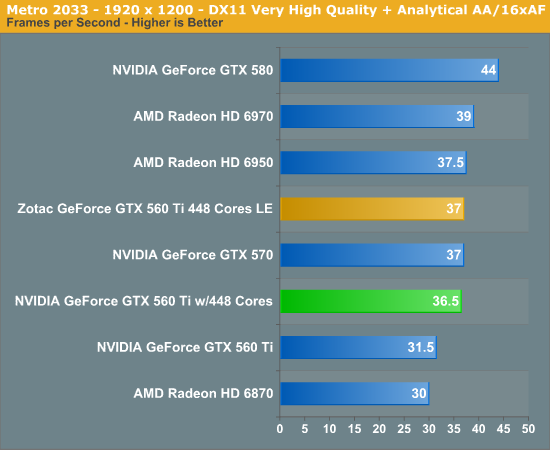
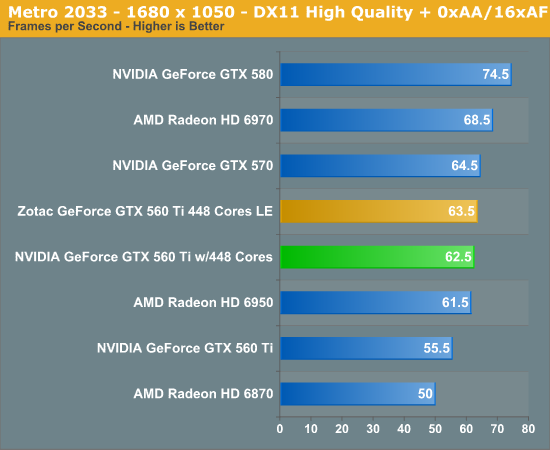
With Metro 2033 we see AMD and NVIDIA swap positions again, this time leaving AMD’s lineup with the very slight edge. This puts the 6950 ahead of the GTX 560-448 at 1920, even with Zotac’s overclock. Practically speaking however you’re not going to break 40fps on a single card without a GTX 580.
Originally published at https://www.anandtech.com/show/5153/nvidias-geforce-gtx-560-ti-w448-cores-gtx570-on-a-budget (Wayback Machine).