
Amazon Kindle Fire Review
- Posted in
- Tablets
- Mobile
- Amazon
- Kindle Fire
- Kindle
GPU Performance
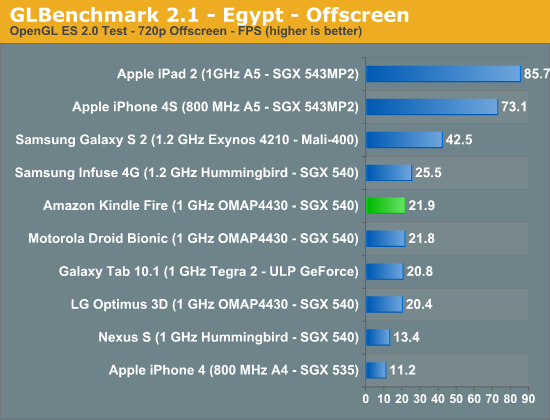
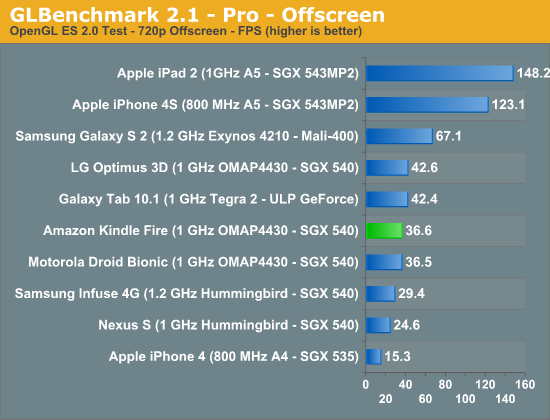
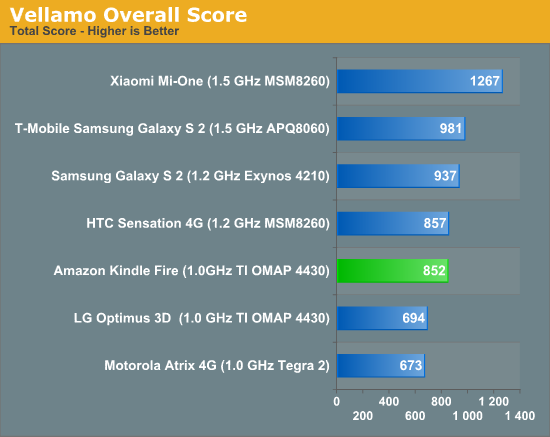
I threw GLBenchmark on the Kindle Fire (Android apps can be sideloaded via USB and a file manager to run the .apk) to see if Amazon skimped on its GPU driver optimizations. Luckily it didn't, the Kindle Fire's PowerVR SGX 540 performs just as well as you'd expect it to:
WiFi Performance
Amazon didn't sacrifice compute in building the Kindle Fire, but WiFi performance is pretty bad. As I alluded to in our earlier piece on Silk performance, the Fire is limited to around 15Mbps over 2.4GHz 72Mbps 802.11n (5GHz isn't supported):
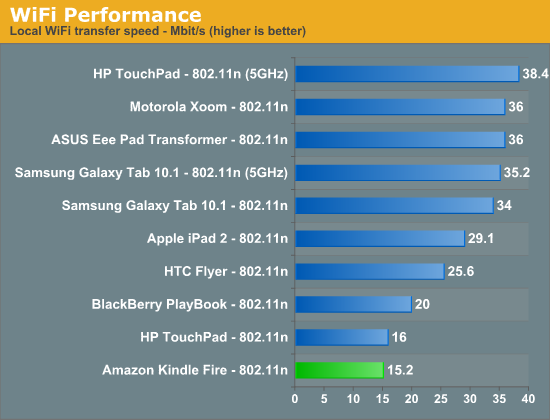
It's unclear if this limitation is due to the TI WL1271 chip on-board or if Amazon just didn't tune the WiFi driver stack for performance vs. power consumption. I'd assume the latter given the focus of the Kindle Fire.
I also measured transfer rates over USB 2.0 to confirm this wasn't some NAND performance limitation. The Kindle Fire uses a single 8GB eMMC package from Samsung. Sequential read speeds were nice and high at 24MB/s, but sequential writes to the device were noticeably lower. I measured between 4 - 6MB/s, which isn't unheard of for low-end NAND. The lowest sequential write speed I measured is still 2x the speed of the fastest transfer I recorded over WiFi, so this is definitely the result of the wireless stack.
Originally published at https://www.anandtech.com/show/5128/amazon-kindle-fire-review (Wayback Machine).