
Intel DX79SI Review: The Default X79?
- Posted in
- Motherboards
- Intel
- X79
On the basis that Intel primarily ships a working motherboard at the beginning of a chipset release, it is hard to say how much effort they put into a product for the consumer. As media, our media samples usually contain an Intel board and a processor – that board being the product of what one assumes to be from a small team in comparison to the processor and chipset design arms. For other companies for which motherboard manufacture is their one and only business, they are more likely to heed consumer feedback and adapt their products to better fit into the market. Intel does not need to do this – their motherboard sales are a fraction of everything else. Nevertheless, consumers and system builders may wish to pair an Intel board with an Intel CPU as an indicator to retain a single company's components.
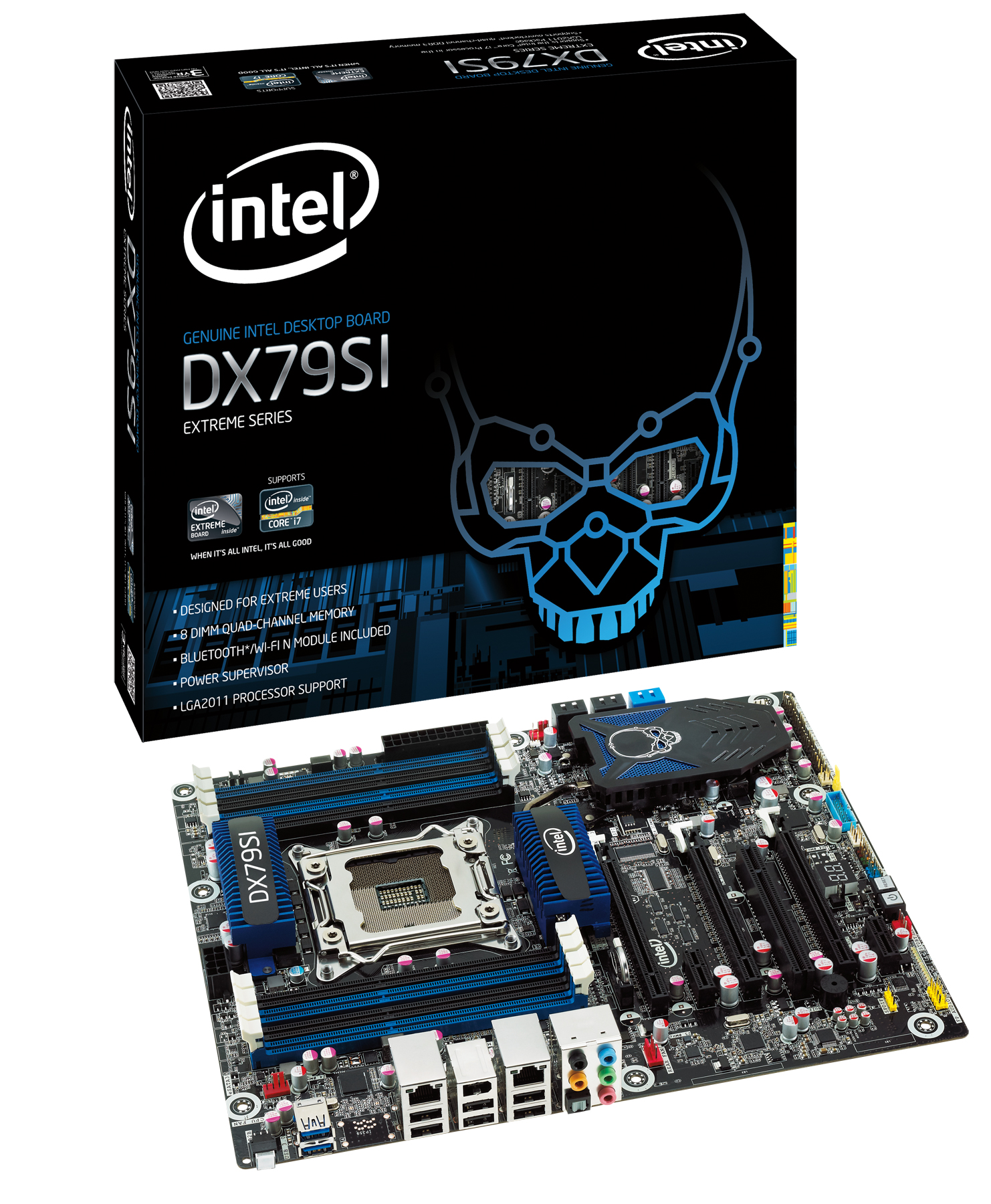
So what Intel has provided is a simple, yet functional, $300 motherboard for X79. The good thing is that it works, and is stable. As a stickler for specifications, Intel does not have to pursue absolute performance from the VRMs in overclockability, but if that happens anyway, it becomes a bonus. However, in this quest for a ‘board that works’ philosophy, we are let down on several points.
Firstly is the PCIe configuration, especially when double slot dual GPUs are used. These have to take up the first two PCIe x16 slots, which when the GPUs are double slot width leave no gap between them. There were times in my dual GTX580 testing where I was concerned about temperatures, perhaps suggesting that users in this situation use custom fan profiles on their GPUs. Next in the firing line is the software for users – there is nothing apart from an overclocking utility for the OS. Although it is well made, some form of fan controls is essentially a must-have in the current land of motherboard comparison. As a result, this automatically removes it from any awards I may have been considering giving the board after testing. Also of note is the lack of SATA cables in the package. Unfortunately, I have a media sample rather than a retail package, which lacks the Bluetooth/Wifi module, but nothing in the product specifications points to any SATA cables being bundled.
Despite this, there are positives to the board. It houses dual gigabit Intel NICs, which is always welcome when spending $300 on a board. Alongside this, I really liked the ‘Back2BIOS’ button on the I/O panel, providing a quick and sure-fire way to get back into the BIOS and change various options. The BIOS does not win any awards, being a simple functional menu system with various ASCII art representations of parts of the board, but it gives info when required which is still an issue for some motherboard manufacturers. Also a positive is the overclocking settings, which on the 1.00x gear ratio instantly provided 4.6 GHz at 1.42 V. As we’ve reviewed previously, at this speed and voltage the processor can get quite toasty (80C in a Blender stress test), even with the Intel Liquid Cooler outside of a case, so consumers may consider a lower speed setting which also works well with memory, such as 4.4 GHz and DDR3-1866.
In the grand scheme of things, this board works. However for the price, there is not anything that makes it stand out from the crowd. I would not recommend it for anyone considering using more than one GPU due to the spacing, or for those that want to adjust fan speeds for temperature and noise from motherboard OS controls.
The Intel DX79SI is expected to retail in the $290-$300 region, and comes with a 3 year limited warranty.
Originally published at https://www.anandtech.com/show/5123/intel-dx79si-review-the-default-x79 (Wayback Machine).