
ASUS P3V4X Apollo Pro 133A Slot-1 ATX
- Posted in
- Motherboards
ASUS's latest boards feature their JumperFree CPU configuration as well as DIP switches on the board. In their default position, the DIP switches are ignored and the CPU is configured from within the BIOS. For those that don't feel as comfortable with the jumperless setup - e.g. a system that will be available for public use - the CPU can be configured by the DIP switches.
Nine high quality 1500uF sit behind the Slot-1 connector and contribute to the rock solid stability of the P3V4X. In fact, we found the P3V4X to be the most stable Apollo Pro 133A board in our initial roundup. Thanks to core voltage tweaks in the BIOS and a plethora of FSB speeds, we had no problems overclocking our test-bed Pentium III 550E and 733EB without compromising stability. Those FSB speeds include 66 / 68 / 75 / 80 / 85 / 90 / 95 / 100 / 103 / 105 / 110 / 112 / 115 / 116 / 118 / 120 / 124 / 126 / 130 / 133 / 135 / 138 / 140 / 142 / 144 / 146 / 148 / 150 / 155 / 160 / 166 - that's a total of 32 settings and are spaced well to keep almost any overclocker happy. AGP and PCI speeds are all kept as close to spec as possible thanks to the AGP/PCI ratios being automatically set, even while overclocking. It should be noted that there are only 16 possible FSB speeds when configured via the DIP switches, but all are available in JumperFree mode.
The P3V4X also features an undocumented jumper that's labeled VIO near the DIMM slot. It's purpose is to raise the I/O voltage of the memory, chipset, and CPU to 3.6V from the already high 3.5V (the traditional value is 3.3V). While we've yet to see it actually make a difference, it can theoretically help in certain overclocking situations.
That BIOS is the Award Medallion 6.00 BIOS, which looks a lot like the old Phoenix BIOS, most likely due to the merger between Phoenix and Award last year. Fortunately, the Medallion BIOS merely looks and operates like a Phoenix BIOS, but offers all the tweaking options we've come to expect from the standard Award setup found on virtually all other boards out there. When it comes to BIOS support, ASUS is quite possibly the best manufacturer, with constant BIOS updates and betas available seemingly every day. In the past, they've continued that support with fixes and new features even after the board has been discontinued.
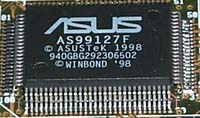 By
passing on the VIA 686A Super South Bridge, ASUS also passed on the integrated
hardware monitoring features of that chip. To compensate, the P3V4X uses a custom
ASUS AS99127F ASIC for hardware monitoring that can monitor 3 temperatures,
3 fan speeds, and 6 voltages. In the case of the P3V4X, CPU temperature is read
from the on-die thermal diode found on all 0.25 and 0.18 micron Intel CPU's.
An external thermistor header, designated for power supply temperature, but
could really be used for anything, is located near the Slot-1 connector.
ASUS includes their own PC Probe utility for reading from this chip, but its simple enough to use any one of the many third party utilities that are out there. The P3V4X ships with the usual high quality ASUS manual as well as a helpful CD that contains all of the necessary drivers and utilities to get your system up and running reliably. Nothing but the best, which is what we've come to expect from a company like ASUS.
Originally published at https://www.anandtech.com/show/506 (Wayback Machine).