
OCZ Z-Drive R4 CM88 (1.6TB PCIe SSD) Review
- Posted in
- Storage
- SSDs
- OCZ
- Z-Drive R4
- PCIe SSD
Enterprise Storage Bench - Oracle Swingbench
We've been toying with the idea of bringing enterprise performance tests to our SSD reviews for over a year now. We had expected to have more time to launch the suite but the Z-Drive R4 (and another enterprise SSD) were dropped on us unexpectedly so we had to rush things a bit. By no means is this the extent of our enterprise storage bench, but it's a start.
We begin with a popular benchmark from our server reviews: the Oracle Swingbench. This is a pretty typical OLTP workload that focuses on servers with a light to medium workload of 100 - 150 concurrent users. The database size is fairly small at 10GB, however the workload is absolutely brutal.
Swingbench consists of over 1.28 million read IOs and 3.55 million writes. The read/write GB ratio is nearly 1:1 (bigger reads than writes). Parallelism in this workload comes through aggregating IOs as 88% of the operations in this benchmark are 8KB or smaller. This test is actually something we use in our CPU reviews so its queue depth averages only 1.33. We will be following up with a version that features a much higher queue depth in the coming weeks.
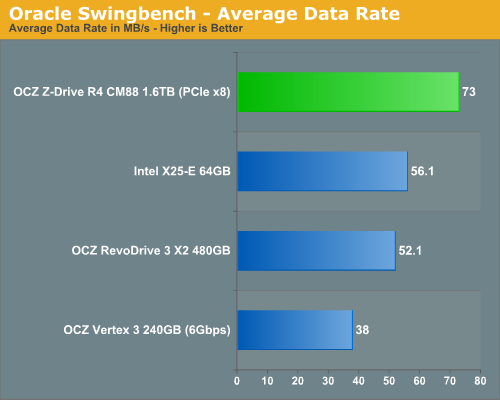
Surprisingly enough the SF-2281 based drives don't actually do all that well here. A single Vertex 3 is only good for 38MB/s, while the old X25-E manages 56.1MB/s. The Z-Drive R4 is the fastest drive here but only by 30% margin.
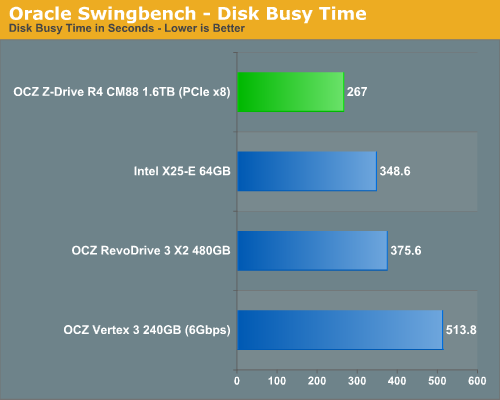
The same results are reflected if we look at disk busy time. However as I mentioned before, this benchmark features a very low average queue depth. With only one IO running most of the time you're not going to see much of a difference between multi-controller and single-controller drives. Despite this fact there's still a 90%+ advantage the Z-Drive R4 enjoys over a single Vertex 3, implying that there are periods of extremely high queue depths that are simply being hidden in the average. In order to see how well the drive does in these periods of very heavy IO activity we need to look at another metric: average service time.
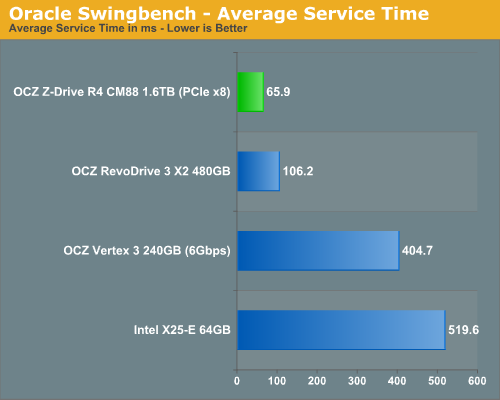
Average data rate and disk busy time tell us how much data is moved but they don't tell us how quickly each stacked IO completes. Average service time gives us this data. Here we see huge performance advantages for the SF-2281 drives, and the Z-Drive R4 is significantly faster than even the RevoDrive 3 X2.
Both metrics are important - one gives you an idea of average performance while the other illustrates how the drive performances under heavy load.
Originally published at https://www.anandtech.com/show/4879/ocz-zdrive-r4-cm88-16tb-pcie-ssd-review (Wayback Machine).