
The Samsung SSD 830 Review
AnandTech Storage Bench 2011 - Light Workload
Our new light workload actually has more write operations than read operations. The split is as follows: 372,630 reads and 459,709 writes. The relatively close read/write ratio does better mimic a typical light workload (although even lighter workloads would be far more read centric).
The I/O breakdown is similar to the heavy workload at small IOs, however you'll notice that there are far fewer large IO transfers:
| AnandTech Storage Bench 2011 - Light Workload IO Breakdown | ||||
| IO Size | % of Total | |||
| 4KB | 27% | |||
| 16KB | 8% | |||
| 32KB | 6% | |||
| 64KB | 5% | |||
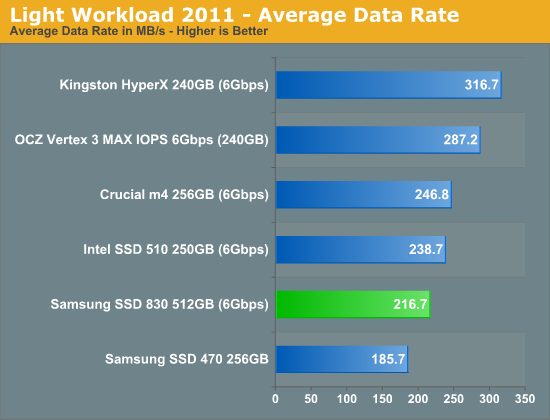
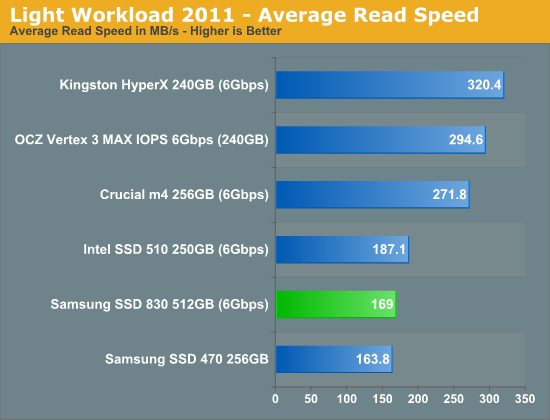
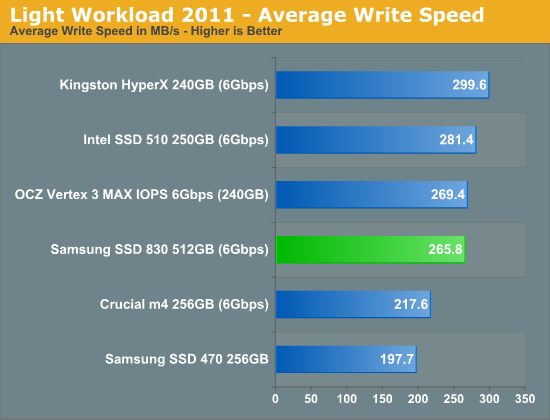
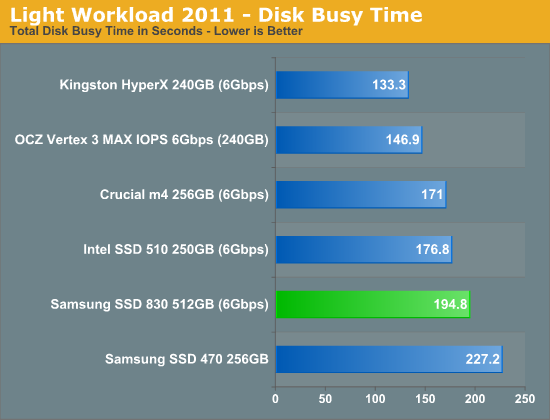
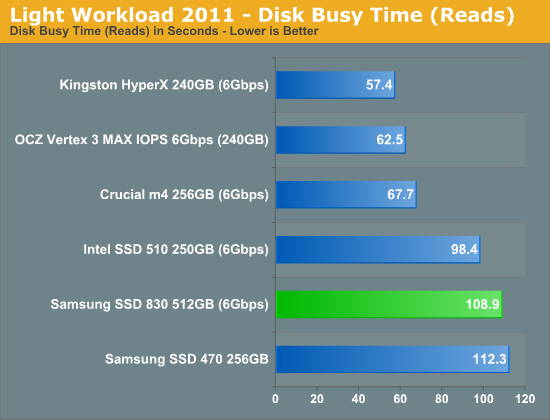
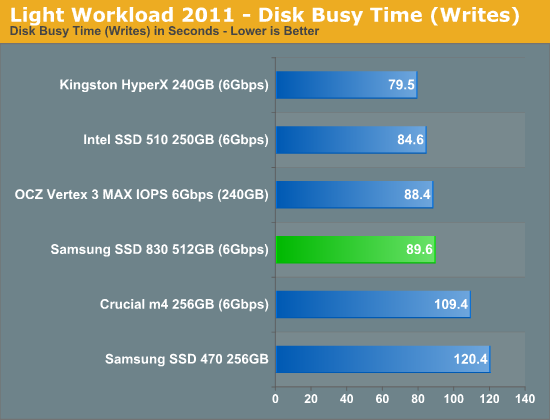
For lighter workloads that involve far less incompressible data, the 830 takes a clear backseat to the SF-2281 based drives. For nearly all users SandForce's real-time compression/dedupe architecture is a significant boon. You simply can't outperform a well designed controller that just writes less than the competition. The SSD 830 is at least significantly faster than the 470 and within striking distance (~10%) of the Intel SSD 510 and Crucial m4.
Originally published at https://www.anandtech.com/show/4863/the-samsung-ssd-830-review (Wayback Machine).