
Hands-On Powerline Networking: How Well (Or Not) Are Latest-Generation Devices Working?
- Posted in
- Networking
- Powerline Adapters
- NetGear
Speaking of adapters, which ones received scrutiny in this study? The five 'base case' adapters were Netgear's XAV2001 HomePlug AV 200 units, which I made sure beforehand were upgraded to the latest-available v0.2.0.5NA firmware release, and are based on the Qualcomm third-generation INT6400 chipset:

Sigma Designs' CG2110 chipset was the foundation of the Motorola-branded (and Sigma Designs-supplied) second HomePlug AV adapter suite that I tested. These particular units offer three-prong power plugs, thereby at least conceptually implementing Sigma Designs' earlier-mentioned ClearPath technology for optionally routing powerline networking traffic over the earth ground connection:

Note that in this particular case, I was unfortunately only able to obtain three adapters from Sigma Designs, two of which I had connected to the powerline network nodes under test at any particular time, and the third mated to the router. The reason for mentioning this discrepancy will become clear in the next section of this article.
And at the performance high end, at least on paper, are Netgear's five XAV5001 IEEE 1901 adapters, derived from Qualcomm's latest-generation AR7400 chipset. As with the XAV2001s, I made sure that they were updated to the latest-available public firmware (v0.2.0.9NA in this particular case) before subjecting them to my barrage of tests:
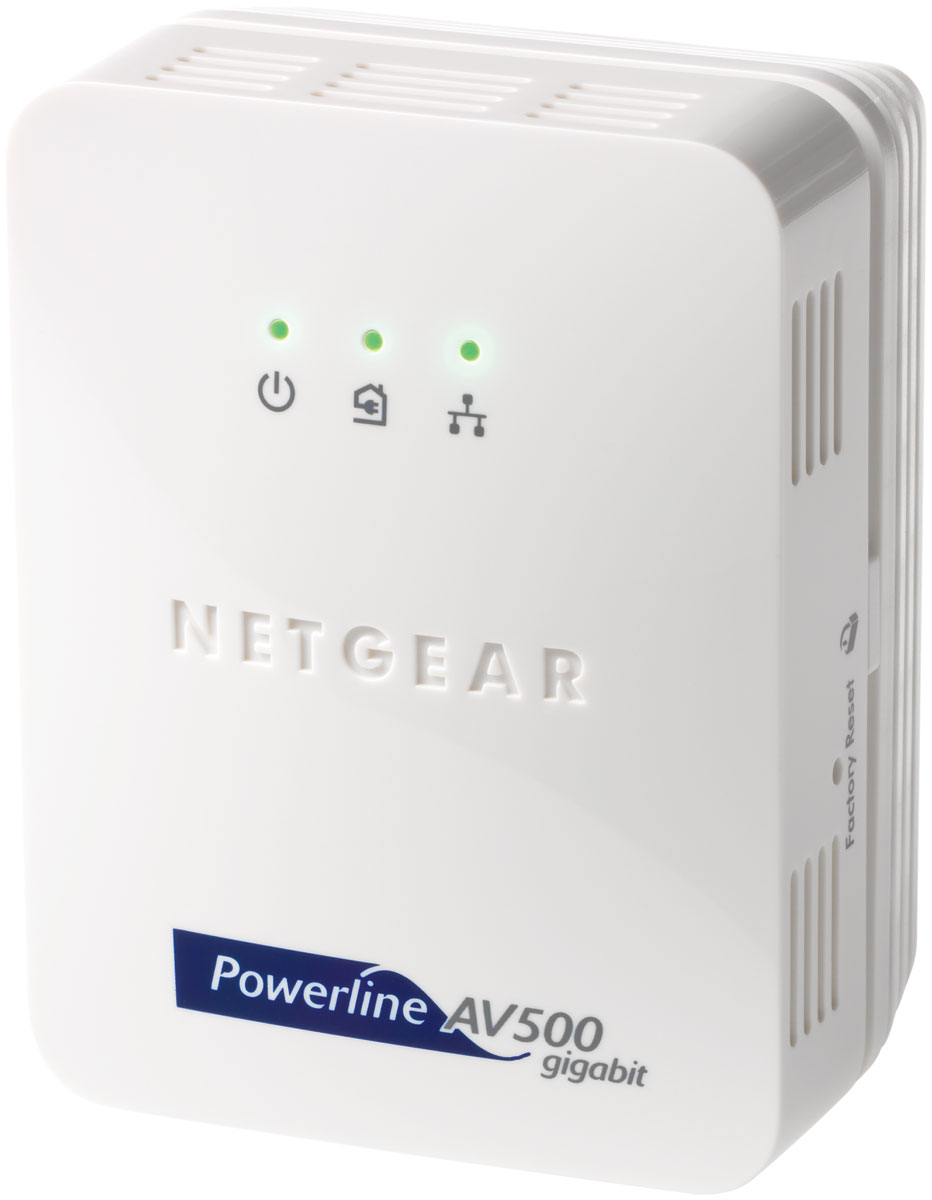
Although at any particular point in time I was only measuring bandwidth between any two adapters, I had all of the adapters of any particular technology (five each for Netgear HomePlug AV and IEEE 1901, three for Sigma Designs/Motorola HomePlug AV) connected to the power grid at all times. As with my earlier description of static-vs-DHCP IP address assignments, this decision might not have enabled any particular adapter to operate at highest possible performance, because it was periodically (albeit briefly) interacting with all of its peers on the premises' power grid. However, such a setup more accurately mimics the way that powerline adapters will be operating in real-life usage settings, which is why I went this route (poor networking pun intended).
I harnessed the Ixia-supplied 'Throughput.scr' script, albeit customizing it to extend the test time by increasing the test-data payload size from 100 KBytes to 1 MByte. And, having learned through past testing situations that powerline adapters (and, more generally, all types of networking equipment) sometimes deliver higher aggregate throughput when more than one stream's worth of data is simultaneously flowing through them, I ran both one- and four-stream testing scenarios:

Originally published at https://www.anandtech.com/show/4695/handson-powerline-networking-how-well-or-not-are-latestgeneration-devices-working (Wayback Machine).