
HTC EVO 3D vs. Motorola Photon 4G: Choosing the Best Sprint Phone
Performance
The Photon 4G uses NVIDIA's first mobile SoC with widespread acceptance: the Tegra 2. Although it only started appearing in Android phones and tablets this year, the design itself dates back to a year prior to its introduction. Despite its age, Tegra 2 does very well against the current competition. Its architecture is pretty simple to explain. You get a pair of ARM Cortex A9 cores running at up to 1GHz with a 1MB L2 cache shared between them. Although each core has a pipelined FPU, neither has ARM's MPE - a SIMD engine needed to run NEON code. NVIDIA built in a low power GeForce GPU into the Tegra 2 and while we've had complaints about it on tablets, at smartphone resolutions the ultra mobile GeForce seems to do reasonably well. Feeding the Tegra 2 is a single channel 32-bit LPDDR2 memory interface.
The EVO 3D on the other hand uses Qualcomm's latest SoC: the MSM8660, which falls under the new S3 brand. Here we also have two cores, although each one is a mostly in-order design running at 1.2GHz. NVIDIA originally told me that the move to out-of-order yielded a 20% increase in IPC at the same clock speed, so Qualcomm's 20% clock speed advantage should help level the playing field between the two on a CPU level. Qualcomm includes both a fully pipelined FPU as well as a NEON unit in each core, giving it an advantage in applications that are accelerated with NEON code. Admittedly to date there isn't a ton available to show where NEON can be advantageous so I don't know how much of an advantage this really ends up being. The two cores share a 512KB L2 cache but have a dual-channel memory interface.
Qualcomm is particularly proud of its ability to run each core at a frequency independent of the other. I haven't been able to demonstrate a tangible advantage to this feature yet and Qualcomm hasn't announced whether it will be present in future SoCs as well so the verdict is still out on this one.
The Adreno 220 is Qualcomm's highest end GPU (for now). Unfortunately we can't talk about its architecture as Qualcomm isn't publicly disclosing much but it is the fastest in the shipping Adreno lineup.
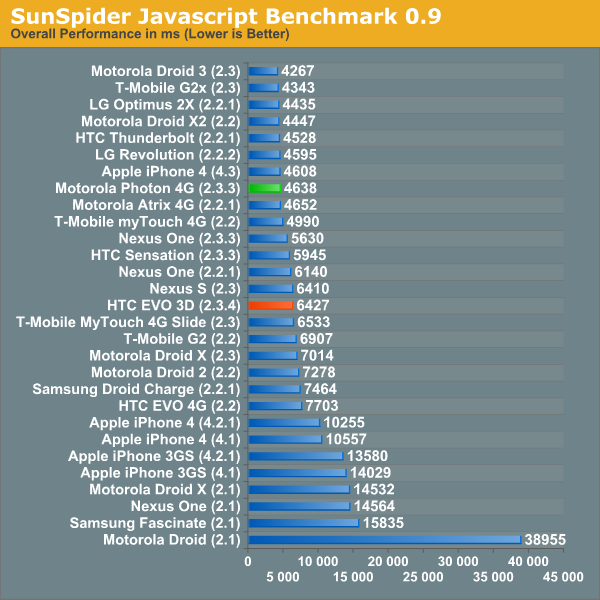
I already alluded to differences in the web browsers of these two phones resulting in varying javascript performance. HTC's browsers have traditionally not performed too well in our javascript tests and unfortunately the EVO 3D is no exception. In our tests it performed a bit worse than its counterpart, the Sensation. In any case, the Photon 4G has two advantages here: the out-of-order A9 architecture as well as a browser with a faster js engine. The comparison here isn't as cut and dry though. Although the EVO 3D's browser has a slower javascript engine, it does scroll smoother than the Photon's browser. The smoother scrolling on the EVO 3D is correctly encapsulated in the relevant scrolling tests in Qualcomm's Vellamo benchmark:
| Qualcomm Vellamo Benchmark - Scrolling Performance Tests | |||||
| Ocean Flinger | Image Flinger | Text Flinger | |||
| HTC EVO 3D | 68.98 | 26.03 | 41.79 | ||
| Motorola Photon 4G | 62.07 | 17.64 | 35.21 | ||
Despite Vellamo being a Qualcomm developed benchmark, the scores in these three tests do echo what I noticed after using the two phones. The EVO 3D's browser has better scrolling performance than the Photon. Neither is perfectly smooth, but the HTC browser is noticeably better than Motorola's.
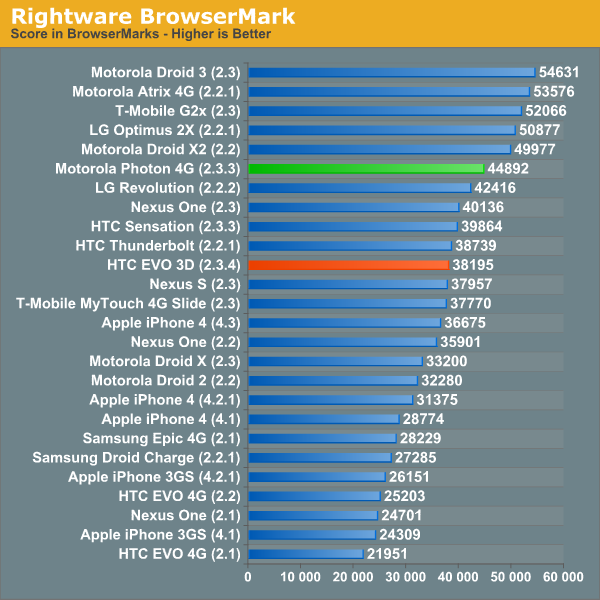
BrowserMark echoes the javascript rendering advantage of the Photon.
Flash performance complicates things. The Photon has consistently better Flash performance regardless of benchmark. GUIMark 2's Vector Charting Test shows the biggest issue with the EVO 3D:
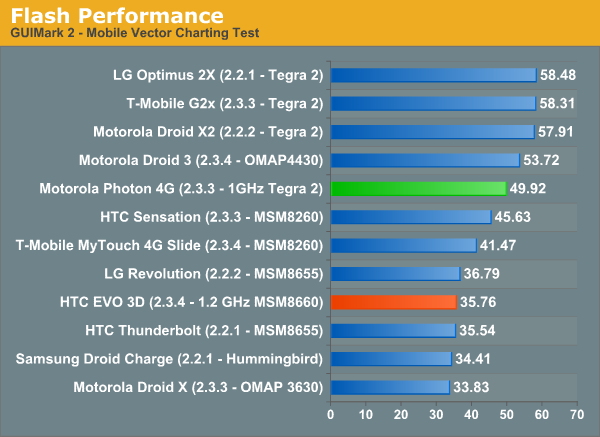
Although the EVO 3D reaches frame rates that are similar to the Photon, lots of stuttering pulls down the average frame rate to what you see above. NVIDIA's Tegra 2 is a clear winner when it comes to Flash performance. Only the OMAP 4 comes close. I'm not entirely sure why the Sensation does so well here, but there's a definite grouping of the Qualcomm based parts.
| GUIMark 3 Performance | ||||||||
| Bitmap - HTML5 Cached | Bitmap - Flash | Vector Test - HTML5 | Vector Test - Flash | Compute - HTML5 | Compute - Flash | |||
| HTC EVO 3D | 51.1 fps | 47.9 fps | 12.4 fps | 27.7 fps | 5.6 fps | 23.3 fps | ||
| Motorola Photon 4G | 37.3 fps | 45.4 fps | 12.1 fps | 35.4 fps | 6.8 fps | 31.3 fps | ||
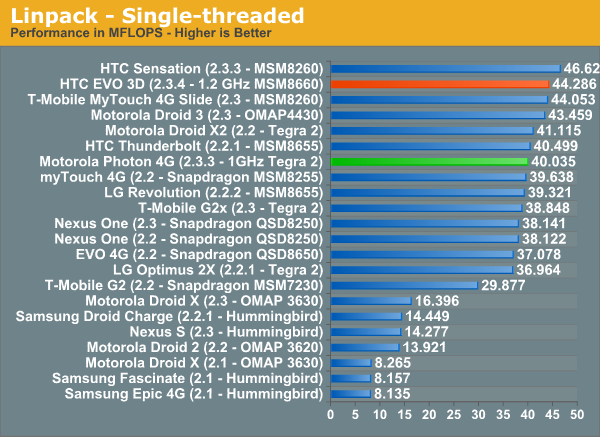
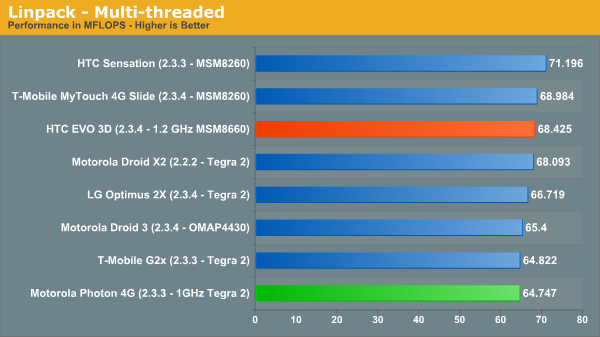
Linpack isn't all that useful of a benchmark under Android, but it does give us an idea of floating point performance of these two platforms. In both cases HTC pulls ahead, likely due to its clock speed advantage.
The GeForce in NVIDIA's Tegra 2 is growing old compared to the latest and greatest from Qualcomm and Imagination. Despite its age however, the Tegra 2 still holds its own pretty well among other qHD competitors. The Adreno 220 and SGX 540 are still faster in our tests though:
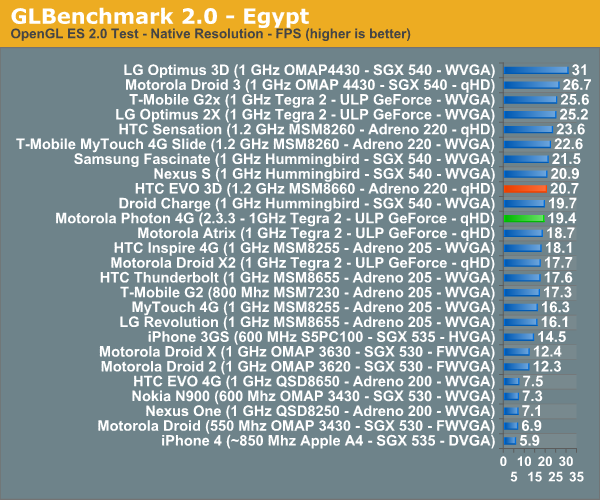
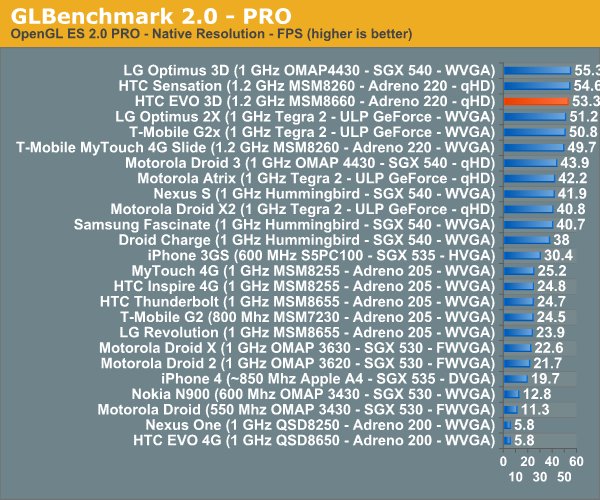
The huge advantage really comes from Basemark ES2 which seems to prefer deferred rendering architectures like the Adreno 220 and SGX 540 to NVIDIA's immediate mode renderer:
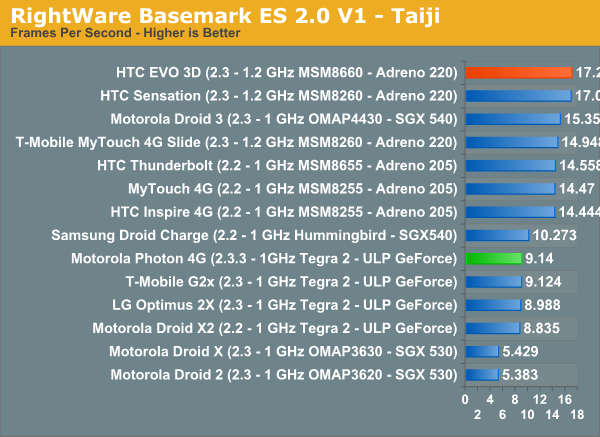
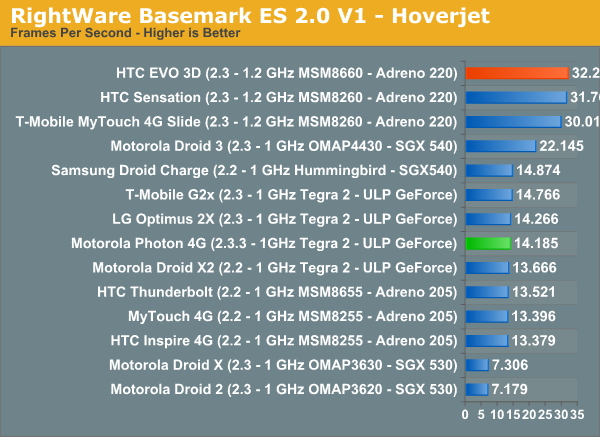
It's difficult to call an overall performance winner here. As we've seen throughout the review, both NVIDIA and Qualcomm trade blows here. The Tegra 2 based Photon 4G has the advantage in Flash and javascript performance while the Snapdragon based HTC delivers smoother browser scrolling and better 3D performance.
Originally published at https://www.anandtech.com/show/4643/htc-evo-3d-vs-motorola-photon-4g-best-sprint-phone (Wayback Machine).