
Motorola Droid 3 Review - Third Time's a Charm
Battery Life
Of course the next question is how battery life fares, after all, it doesn’t matter too much in a mobile device if we have great application performance but need to be tethered to a charger all day long. Back to those Cortex-A9s, the next part of the picture is what power management features are and aren’t supported. First off, OMAP4 is a synchronous architecture, which means that there’s one frequency plane for both A9s - each runs at the same clock. Both can be clock gated, however.
The important next bit is that each CPU is on its own power domain. The power states of each CPU doesn’t have to be the same, and OMAP4 supports three modes - Normal (run), dormant, and power off. You can see the different power domains as illustrated by the following diagram.

TI also provides a nice table with the supported power states and clock gating states depending on what assertions are made in the local power control module register.

What’s particularly interesting is that we can actually watch cores turn on and off both through console output on the device (by running something like dmesg) and moreover there’s even some nice software that will show us graphically. System Panel (which I’m a pretty big fan of) recently added support for visualizing load on multicore Android devices, and you can see how things fare when there’s both idle activity (CPU1 gets shut completely off), and when I’m generating tons of load by flicking the page around wildly (both CPUs are on, and clocked at 1.0 GHz).
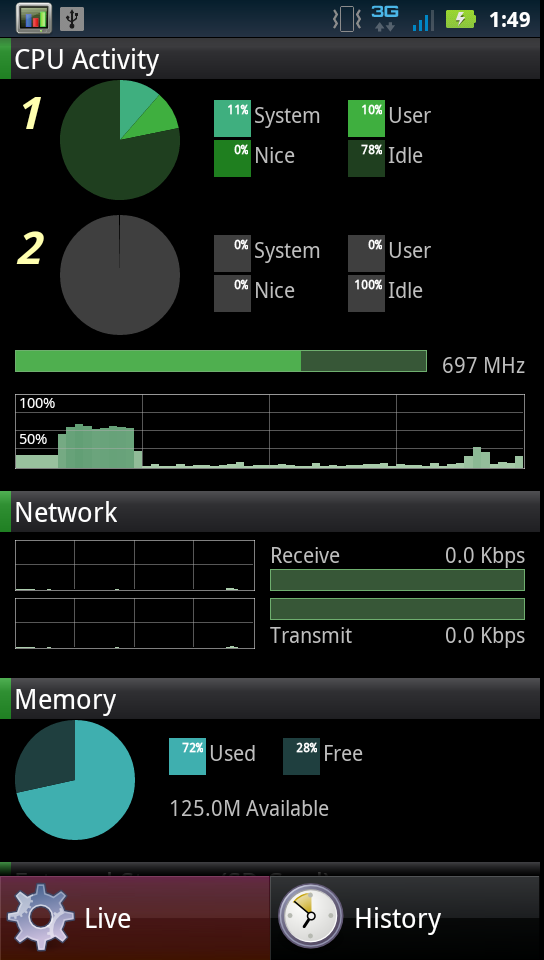
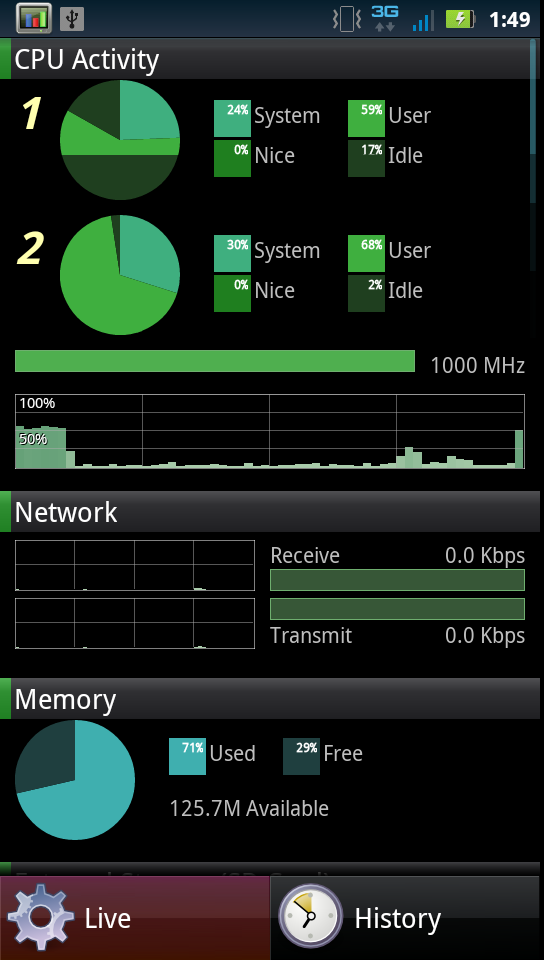
Like most modern SoCs, OMAP4 can dynamically change frequency, however it also can dynamically change voltage with a power management technique called SmartReflex. There are two different modes for SmartReflex, one which consists of an entirely hardware-controlled voltage control loop (class 3) and another which is assisted using software control (class 2). I’ve verified that the Droid 3 is using class 3:
“<6>[ 0.000000] SmartReflex CLASS3 initialized”
SmartReflex encompasses both the dynamic frequency, voltage, and power switching functions on the OMAP4430. The aim is to use silicon in the best way possible depending on either static silicon performance (given manufacturing) or dynamically based on temperature induced performance, and raise or lower voltage accordingly. To a large extent, SmartReflex it somewhat analogous to Intel’s SpeedStep and related suite, and in OMAP5 even gains a turbo mode which allows the SoC to temporarily exceed its normal maximum clock.
Now that we’ve gone over the power features of OMAP4, it’s time to present some Droid 3 specific battery life results. As usual, we’ve run our battery life testing suite on the device. The first set of tests are our page loading suite, which load through a few dozen pages every 10 seconds or so until the phone dies. The backlight brightness is at 200 nits and of course always on, to mimic continual web browsing.
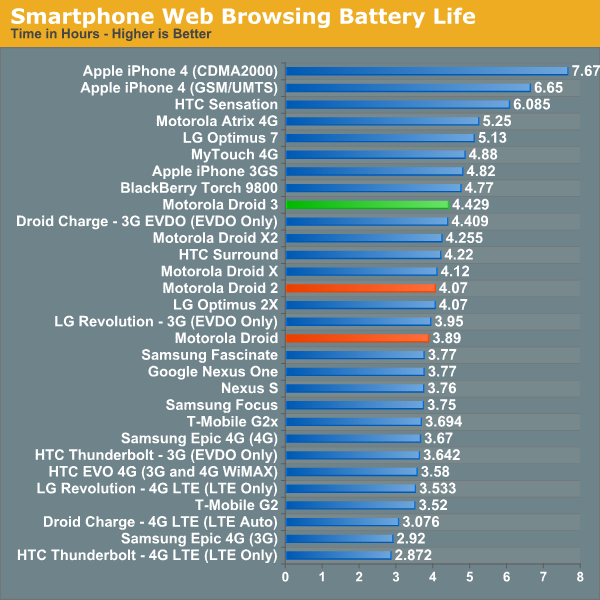
The Droid 3 both brings improvements in performance and display resolution alongside better battery life for smartphone web browsing. The other interesting performer to keep eye on is the Droid X2, which includes the same sized battery and baseband (MDM6600), but Tegra 2.
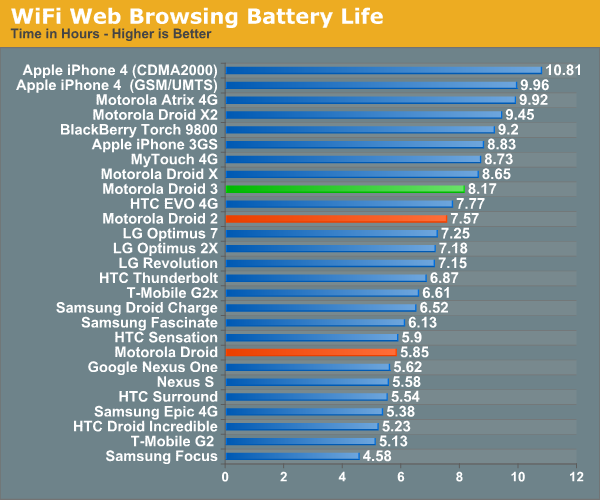
Next up is WiFi web browsing, where we run the same test but using WLAN instead of cellular connectivity. Here we can’t compare to the Droid X2 anymore as there are different WLAN stacks in each, but the Droid 3 continues to outperform its predecessors.
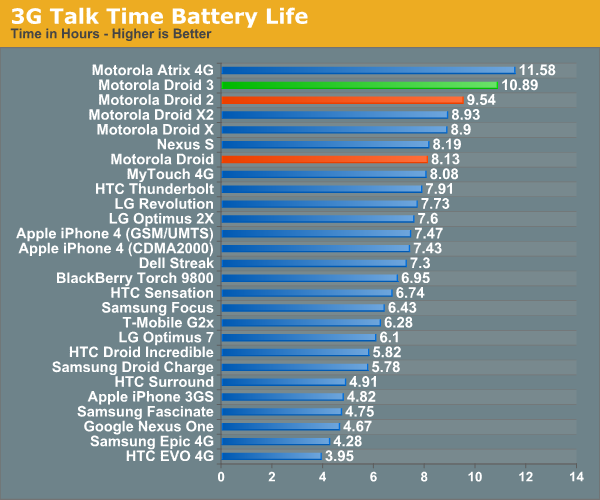
Motorola continues to somehow have a secret sauce for continually delivering incredibly long call time battery life, with now five spots dominated by Motorola devices. I’m still at a loss for exactly what they’re doing that gives them such a leg up, but it’s considerable.
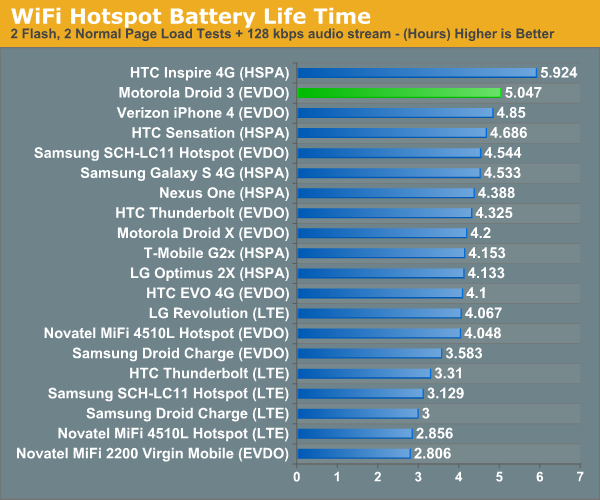
Finally is the WiFi hotspot battery test, which consists of a single WLAN client loading four tabs of our page loading test (two with flash content, two without), and a 128 Kbps MP3 streaming internet radio station. The display on the device is off the whole time. It’s a heavy test that mimics continual use and keeps everything awake on the device.
Here the Droid 3 does very well, though we don’t have any comparison data from the Droid 2 or Droid 1 due to this being a newer test. The overall results definitely illustrate the potential power savings of a dual core architecture - to put it in Anand’s words, you just can’t beat voltage scaling when dealing with power.
Originally published at https://www.anandtech.com/show/4551/motorola-droid-3-review-third-times-a-charm (Wayback Machine).