
Fusion E-350 Review: ASUS E35M1-I Deluxe, ECS HDC-I and Zotac FUSION350-A-E
LAN Speed Test
LAN Speed Test is a freeware program designed for testing the network connection between two PCs on a home network. The speed of the transfer is limited by the lowest common denominator on the network, so if you have gigabit Ethernet capable computers but a 100 Mbit capable router, you are limited to 100 Mbit transfer. Note that this is really a formality – if a network port is rated at 1 Gbps, then chances are that it will hit at least 90+% of this value. The main test here is CPU usage, and how much is offloaded by the controller. For this test, we use LAN Speed Test to transfer a 1000 MB file across a home network with a 100 Mbps lowest common speed to the same machine each time, in a read/write scenario. CPU usage is taken as a visual max/average from task manager.
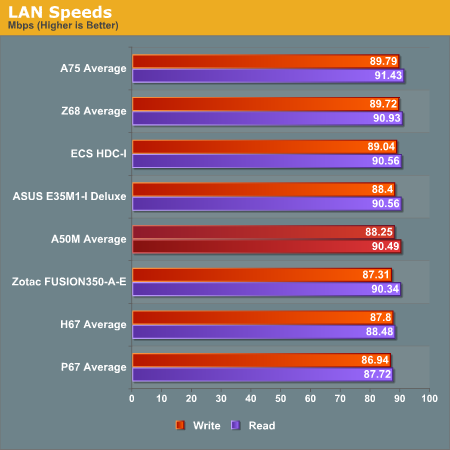
The Fusion boards don't have anything out of the ordinary in the LAN Speed test.
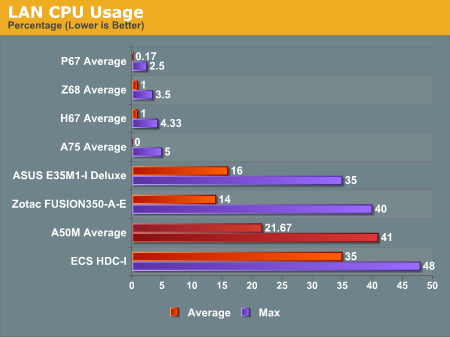
Due to the E-350 CPU in the Fusion boards, transferring data across the network is actually a CPU intensive task, with most boards having a substantial CPU usage. The Zotac has the lowest average CPU usage, but the ASUS has the lowest peak. The ECS board performs badly here, though.
USB Speed
For this benchmark, we run CrystalDiskMark to determine the ideal sequential read and write speeds for the USB port using our 64GB Patriot SuperSpeed USB 3.0 drive. Then we transfer a set size of files from the SSD to the USB drive, and monitor the time taken to transfer. The files transferred are a 1.52 GB set of 2867 files across 320 folders – 95% of these files are small typical website files, and the rest (90% of the size) are HD videos.
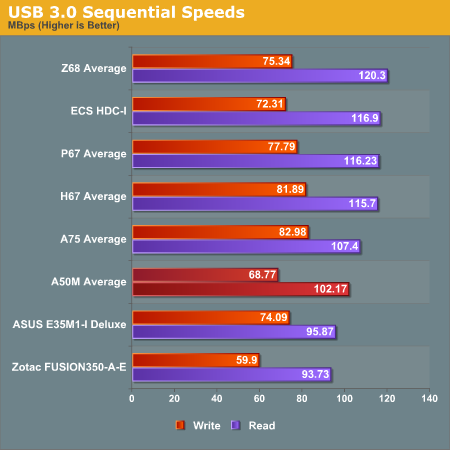
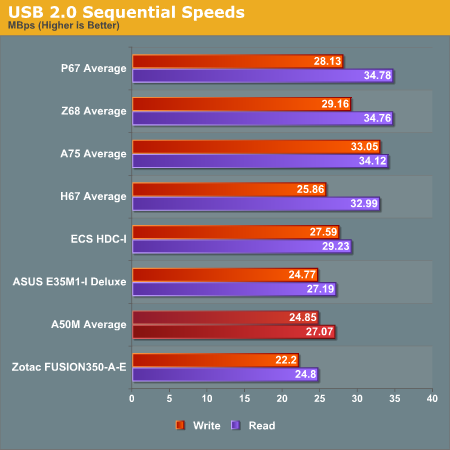
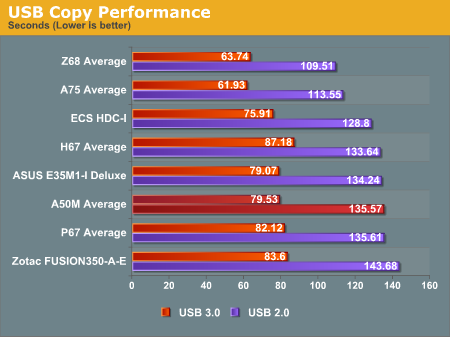
Across the USB tests, the Zotac underperforms by quite a considerable margin. I redid the tests, and then got in touch with Zotac regarding this issue. I was given a new BIOS, but this did not improve the results. The ECS board has the best USB performance out of the three A50M boards.
SATA Testing
We also use CrystalDiskMark for SATA port testing. The operating system is installed on the Micron RealSSD C300, which is rated at 355 MB/s read and 215 MB/s write, and the sequential test is run at the 5 x 1000 MB level. This test probes the efficiency of the data delivery system between the chipset and the drive, or in the case of additional SATA ports provided by a third party controller, the efficiency between the controller, the chipset and the drive.
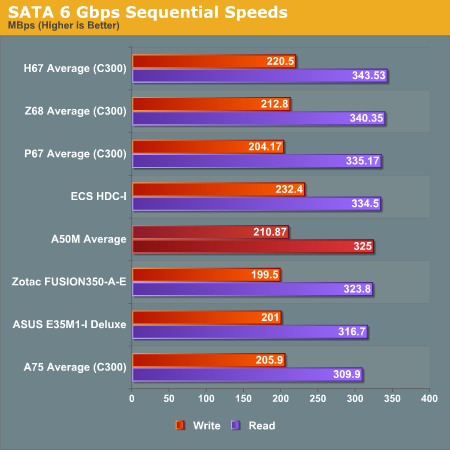
Using the Micron C300, the ECS board outperforms the other two in sequential writes and reads.
DPC Latency
Deferred Procedure Call latency is a way in which Windows handles interrupt servicing. In order to wait for a processor to acknowledge the request, the system will queue all interrupt requests by priority. Critical interrupts will be handled as soon as possible, whereas lesser priority requests, such as audio, will be further down the line. So if the audio device requires data, it will have to wait until the request is processed before the buffer is filled. If the device drivers of higher priority components in a system are poorly implemented, this can cause delays in request scheduling and process time, resulting in an empty audio buffer – this leads to characteristic audible pauses, pops and clicks. Having a bigger buffer and correctly implemented system drivers obviously helps in this regard. The DPC latency checker measures how much time is processing DPCs from driver invocation – the lower the value will result in better audio transfer at smaller buffer sizes. Results are measured in microseconds and taken as the peak latency while cycling through a series of short HD videos - under 500 microseconds usually gets the green light, but the lower the better.
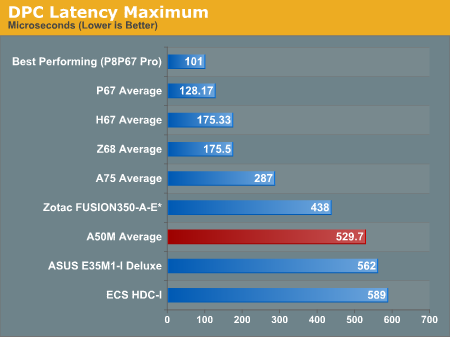
Due to the E-350 CPU, the DPC Latency results of these boards seem a lot worse than the Cougar Point boards we've tested this year. In reality, not many of us will notice this difference.
*A small note about the Zotac board - every thirty seconds or so, a DPC spike is observed around 6000 microseconds. This could seriously be an issue if audio is important to the users of this board - after retesting the board and contacting Zotac, they have not pinpointed the issue yet, but as I understand it, are working on a fix.
Originally published at https://www.anandtech.com/show/4499/fusion-e350-review-asus-e35m1i-deluxe-ecs-hdci-and-zotac-fusion350ae (Wayback Machine).