
Rendering and HPC Benchmark Session Using Our Best Servers
STARS Euler3D CFD
The STARS Euler3D CFD benchmark got popular thanks to Scott of Techreport.com. It is a computational fluid dynamics (CFD) benchmark based on the STARS Euler3D structural analysis routines developed at CASELab, the Computational AeroServoElasticity Laboratory at Oklahoma State University. Since the benchmark has been used for years by Scott, we felt it was a good place to start our HPC benchmarking adventure: we could check if our results are in the right ballpark.
The benchmark is downloadable and described in great detail here. The benchmark score is reported as a CFD cycle frequency in Hertz, with higher results being better.
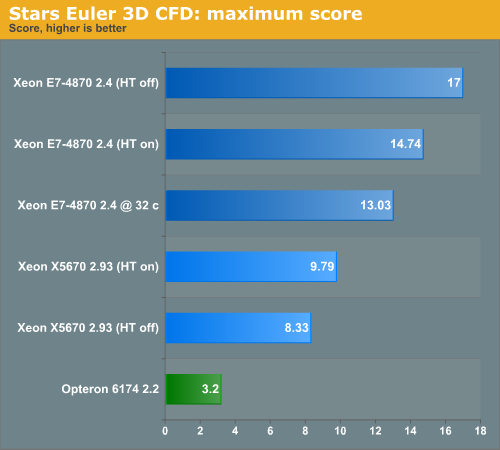
The Xeon E7 scales quite nicely on the condition that you disable Hyper-Threading. The benchmark is able to take advantage of Hyper-Threading, which can be seen on the dual Xeon system. However, the threads work on the same data grid, so the more threads, the more locking contention rears its ugly head. Here's a more detailed look at scaling with the number of threads:
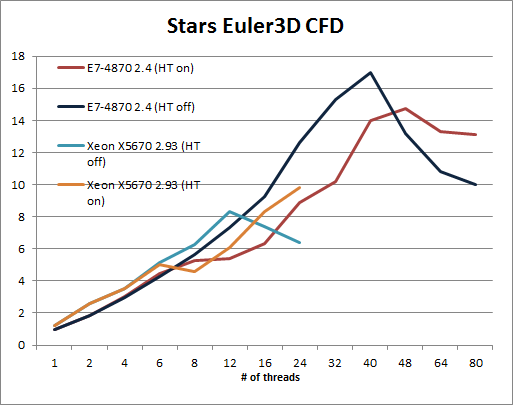
The Hyper-Threading enabled Xeon X5670 performs worse than the non-HT setup until we run more than 12 threads. Once we do that it can offer a decent performance boost (17%). The benchmark however does not scale enough to take advantage of 80 threads. Hyper-Threading offers better resource utilization but that does not negate the negative performance effect of the overhead of running 80 threads. Once we pass 40 threads on the E7-4870, performance starts to level off and even drop.
Of course, you are probably more interested in the other server result. What happened to the Opteron scores? Why is the 48 core Opteron five times slower than the 40 core Xeon E7? Let's investigate further.
Originally published at https://www.anandtech.com/show/4486/server-rendering-hpc-benchmark-session (Wayback Machine).