
Samsung Galaxy Tab 10.1 Review: The Sleekest Honeycomb Tablet
A Beautiful Display
Other than form factor, the 10.1's display is the only other major advantage Samsung holds over ASUS. While the Eee Pad's display is quantifiably similar to Apple's iPad 2, it does fall victim to an incredible amount of glare. There's a sizable gap between the LCD panel and the outermost glass, which results in more glare than most other tablets we've reviewed this generation. The 10.1 however doesn't suffer this fate and as a result is more directly comparable to the iPad 2.
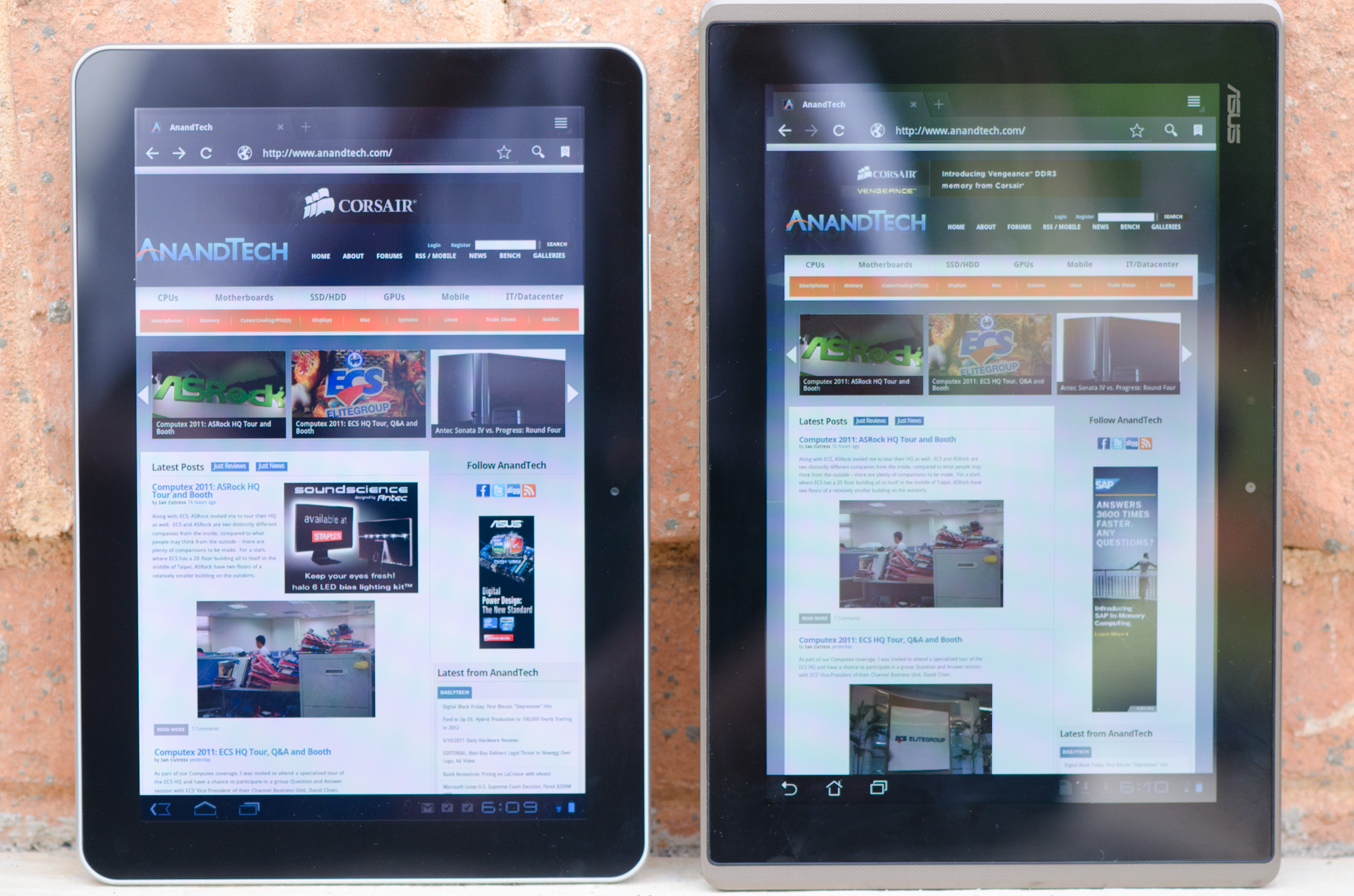
Samsung Galaxy Tab 10.1 (left) vs. ASUS Eee Pad Transformer (right)

Samsung Galaxy Tab 10.1 (left) vs. Apple iPad 2 (right)
While both ASUS and Apple use an IPS panel in their tablets, Samsung uses its own technology called Super PLS (plane line switching). Brian Klug, our resident smartphone and display guru did some digging and it turns out that Super PLS is Samsung's own take on IPS that maintains viewing angle while boosting throughput (brightness). The Samsung supplied photo below shows a comparison of the tradeoff you make with S-IPS and I-IPS, as well as both of those compared to Super PLS:
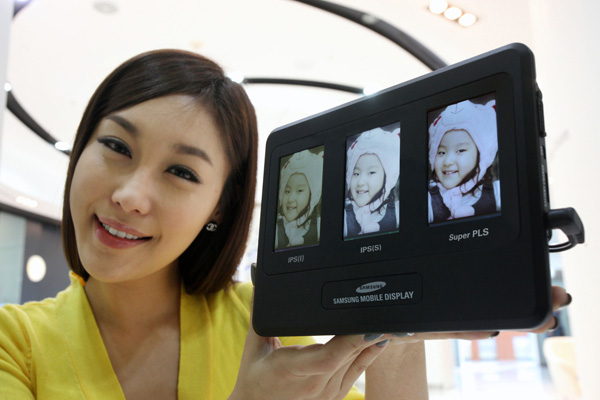
Traditionally you'd have to trade off viewing angle for brightness or vice versa even within the IPS family. Super PLS lets you have your cake and eat it too, giving you the same side viewing angles as S-IPS but with the light throughput of I-IPS.

Perhaps due to the use of Super PLS, Samsung actually managed to outfit the Galaxy Tab 10.1 with a brighter panel than what we saw with the iPad 2. Black levels aren't quite as good but peak brightness is measurably better at nearly 500 nits. While the display isn't what I'd consider bright enough to use in direct sunlight, it is more versatile than the iPad 2's as a result of its brightness.
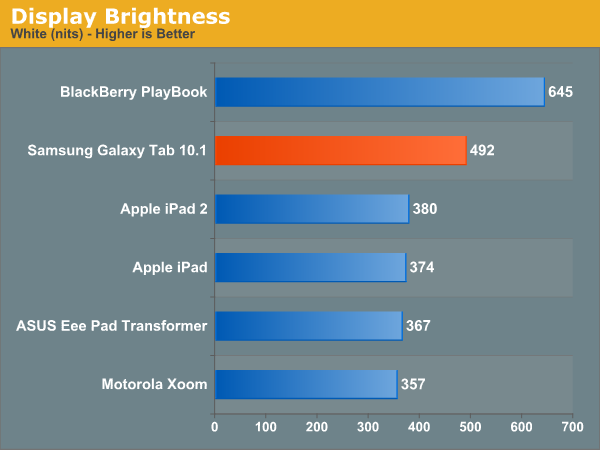
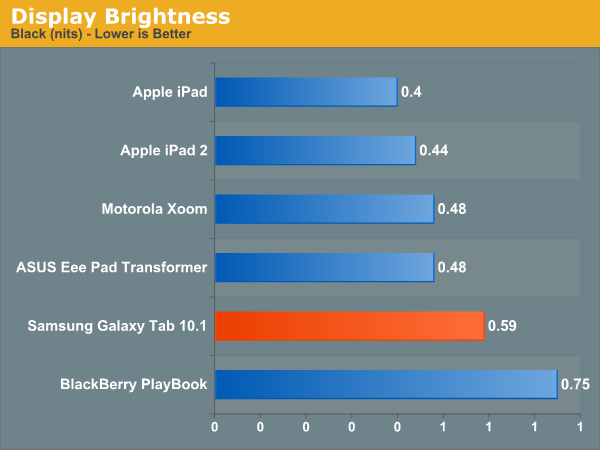
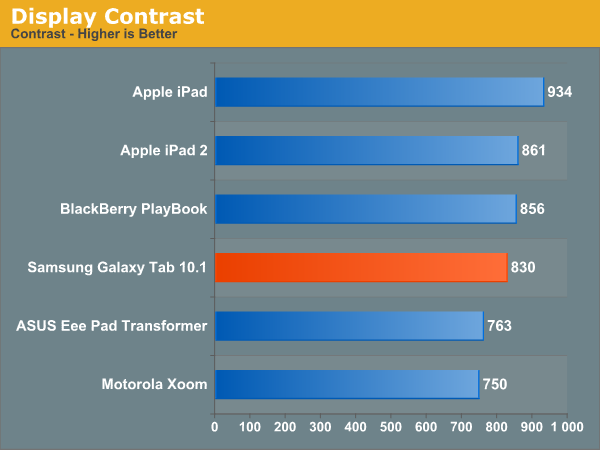
The higher black levels balance out the brighter panel and deliver a contrast ratio comparable to that of the iPad 2:
I should mention that the quality of the panel on the retail 10.1 sample is significantly better than what I saw with Samsung's Galaxy Tab 10.1 Limited Edition at Google IO. The sample from IO had noticeably worse black levels, lower peak brightness and as a result lower overall contrast. On top of all of that, the LE suffered light bleed from one of its corners - a problem I haven't seen on the retail 10.1. With only two Galaxy Tabs to compare this is either an indication of wildly varying quality control, or more likely that Samsung simply repackaged its early samples as LEs and saved the mass production hardware for paying customers a month after Google IO.

As you can see in the shot above the Samsung panel has a considerably cooler white point than the Eee Pad Transformer. A quick measure with our colorimeter shows a white point of 8762 (vs 7805K for the Eee Pad). It does make Samsung's default wallpaper look very pretty. If you're wondering, the iPad 2's panel is calibrated to a 6801K white point - at least with our 16GB CDMA sample here.
Originally published at https://www.anandtech.com/show/4445/samsung-galaxy-tab-101-review (Wayback Machine).