
HP Veer 4G Review - Getting Us Excited for Pre 3
Compared to the Pixi and even the Palm Pre Plus, the Veer offers a dramatic difference in speed and smoothness. Unfortunately the Pixi lacks WiFi so running our webpage loading suite didn’t make much sense, however I timed application loads between the Pixi, Veer, and Pre Plus. There’s a dramatic difference between the older ARMv6 Pixi and the newer ARMv7 Veer. Again the Veer runs an 800 MHz MSM7230 with 512 MB of LPDDR RAM.
| Application Launch Time Benchmarking | |||||||
| Application / Launch Time (s) | Palm Pre Plus | Palm Pixi | HP Veer 4G | ||||
| Maps | 15.3 | 20.1 | 7.1 | ||||
| Camera | 4.5 | 5.0 | 3.6 | ||||
| Memos | 4.0 | 4.5 | 2.7 | ||||
| Web | 3.3 | 2.5 | 2.1 | ||||
| Clock | 5.0 | 3.8 | 3.3 | ||||
| Startup | 2:19.1 | - | 1:39.9 | ||||
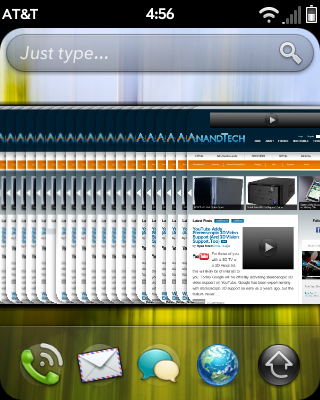
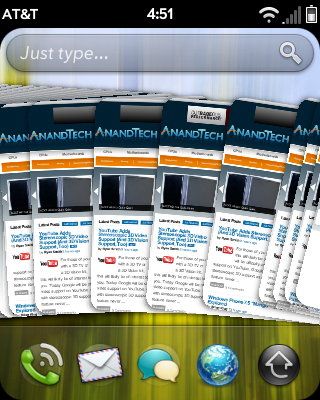
The difference in raw, perceptible performance difference between the Veer and everything that came before it (save the Pre 2) is huge. Animations are completely fluid, typing fast no longer results in dramatic lag, and there’s no longer huge stalls in responsiveness. WebOS 2.0 also seems to have better memory management – I opened nearly 100 cards with AnandTech.com fully loaded and never once got an out of memory error. I did notice huge amounts of memory being swapped to disk (it’s very easy to monitor using top over novaterm on the Veer), but the device continued being fully responsive.
Unfortunately loading times on the Veer are still incredibly long due to some mismanagement of the linux boot process. Unfortunately it appears that WebOS increases the sleep time that apps send to the caller during the boot process from an already crazy 60 seconds to 120 seconds. There’s discussion of this on WebOS Internals, but the situation is even worse now, at 120 seconds.
This is somewhat masked with much faster hardware, yet I have very little doubt that the Pre 3 will take an inexcusably long time to boot as the Veer and every WebOS device that came before it.
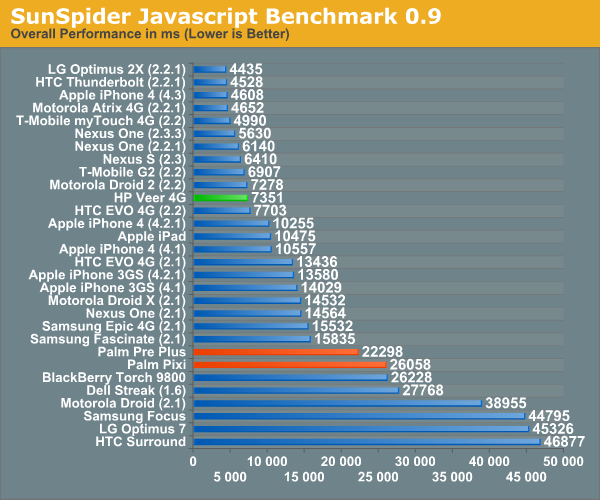
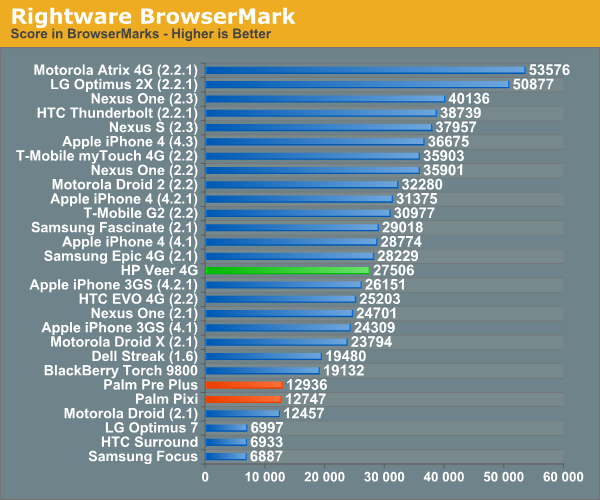
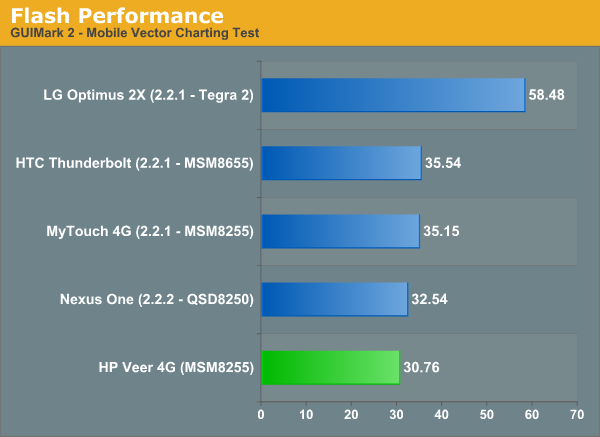
We also ran the standard web benchmarks on all three devices. Results are comparable here but not entirely - WebKit remains 532.2 between both versions of WebOS, but it's clear that a newer JavaScript engine is being used in WebOS 2.0, possibly V8 which Qualcomm works closely to maintain and optimize for OEMs. What we’re seeing here however does translate to a perceptible performance delta.
Whereas the Pixi is essentially laggy to the point of unusable, so much so that I honestly wonder how the device was ever considered releasable, the Veer is completely fluid.
Originally published at https://www.anandtech.com/show/4424/hp-veer-4g-review-getting-us-excited-for-pre-3 (Wayback Machine).