
Infrastructure as a Service: Benchmarking Cloud Computing
- Posted in
- IT Computing
- Cloud Computing
Response Time
Our current virtualization stress tests are focused on measuring the maximum throughput of a certain server CPU or server platform. As a result we try to maximize CPU load by using high amounts of concurrent (simulated) users. In other words, the concurrencies are quite a bit higher than what the (virtual or physical) machine can cope with, in order to attain 95-100% CPU load. As a result, the response times are inflated above what would be acceptable in the real world. Still, it would be interesting to get an idea of the response times for our server versus the cloud server.
Our vApus Mark II test starts off with 400 concurrent users and ends with 800 concurrent users. The 400 concurrent users still cause very high CPU load on most machines (80-90%), but that should still give us a "worst case" response time scenario. In the next graph we list the response time at the lowest concurrency. Terremark's data center was in Amsterdam, and we had an 11 to 20 ms round trip delay from our lab, so to be fair to Terremark you should deduct 11 to 20 ms from the Terremark numbers.
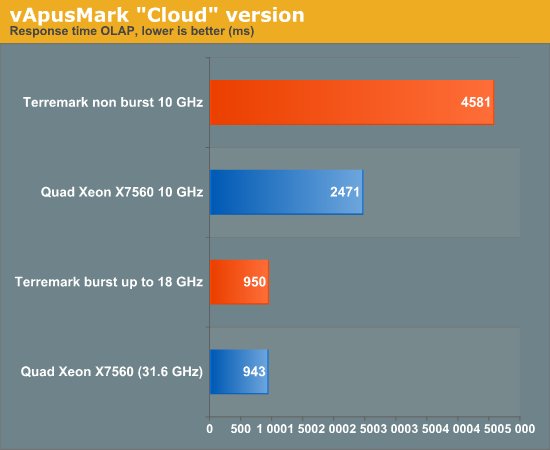
Both the "in house" server with 10GHz resource pool and the 10GHz Terremark "cloud server" get hit very hard by 400 concurrent MS SQL server connections, but the 10GHz resource pool that we get from the Terremark cluster is less powerful as it needs up to 85% more time to respond. The reason for that is twofold.
First, while the limit of the resource pool is at 10GHz, only 5GHz is reserved. So depending on how hard the parent resource pool is loaded by other VMs, we probably get somewhere between 5 and 10GHz of CPU power. Second, there is some extra overhead coming from the firewalls, routers, and load balancers between us and the VM. The infrastructure of Terremark is--for safety and security reasons--quite a bit more complex than our testing environment. That could add a few tens of ms too.
We also noticed that some parts of the Terremark cluster were using slightly older drivers (vmxnet 2 instead of vmxnet 3 for example), which might result in a few lost CPU cycles. But we are nitpicking and Terremark told us it is just a matter of time before the drivers get updated to the latest version.
And there is good news too. If you are willing to pay the premium for "bursting", the Terremark cluster scales very well and is capable of giving response times similar to what an "in house" server delivers. That is the whole point of cloud computing: pay and use peak capacity only when you actually need it.
Originally published at https://www.anandtech.com/show/4349/infrastructure-as-a-service-benchmarking-cloud-computing (Wayback Machine).