
AMD’s Radeon HD 6670 & Radeon HD 6570: Two’s Company, Sub-$100’s A Crowd
Crysis: Warhead
Kicking things off as always is Crysis: Warhead, still one of the toughest games in our benchmark suite. Even three years since the release of the original Crysis, “but can it run Crysis?” is still an important question, and for three years the answer was “no.” Dual-GPU halo cards can now play it at Enthusiast settings at high resolutions, but for low-end cards even Mainstream/Medium quality is about the best that can be achieved.
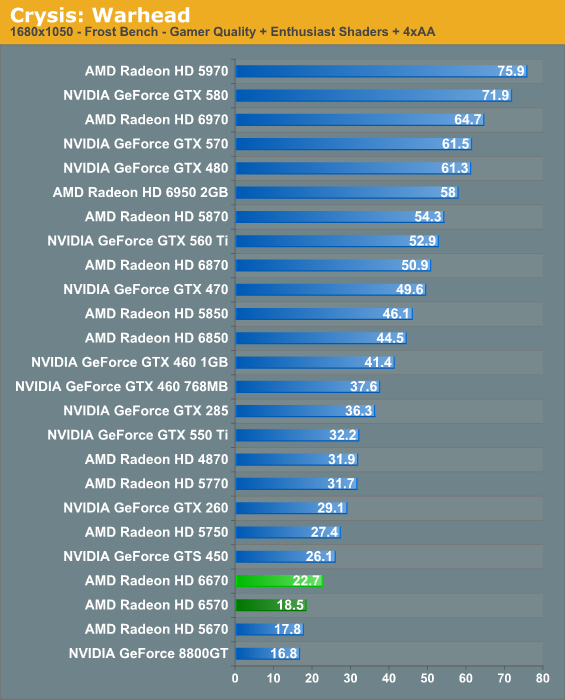
It takes a 5770 to crack 30fps in Crysis at 1680x1050, so the fact that the 6670 is only a bit over 20fps isn’t a big surprise. As far as performance at 1680 is concerned Crysis is a good summary of what we’ll see: too slow for 1680, and well behind the next tier of cards represented by the GTS 450 and the Radeon HD 5770/5750. However the 6670 does have a notable advantage here: with 1GB of VRAM it handles 1680 much better than the 512MB 5670, even if it’s ultimately too slow to be playable at these specific settings.
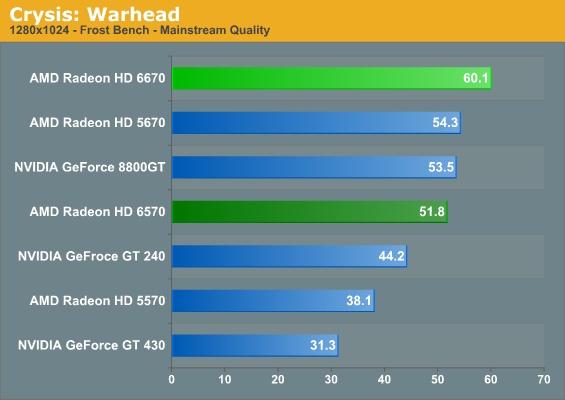
So for the kind of high settings we like to test at, it’s 1280 that’s going to be playable on the 6670, 6570, and similar cards. Once we drop down to 1280 and Mainstream quality the 6670 can crack 60fps, and with a bit of fiddling it should be possible to increase the quality of a setting or two without significantly impacting performance. Overall the 6670 has a 10% lead over the 5670 it replaces, which is a reasonable outcome for a game that’s largely (but not completely) shader-bound.
As for the 6570, it’s well-entrenched near the top of the pack. At 95% of the performance of the 5670 it does quite well, and the next-fastest modern card is the GT 240 which is quite some distance off. Against the 5570 it has a 35% lead, thanks largely to the use of GDDR5 instead of DDR3.
We have also thrown in the 8800GT into our 1280 results, just to offer a different look at performance relative to NVIDIA’s retired champion. It’s a good reference point for where we’re at now, versus what a $300 card did 3 years ago; and once we get to power/temperature/noise testing how better process technology and smaller GPUs have improved those metrics.
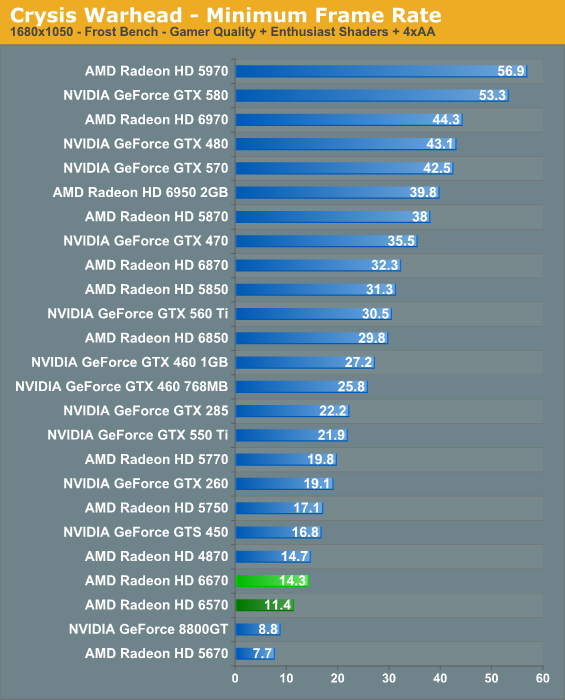
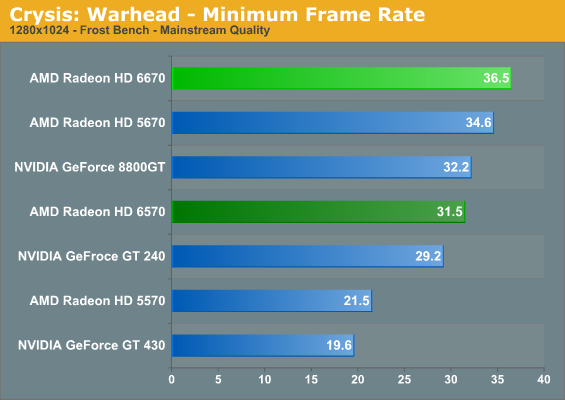
Looking at the minimum framerates, the relative ranking of our cards remains unchanged. The 6670 cements its lead over the 5670 here at 1680 thanks to its 1GB of VRAM, while at 1280 the gap narrows significantly to 5%. Meanwhile the 6570 loses ground on the 5670, with the 5670 taking a 10% lead.
Originally published at https://www.anandtech.com/show/4278/amds-radeon-hd-6670-radeon-hd-6570 (Wayback Machine).