
AMD's Radeon HD 6790: Coming Up Short At $150
Power, Temperature, & Noise
Last but not least as always is our look at the power consumption, temperatures, and acoustics of the Radeon HD 6790. Our power usage data should closely mirror any other 6790, but given the unique design of our card versus what AMD’s partners are going with, we can’t fully account for all the different designs.
On that note, at this point we do not know what the 6790’s default voltage is. None of our usual low-level tools recognize the 6790; it’s possible that AMD is using different controllers than on the 6800 series, or perhaps it’s related to drivers. In any case we believe it’s close to the 6870’s voltage of 1.17v, but we can’t measure it at this time.
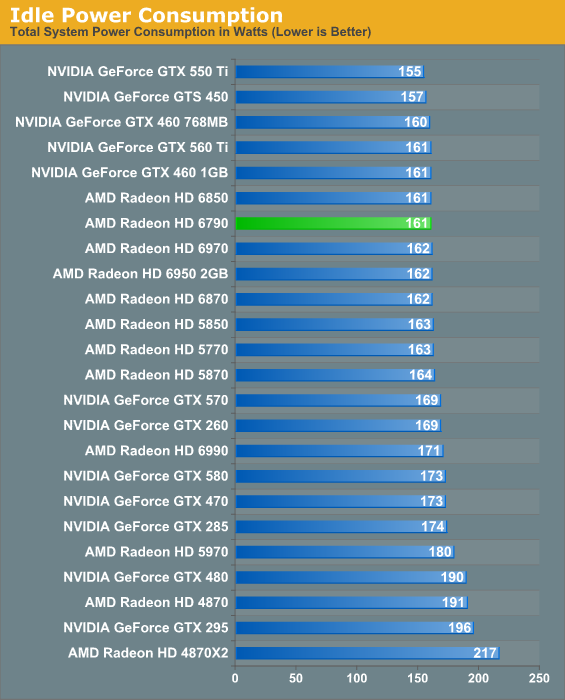
Idle power consumption rarely changes among the different tiers of a GPU, so the fact that the 6790 pulls almost as much power at idle as the 6800 series should not come as a surprise. It does end up being worse than the GTX 550 Ti, but almost exactly alike the GTX 460.
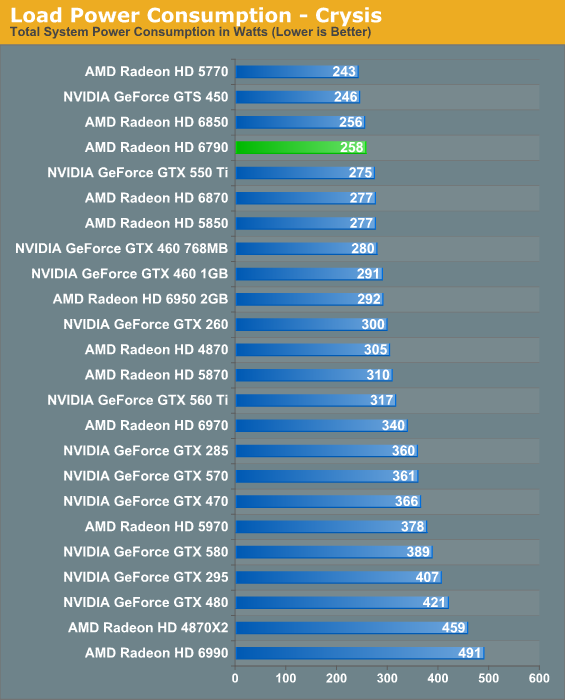
Given AMD’s TDP numbers, we were expecting our power results to closely shadow our 6870 results. Instead we had a pleasant surprise: power consumption under Crysis is higher than the 6850, but not significantly so. In fact it’s still below the GTX 550 Ti even though it significantly outperforms said video card on this game, and even compared to the 5770 it’s not significantly worse for the 6790’s performance advantage. Not that it’s great to be consuming more power than a 6850 for less performance, but it could very well have been worse.
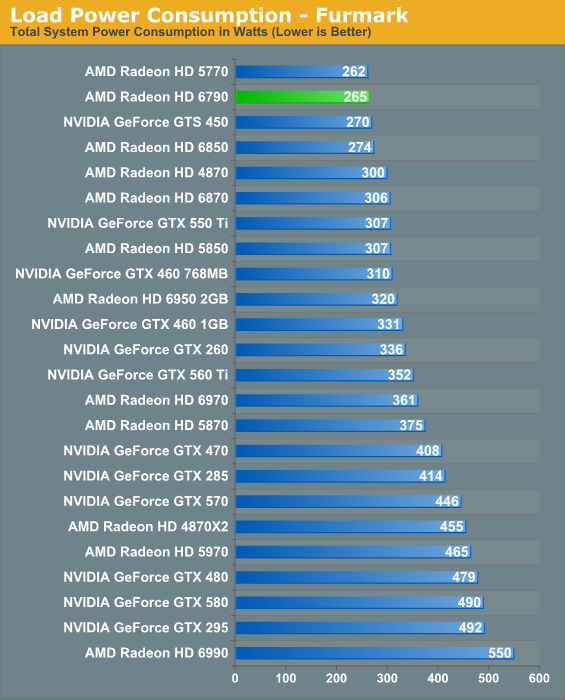
The situation under Furmark is even better surprisingly enough. The 6790 consumes less power than the 6850 here – not a ton less, but less. Perhaps more surprising is that compared to the 5770 it’s only consuming 3W more; this Barts chip may have a lot of functional units disabled, but that’s still quite remarkable, and is all the more proof of the optimizations AMD made for Barts compared to Cypress. This also makes it look exceptionally good versus the GTX 550 Ti and GTX 460 768MB, as it’s consuming 40-45W less.
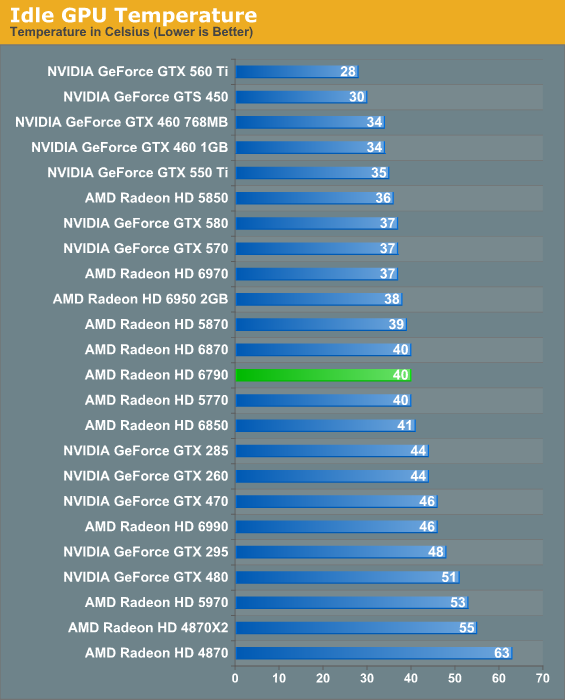
With idle power consumption being identical to the 6800 series and using the same cooler, the idle temperature is similarly close.
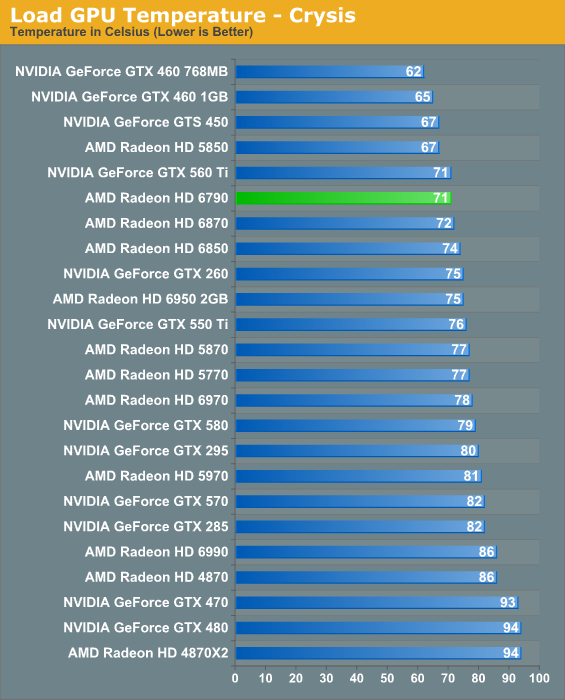
Given the power numbers we saw earlier, the 6870’s cooler ends up being overkill for the 6790. As a result Crysis temperatures are quite low, although the fully exhausting cooler can’t keep up with the open cooler of the GTX 460. Then again our 5770 is an open cooler, and it’s still much warmer. Keep in mind that this is going to highly vary with the design of the cooler the partner uses though.
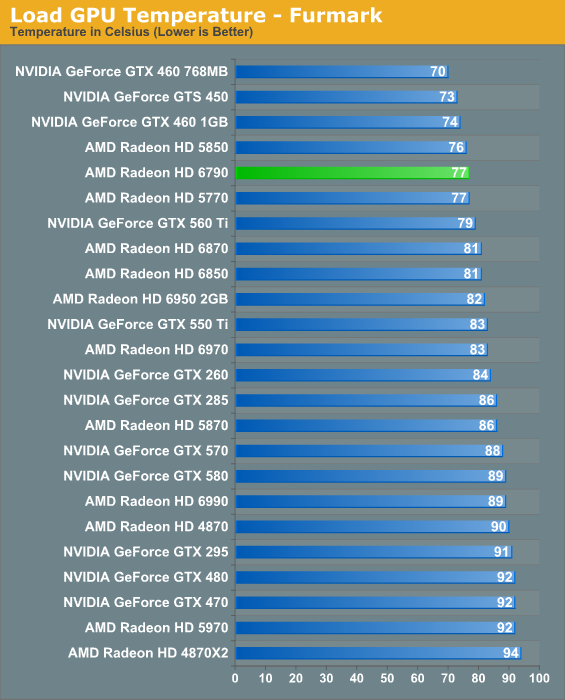
Temperatures under Furmark closely trend Crysis. An open cooler might be able to get the 6790 down to the low 70s.
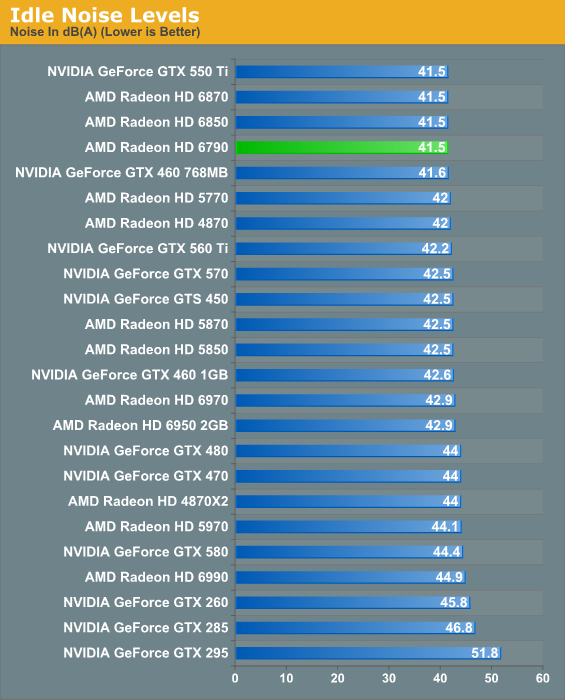
Idle noise is identical to the 6800 series, as we’d expect.
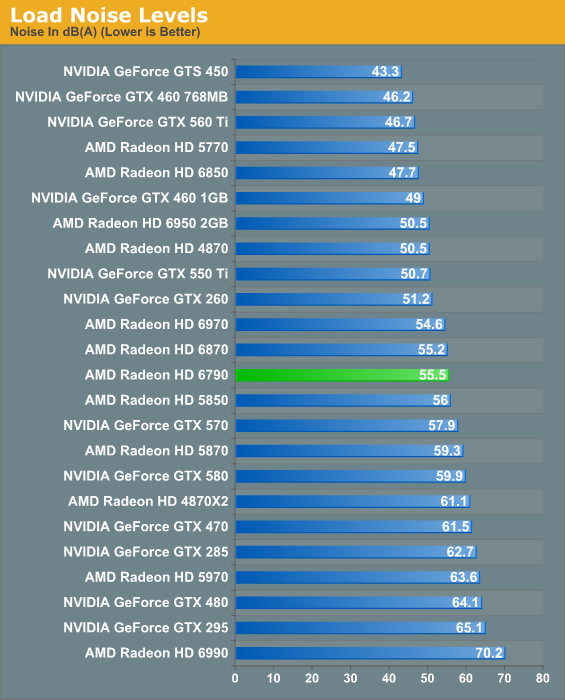
Load noise is where the wheels begin to fall off on our 6790 sample. The card does so well with regards to power consumption and temperature, but noise is just as bad as the 6870. This undoubtedly is due to how AMD tweaked the 6790 engineering sample – which is to say it likely hasn’t been optimized much if at all since it won’t go into production. Given the power data we’ve seen the 6790 doesn’t need to be much louder than a 6850, so hopefully partner cards will reflect this. If not, the worst case scenario may very well be having all the noise of a 6870 and not nearly the performance.
Originally published at https://www.anandtech.com/show/4260/amds-radeon-hd-6790-coming-up-short-at-150 (Wayback Machine).