
NVIDIA's GeForce GTX 550 Ti: Coming Up Short At $150
Compute & Tessellation
Moving on from our look at gaming performance, we have our customary look at compute performance, bundled with a look at theoretical tessellation performance.
Our first compute benchmark comes from Civilization V, which uses DirectCompute to decompress textures on the fly. Civ V includes a sub-benchmark that exclusively tests the speed of their texture decompression algorithm by repeatedly decompressing the textures required for one of the game’s leader scenes.
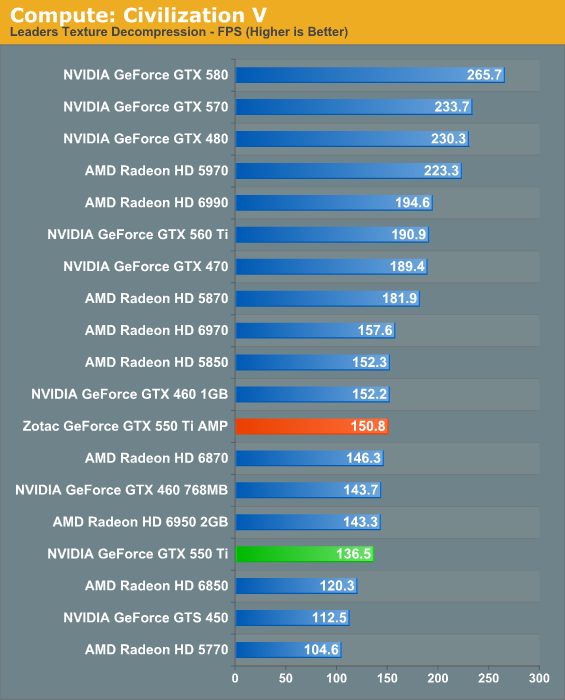
Unlike our gaming benchmarks, Civ V’s compute performance strongly favors NVIDIA’s Fermi family here, giving the GTX 550 a very strong showing. At 136fps it’s competitive with the much more expensive 6950 and even comes quite close to the GTX 460 768MB. The 6850 and 5770 meanwhile fall well behind.
What’s quite interesting is that with a bit more gas, the Zotac AMP really climbs up the charts. At 150fps it’s tailing the GTX 460 1GB and even AMD’s single-GPU king, the 6970. And ultimately while this benchmark is compute bound, it’s also memory bound at least part of the time, which is why the GTX 550 outperforms the GTS 450 by 21%.
Our second GPU compute benchmark is SmallLuxGPU, the GPU ray tracing branch of the open source LuxRender renderer. While it’s still in beta, SmallLuxGPU recently hit a milestone by implementing a complete ray tracing engine in OpenCL, allowing them to fully offload the process to the GPU. It’s this ray tracing engine we’re testing.
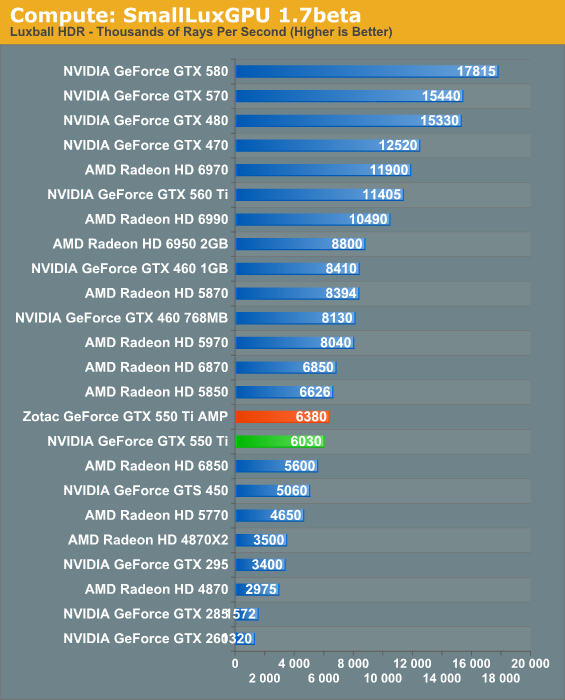
SmallLuxGPU also gives NVIDIA a solid standing here, however not quite as much as with Civ V. The GTX 550 beats the 5770 and even pulls ahead of the 6850 here. The benefit from the memory bandwidth increase is minimal however, leading to a lower 15% gain versus the GTS 450, and a larger 25% gap versus the GTX 460.
Our final compute benchmark is a Folding @ Home benchmark. Given NVIDIA’s focus on compute for Fermi, cards such as the GTX 560 Ti can be particularly interesting for distributed computing enthusiasts, who are usually looking for a compute card first and a gaming card second.
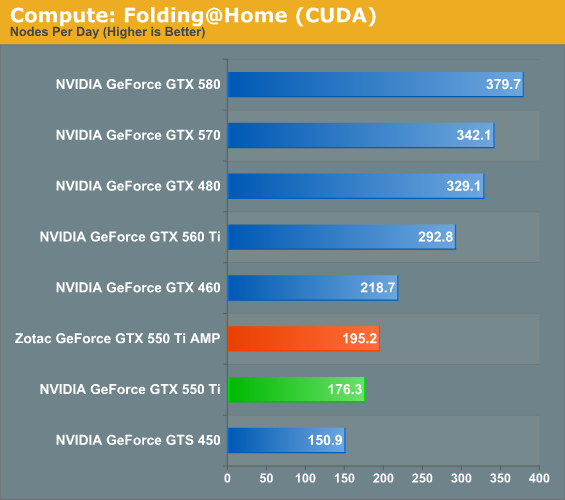
We do not normally classify Folding@Home to be very memory bandwidth sensitive on GPUs, which makes our results here more interesting than we expected. A 17% gain over the GTS 450 is in-line with the core clock increase, but achieving 81% of the GTX 460 is no small feat. With the AMP’s overclock, the card closes to within 10% of the GTX 460.
At the other end of the spectrum from GPU computing performance is GPU tessellation performance, used exclusively for graphical purposes. With Fermi NVIDIA bet heavily on tessellation, and as a result they do very well at very high tessellation factors. With 1 GPCs the GTX 560 Ti can only retire 1 triangle/clock however, which nullifies much of the architectural advantage on paper.
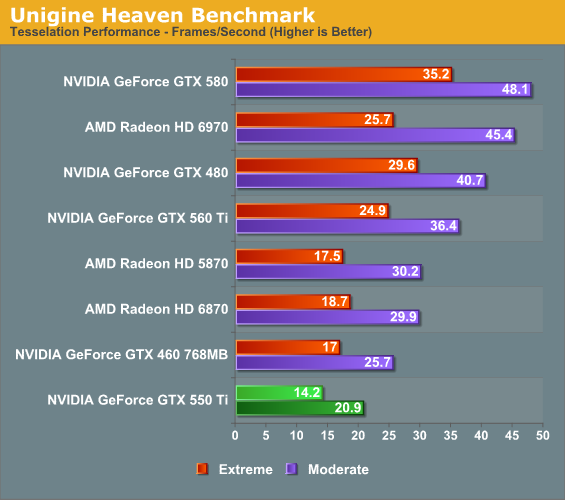
Even with extreme levels of tessellation, the lower geometry throughput of the GTX 550 keeps a lid on performance. It’s consistently around 80% of the performance of the GTX 460, however the hit for using extreme tessellation ultimately is greater here than on NVIDIA cards with more geometry throughput. As NVIDIA likes to note it has quite a bit more geometry throughput than older generation cards, but tying geometry performance to the number of SMs means parity between high and low-end cards is lost.
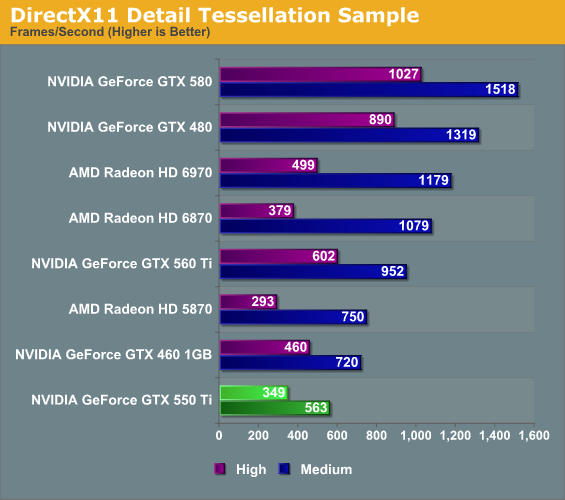
The DX11 Detail Tessellation sample reinforces those findings. NVIDIA does keep up their solid scaling from medium to high tessellation versus AMD though., including a very surprising score versus the 5870 and 6870 at high tessellation.
Originally published at https://www.anandtech.com/show/4221/nvidias-gtx-550-ti-coming-up-short-at-150 (Wayback Machine).