
The Battle of the P67 Boards - ASUS vs. Gigabyte at $190
- Posted in
- Motherboards
- Gigabyte
- Asus
- P67
| Test Setup | |
| Processor |
Intel i5-2500K ES – 3.3 GHz (3.7 GHz Turbo) 4 Cores, 4 Threads, 6MB L3 |
| Motherboards |
ASUS P8P67 Pro Gigabyte P67A-UD4 |
| Cooling | Corsair H50-1 Water Cooler |
| Power Supply | Enermax Modu87+ 600W 80PLUS |
| Memory |
Patriot Viper Xtreme DDR3-2000 9-10-9-27 2x4GB Kit, 1.65V Patriot Viper Xtreme DDR3-2133 9-11-9-27 2x2GB Kit, 1.65V Corsair Vengeance DDR3-1600 9-9-9-24 2x4GB Kit, 1.50V |
| Memory Settings | Patriot Viper Xtreme DDR3-1333 9-9-9-24 2x2GB |
| Video Cards | XFX HD 5850 1GB |
| Video Drivers | Catalyst 10.12 |
| Hard Drive | Intel X25-M 80GB SSD Gen2 |
| Optical Drives | LG GH22NS50 |
| Case | Open Test Bed – CoolerMaster Lab V1.0 |
| Operating System | Windows 7 64-bit |
| USB 2/3 Testing | Patriot 64GB SuperSonic USB 3.0 |
Power Consumption and CPU Temperature
Power consumption was tested on the default system as a whole with a wall meter connected to the power supply, using a dual GPU configuration. This method allows us to compare the power management of the UEFI/BIOS and the board to supply components with power under load, and includes typical PSU losses due to efficiency. These are the real world values that consumers may expect from a typical system (minus the monitor) using these motherboards.
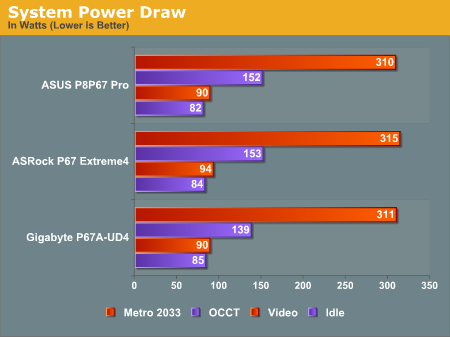
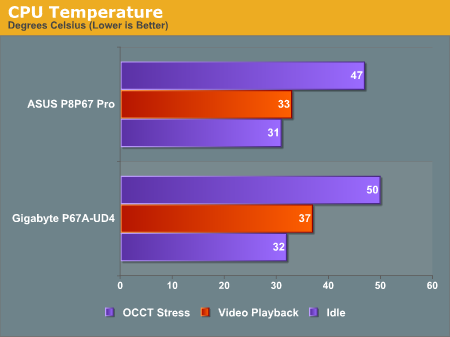
Neither system does too badly in power consumption readings, but the Gigabyte is behind on temperature deltas. This could easily be attributed to the mounting - while every attempt is made to repeat the mounting technique, there is always a range of statistical variation, so the 2-4ºC difference is nothing obvious to be concerned about.
Originally published at https://www.anandtech.com/show/4130/the-battle-of-the-p67-boards-asus-vs-gigabyte-at-190 (Wayback Machine).