
DigitalStorm BlackOps: Almost Too Fast
The BlackOps in Practice: Build, Noise, Heat, and Power Consumption
So what is it like to actually use the DigitalStorm BlackOps? The system is obscenely powerful, but there are chinks in its armor that prevent me from being too excited about it, and I'm not talking about price. Machines like this are already priced past the point of reason and don't exist to produce bang-for-the-buck; they cater to customers who simply must have the best and most powerful desktop they can afford.


The first item on my list is basically the same complaint I've had about other pre-overclocked machines from boutique manufacturers: lazy overclocking. I'm starting to wonder if these towers come with water-cooling standard not because of its superior performance, but because it allows them to just dump a bunch of voltage into the processor, set the clocks high, and call it a day. DigitalStorm is guilty as sin for this: the overclock is achieved with 1.32V on the core, and the processor doesn't idle. Instead, the i7-950 just runs at 3.83GHz all the time. When you're paying this much for a tower, it would be nice to see a more finely tuned overclock than this because it plays hell on idle power consumption and results in a tower throwing more heat into the room than it needs to. When we get to those power numbers, you're going to see what I mean.
My second issue is kind of a silly one but it bears mentioning: there's no eSATA anywhere on this tower. eVGA's motherboard doesn't have an eSATA port (or any digital audio for that matter), making it a questionable choice for such a high-end machine. My personal tower—which cost maybe half as much to build, if that—shouldn't run circles around a computer like this in terms of connectivity.
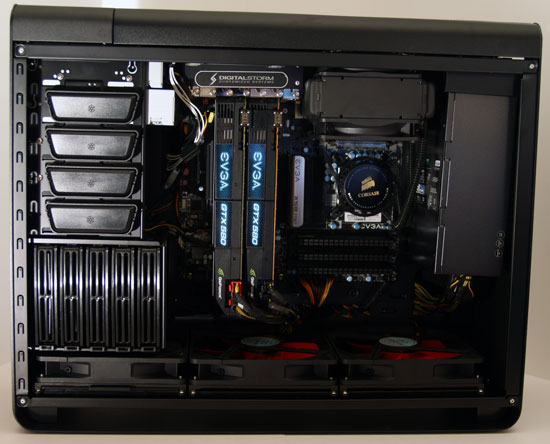
Third and final complaint: while I'm glad DigitalStorm splashed out on the cooling and especially the case (the SilverStone Fortress really is a sight to see), I do feel like they cheaped out a bit on the memory and power supply. You can order a 1.2 kilowatt Corsair power supply but it'll cost twice as much as the one in this build. Likewise, I would've liked to see a better brand of memory than A-Data. A-Data's stuff works fine and the BlackOps was perfectly stable in testing, but I'd like to see a more reputable/performance oriented brand.
So, how about that power consumption? As it turns out, not so good. The DigitalStorm BlackOps idles at about 240 watts at the desktop. NVIDIA has made great strides in keeping idle power consumption low on their high-end cards, but that processor idling at such a high voltage and clock is a killer. When placed under different loads, I saw a peak consumption of about 660 watts. That's not horrible given what's in the tower, but I'll put it another way: while the BlackOps was running, I never turned the heater on in my apartment.
For comparison's sake I ran the same tests on my tower. I have an i7-930 overclocked to 3.6GHz, but it idles at 2GHz and the voltage drops. Likewise, I'm running a single AMD Radeon HD 5870 instead of a pair of GeForce GTX 580s. My idle consumption is 190 watts, which seems high until you realize I have three screens connected to the 5870 that keep its clocks up. Under the same load the BlackOps was tested with, my tower only consumes 320 watts. It's nowhere near as fast in games, but nonetheless it draws less than half the wattage the BlackOps does. Given that kind of power consumption, how does the BlackOps fare in terms of managing heat?
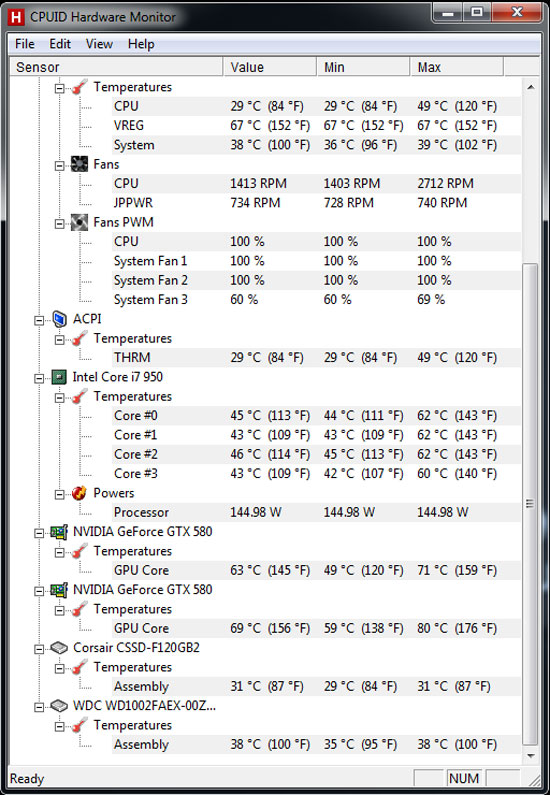
Really well, actually, and the smart case design (along with Corsair water-cooling and the improved coolers on the GTX 580s) keeps both thermals and noise down to reasonable levels. The iBuyPower Paladin XLC with SLI 470s generated far more noise under load than the BlackOps does. Of course, the BlackOps is doing a much more efficient job of dissipating all that heat...right into your living room. I can't stress that enough, a computer this powerful that draws this much current is going to noticeably increase room temperature. That's fine in the winter months, but when summer comes you may find a machine like this hitting your power bill from two sides: consumption on its own, and the air conditioning required to keep your living space habitable.
Originally published at https://www.anandtech.com/show/4074/digitalstorm-blackops-almost-too-fast (Wayback Machine).