
AMD Athlon Buyer's Guide - Part 1: Motherboards
- Posted in
- Guides
Other Overclocking Options
Other than physically modifying the processor card itself (or purchasing a pre-modified CPU) the only other option for overclocking your Athlon lies in the hands of the motherboard -- FSB frequency control. Out of the four motherboards we looked at (not including the Fester), only two offered FSB frequency adjustments, the ASUS K7M and the FIC SD11.
The default FSB for the Athlon is 100MHz (the "200MHz EV6 Bus" comes from the ability of the bus to transfer on both the rising and falling edges of the clock, thus effectively doubling the transfer rate) but you must keep in mind that overclocking the FSB on Athlon motherboards is much more of a sensitive process than on the BX boards we are used to.
The EV6 bus protocol is apparently not as overclocking friendly as Intel’s GTL+, at least at this point in time of the Athlon’s evolution, therefore the FSB overclocking options are very limited. Any frequencies above 110MHz should just be considered to be completely out of the question, meaning that the 124/133MHz of FIC’s SD11 are worthless because they won’t even boot. This limitation is obviously temporary as the EV6 bus is scalable up to 200MHz (200MHz x 2 = 400MHz), but for now don’t expect to be able to use the FSB as a real overclocking option.
Below the 115MHz mark, the options become a bit more reasonable. The general consensus is that 110MHz is the limit of the ASUS K7M, the only motherboard of the four we’re looking at that supports overclocked frequencies less than the 124/133MHz of the SD11. As with all forms of overclocking, your mileage will vary, while some users have been able to hit 110MHz others are limited to around 103 or 105MHz, on the K7M in particular.
From our in lab experience with the Athlon and FSB overclocking, the performance gain is not worth the potential risk of overclocking the FSB on Athlon motherboards, especially with the current quality of Athlon motherboards and the electrically demanding nature of the CPU. You’ll probably want to look to some third party overclocking options for the Athlon, some of which we will be covering in Part 2 of our coverage.
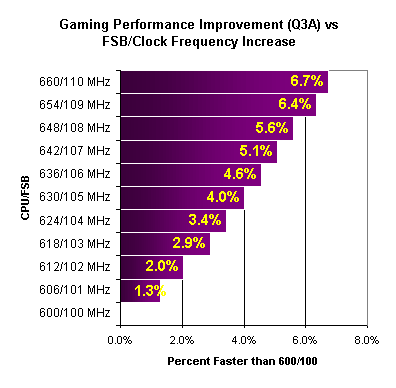
A 10% increase in the FSB frequency and a resulting 10% increase in the clock speed of the Athlon yields a little less than a 7% performance gain in our Quake 3 tests using a GeForce 256. The performance improvement is definitely there but as we mentioned before, the stability of your system at the 110MHz FSB may be undesirable and thus force you to select a lower FSB setting. Not to mention the possible ramifications of running the FSB 10% out of spec. The EV6 bus isn't as welcome to overclocking as the GTL+.
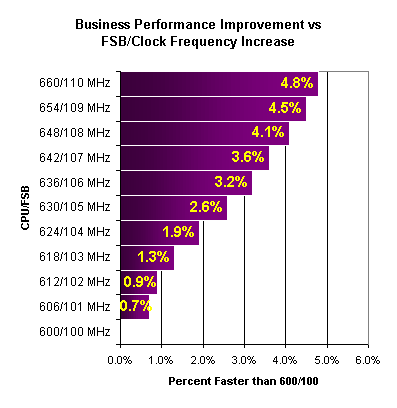
In business applications and overall system performance, the performance improvement to clock speed increase ratio is smaller than what we noticed in the gaming tests. The 10% increase in FSB and CPU clock speed results in just under a 5% overall performance improvement with diminishing returns as the FSB frequency drops below 110MHz.
Originally published at https://www.anandtech.com/show/404 (Wayback Machine).