
The Brazos Performance Preview: AMD E-350 Benchmarked
Final Words
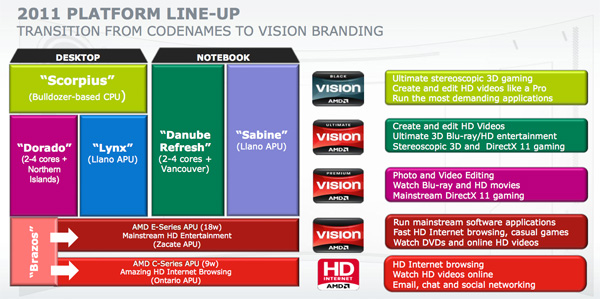
The Brazos platform really poses the question of what is fast enough from a CPU standpoint. Netbook makers often argued that Atom was fast enough, and honestly they'd be right if Atom wasn't paired with such a heavyweight OS. Running Windows 7, Atom just wasn't fast enough but many made the sacrifice in order to get the form factor and battery life benefits that went along with the platform. The E-350 offers an alternative. You get faster than Atom CPU performance (particularly in single threaded tasks) and a fairly potent GPU. The only issue is that the E-350 doesn't compete against Atom. Most of the time you'll find it up against Pentium or low end Core i3 notebooks.
From a CPU performance standpoint, the E-350 can't compete with either of those CPUs clock for clock. Where AMD has the advantage is in power consumption and GPU performance. This is effectively AMD's answer to Intel's CULV platform, but with better graphics performance.
This is a huge statement from AMD, echoing what Apple has been saying for the past year: while CPU performance matters, GPU performance must scale at least as quickly, if not more to make up for lost time. The only thing we're really lacking are the killer apps (outside of 3D gaming and HD video) to support this mentality today.
The Radeon HD 6310 in the E-350 does very well, despite the memory bandwidth limitations. Its easily faster than Intel's HD Graphics, although some games (e.g. Starcraft 2) are still held back by the performance of AMD's Bobcat cores. Despite being a significant step forward for integrated graphics at this price point, I would be lying if I said I didn't wish it were faster. Ideally I would like to see > 30 fps performance across the board from the E-350.
There's also the GPU compute argument that AMD makes for Fusion, however the GPU compute tests I tried to run on Brazos didn't exactly work. Cyberlink Media Espresso would not use the GPU for encoding and the Civilization V compute shader test wouldn't run either. Both I suspect will be worked out by the time the platform actually ships.
What matters the most with Brazos is what the OEMs do with it. We'll of course get mini-ITX boards to turn into HTPCs, but on the mobile side Brazos needs to be paired with a sleek/well built chassis, good display, fast storage and a large battery to truly be attractive. I am also concerned about the performance of the Ontario based APUs. In many areas the E-350 isn't that much quicker than a dual-core Atom, which makes me wonder how the C-30 and C-50 would do.
Brazos ultimately has the same problem Atom had at its introduction. Compared to similarly priced notebooks based around 2.2GHz Pentium dual-core CPUs or Core i3s, the CPU just isn’t competitive. Unlike Atom however, in GPU bound scenarios the E-350 is actually faster than those two. The only issue, as I mentioned above, is that currently the majority of mainstream applications that are GPU bound are 3D games. Like Atom however, the Brazos platform is also destined for ultra thin formfactors - places a low end Core i3 can’t go. It’s in that comparison that AMD is most successful.
Compared to a Core i3-330UM, Brazos offers much better GPU performance and it’s even competitive in CPU dependent games like Starcraft 2. The i3-330UM is still faster CPU bound scenarios though, reinforcing the CPU speed for GPU performance tradeoff that you’re faced with when considering these two.
The E-350 delivers 50 - 60% of the multithreaded CPU performance of the Core i3-330UM, and nearly 70% of the single threaded performance. It’s a noticeable gap, but AMD attempts to make up for it by delivering up to twice the GPU performance in games.
Then there’s the issue of die size. For years AMD has had to give sell you a larger die at a lower price than Intel in order to remain competitive. The Brazos platform changes that. At 75mm^2, the Zacate die is smaller than just the CPU portion of a Core i3 and it’s less than 40% of the total die area when you include Intel’s HD Graphics. While more CPU performance would be nice to have, this is a good start.
AMD is committed to revving the Brazos platform yearly. We’ll obviously see updated graphics next year but I’m hoping for updates to the CPU cores as well. The biggest mistake Intel made with Atom was to be too conservative with its roadmap. AMD has a history of not making the same mistakes as Intel, so hopefully the Brazos roadmap looks good. Now we wait for the notebooks.
Originally published at https://www.anandtech.com/show/4023/the-brazos-performance-preview-amd-e350-benchmarked (Wayback Machine).