
10G Ethernet: More Than a Big Pipe
- Posted in
- IT Computing
- Networking
- 10G Ethernet
ESX 4.0 Performance
Let us see what these NICs can do in a virtualized environment. After some testing in ESX 4.1 we had to go back to ESX 4.0 u2 as there were lots of driver issues, and this surely was not the NIC vendors fault solely. Apparantly, VMDirectPath is broken in ESX 4.1, and a bug report has been filed: update 1 should take care of this.
We started NTttcp from the Windows 2008 node:
NTttcp –m 4,0, [ip number] -a 4 –t 120
On the “virtualized node”, we created four virtual machines with Windows 2008. Each VM gets four network load threads. In other words, there are 16 threads active, all sending network traffic through one NIC port.
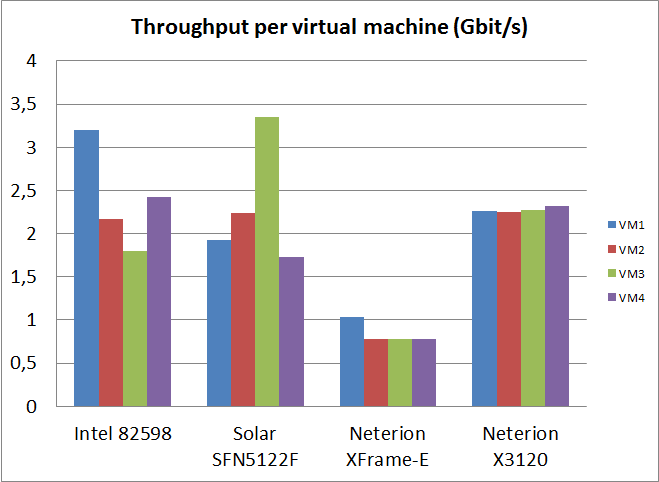
The Intel chip delivered the highest throughput with 9.6 Gb/s, followed closely by the Solarflare (9.2 Gbit/s) and the Neterion X3100 (9.1 Gbit/s). The old Xframe-E was not capable of delivering more than 3.4 Gbit/s. The difference between the top three is hardly worth discussing: few people are going to notice a bandwidth increase of 5%. However, notice that the Neterion NIC is the one that load balances the traffic the fairest over the four VMs. All Virtual machines get the same bandwidth: about 2.2 to 2.3 Gbit/s. The Solarflare SF5122F and Intel 82598 are not that bad either: the lowest bandwidth was 1.8 Gbit/s. Bandwidth tests with the Ixia Chariot 5.4 test suite gave the same numbers. We also measured response times.
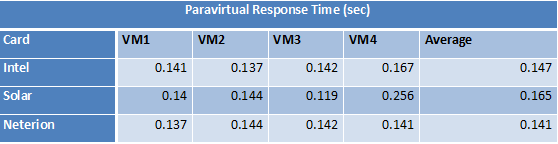
Again, the Neterion X3100 chip stands out with a low response time in all virtual machines. The Solarflare SF5122 drops a stitch here as one VM gets twice the amount of latency. Let us see how much CPU power these NICs needed while they round-robin the network traffic over to the virtual machines. This test was done on the Xeon E5504 (2GHz) and the Xeon X5670 (2.93GHz); Hyper-Threading was disabled on all CPUs.
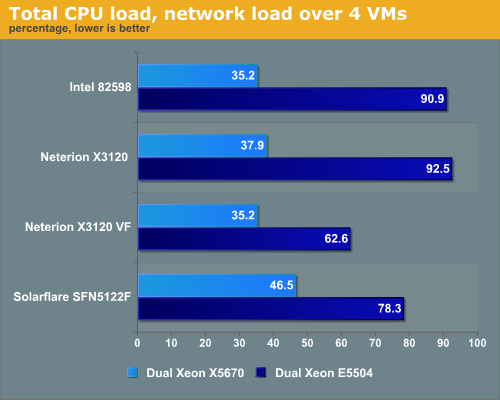
Nine gigabits of paravirtualized network traffic is enough to swamp the dual quad-core 2GHz Xeon CPU in most cases. Although it is one of slowest Xeons now available, it is still impressive that nothing less than eight of these cores are necessary just to run the benchmark and manage the network traffic. So be warned that these 10GbE NICs require some heavy CPU power. The Solarflare chip offers the low-end Xeon some breathing space, the Neterion chip needs the most for it’s almost perfect load balancing services.
But the Neterion chip has a secret weapon: it is the only NIC that can make virtual functions available in VMware ESX. Once you do this, the CPU load is a lot lower: we measured only 63%. This lower CPU load is accompagnied with a small dip in the network bandwidth: we achieved 8.1 Gbit/s instead of 9.1 Gbit/s.
Once we use one of the fastest Xeons available, the picture changes. The Intel and Neterion make better use of the extra cores and higher frequency.
Originally published at https://www.anandtech.com/show/4014/10g-more-than-a-big-pipe (Wayback Machine).