
Hybrid Clouds: are we there yet?
- Posted in
- IT Computing
Telecom finally enters the 21st century
Telecom devices used to belong to a dark world where the vendors still rule and customers have to cope with their wims. Although modern telecom software is interfacing with mailboxes, VOIP and web conferencing, most telecom vendors force upon the sysadmins proprietary boxes which are completely closed. The vendors felt they could ignore the evolution towards modern flexible virtualized clusters. The motto was "We can only support you if you use our software on our hardware with specialized firmware". The "it will not work otherwise" smokescreen needed to hide the fact that vendors made customers pay premiums for outdated hardware.
Mitel put a cat among the pigeons by offering their software a virtual appliance, i.e. an OVF image. The Virtual Mitel Communications Director (VMCD) does not demand its own server like the rest of the haughty telco software, but humbly installs itself on the virtual layer of your datacenter.

Click to enlarge
It only requires that you reserve 2 to 4 cores and 2 to 4 GB of RAM so it can do its work for up to 1000 active users. Those cores must be an 2 GHz EPT (Hardware MMU) enabled Nehalems or better. The only supported hypervisor so far is VMware's vSphere 4.0 update 2.
Summary
It is pretty clear: advanced virtualization technology brings the advanced capabilities of the "public clouds" inside the datacenters of many enterprises. The virtual intelligent cluster is not going away, especially now that even the most "stubborn" applications such as OLTP databases and telco software are being virtualized.
New "hybrid cloud" management software (vCloud Director, openQRM) will allow the sys admin people to offer the users an easy self service portal. At the same time the sys admins get a single pane to control both the public as the private cloud resources. We are not there yet. More advanced "cloud" networking software and storage migration tools will make it a lot simpler to seamlessly move virtual machines from your own premisses to the large datacenters and back.
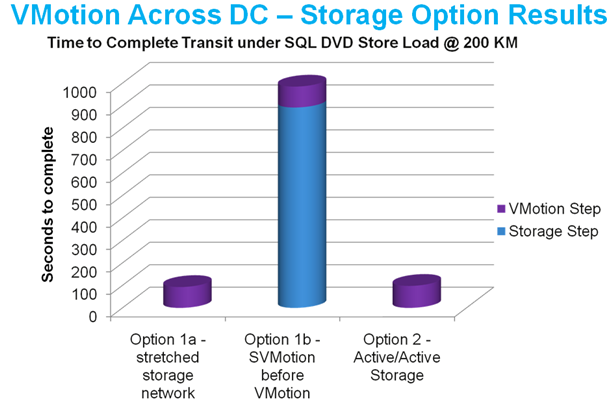
But we are getting close. At the high end, EMC VPLEX technology shows that this will become a reality even more for massive migrations that involve moving hundreds of VMs over great distances. And if you only want to move a few VMs from time to time, that is already possible with some careful tweaking, although not fully supported. Just take a look at the benchmark below, done by the EMC lab.
Click to enlarge
VMware vSphere build-in Storage vMotion does the job of moving a complete VM + datastore to another datacenter a lot slower than the VPLEX setup (option 2) but it works without disruption. It won't take long before the Hybrid Cloud will also arrive in the smaller and medium IT business too.
Originally published at https://www.anandtech.com/show/3975/hybrid-clouds-are-we-there-yet- (Wayback Machine).