
Toshiba A665-3DV: 3D or Not 3D?
Suffering the Slings and Arrows of a 3D Fortune
So what's there to say about the Toshiba A665-3DV? A lot, but much of what we have to say isn't that positive. The current (soon-to-be-outdated) 3D Vision notebook experience feels kludgy and tacked on with the A665-3DV, with a separate 3D emitter required. It usually works and when it does it looks fine, but on hardware like the GTS 350M it's more for movies and images than for gaming. If you buy a 3D camera like the Fuji Real 3D W1 we played around with, you can get some additional use out of the technology, which is good since finding new 3D content in other formats is sketchy right now. Honestly, my nearly eight-year-old daughter had far more fun with the 3D camera and display than I did; perhaps she's more easily impressed, or merely less jaded.
Given this is a $1400 laptop that uses the same chassis as the $750 A665D-S6051, build quality is another concern. We were iffy with build quality on the A660D with AMD components, and the similar A665D-6059 is priced at $800. Add $600 to the price and even with the improved performance we're left wanting more. Cheap, glossy plastic (with textures) is entry-level stuff, and the A665-3DV is not priced or spec'd as such. We said the 3D felt tacked on, and this is part of the problem with reusing designs. It was probably very easy to use the basic A665 design, swap out the 16" LCD for a 15.6" 120Hz panel, and add in a GTS 350M GPU. Easy, yes, but the resulting product isn't particularly compelling.
What you get with the A665-3DV is a reasonably fast midrange laptop, priced higher than other laptops sporting better components. The MSI GX640 we reviewed has a dual-core CPU, but the HD 5850 is substantially faster than the GTS 350M (with DX11 support as a bonus). It also has a better LCD and it's priced lower, though the keyboard is certainly a low point. There's also the ASUS G51Jx, with a GTS 360M (a nominal ~10% speed bump from the GTS 350M) and 720QM paired with a 1080p LCD; all that and you save $225 compared to the A665-3DV. However, pricing does warrant a closer examination.
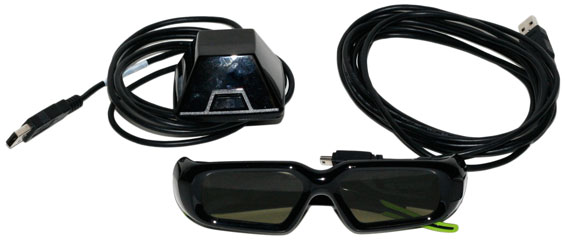
NVIDIA sells their 3D Vision package with the glasses and emitter as a $180 kit, so you have to include that in the price. That means we're really looking at a $1220 notebook with a 3D Vision kit—a slightly more palatable proposition. If you're comparing to the ASUS G51Jx we just mentioned, you also get Blu-ray support and ExpressCard from Toshiba (though ASUS offers what we can only assume is another questionable 768p 3D Vision laptop with the G51Jx 3D, priced at $1600+). But when the raison d'être of the A665-3DV is 3D and what we get is a half-baked attempt at 3D, this is a notebook that we can't really recommend. If you really like the concept of 3D movies, pictures, etc. you can give it a shot and it will work okay, but right now the 3D notebooks feel more gimmicky than useful.
The next generation 3D Vision with an integrated emitter will certainly help, but we really want a higher quality panel to go along with the other features—something that can do at least 500:1 contrast would be great, and while we normally wouldn't say this we also need a brighter LCD for 3D modes. With the shutter glasses, each eye only gets roughly half the luminance, so a panel that can put out more than 300 nits would be a good place to start. 3D Blu-ray is the other story here, and that means ideally you want a 1080p panel rather than downscaling content to a 768p display. If you want all that with 3D gaming, you're going to need much more than a GTS 350M; we'd say shooting for GT 445M would be the minimum, and preferably 460M or higher. We should see some notebooks in the near future that look to provide all of the above, but expect to pay a premium.
Given all the other features I want in a laptop, frankly, 3D support isn't high on my list. I'm happier with better performance, better battery life, a better LCD, better build quality and/or better portability, not to mention less eyestrain and no silly glasses… but I do have to admit that even without 3D, the 120Hz refresh rate is a nice extra. If you routinely attend the theater and spend the extra money for a 3D film, you might find 3D Vision laptops a better upsell, or you might prefer something like the ASRock 3D Vision HTPC Ganesh just reviewed. The rest of us should probably let the technology mature a bit longer before jumping on the 3D notebook bandwagon.
Originally published at https://www.anandtech.com/show/3956/toshiba-a6653dv-nvidia-3d-vision-notebook (Wayback Machine).