
NVIDIA GeForce GTS 450 Launch Roundup: Asus, EVGA, Palit, and Calibre Overclocked and Reviewed
Power, Temperature, & Noise
As we’ve discussed in previous articles, with the Fermi family GPUs no longer are binned for operation at a single voltage, rather they’re assigned whatever level of voltage is required for them to operate at the desired clockspeeds. As a result any two otherwise identical cards can have a different core voltage, which muddies the situation some. All of our GTS460 cards have an idle voltage of 0.962v, while their load voltage is listed below.
| GeForce GTS 450 Load Voltage | |||||||
| Ref #1 | Ref #2 | Asus | EVGA | Palit | Sparkle | ||
| 1.05v | 1.062v | 1.125v | 1.112v | 1.087v | 1.087v | ||
As all of our vendor cards in today’s roundup are factory overclocked, they all have an above-average VID. This ranges from 1.087v for the Calibre and Palit cards to 1.125v for the Asus. Given the lack of correlation between overclocks and VIDs even in our small sample size, it’s likely that any and every card in today’s roundup be in this voltage range depending on the qualities of the GPU in use.
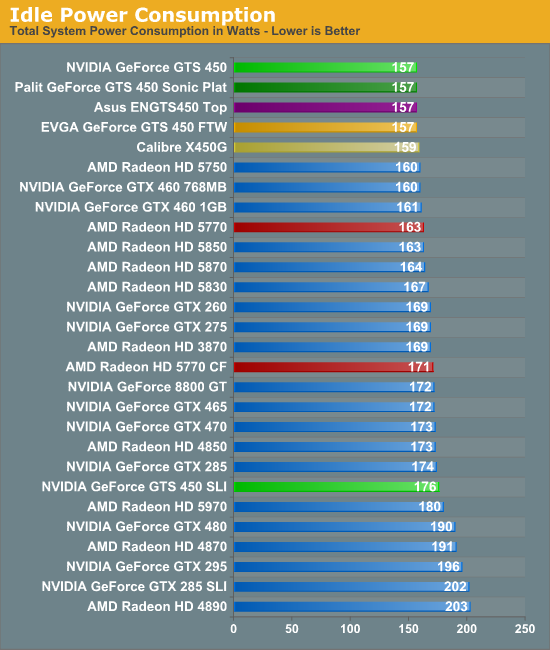
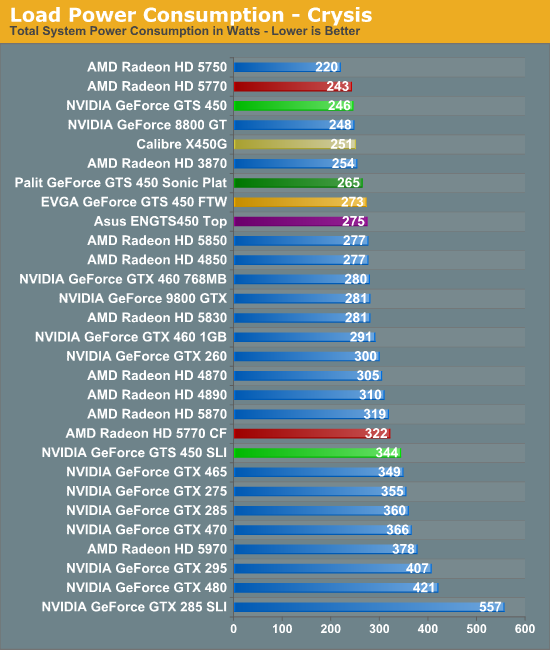
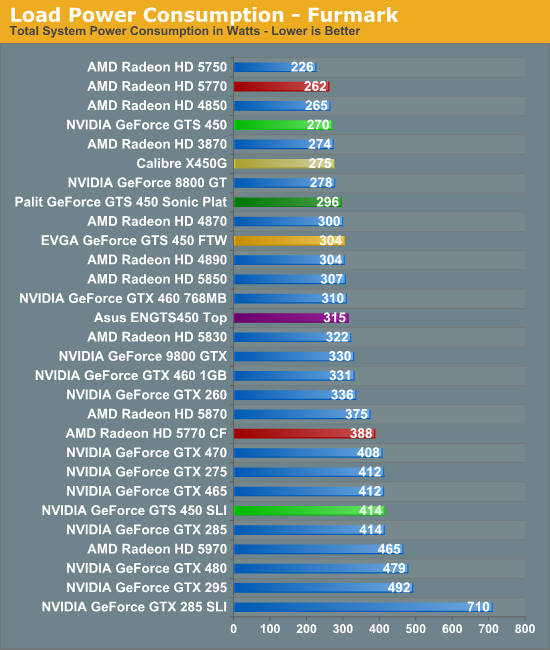
With the exception of the Calibre card –which needs to drive 2 92mm fans instead of one – all of our GTS 450 cards draw the same amount of power at idle, due to the fact that they all run at the same idle clocks and voltage. Under load the power consumption trends with the VID of the card, with the Calibre drawing the least amount of power, followed by the Palit, the EVGA, and finally the Asus card. The Asus card has the unfortunate distinction of drawing even more power than a GTX 460 768MB under Furmark, which is the penalty to be paid for an overclocked/overvolted card.
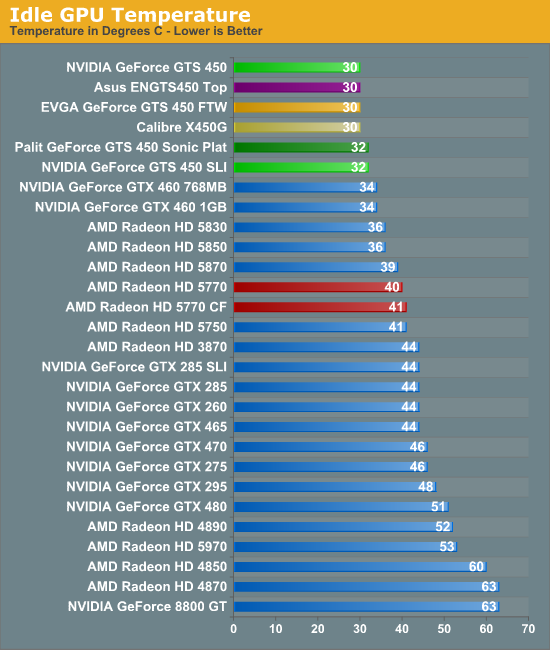
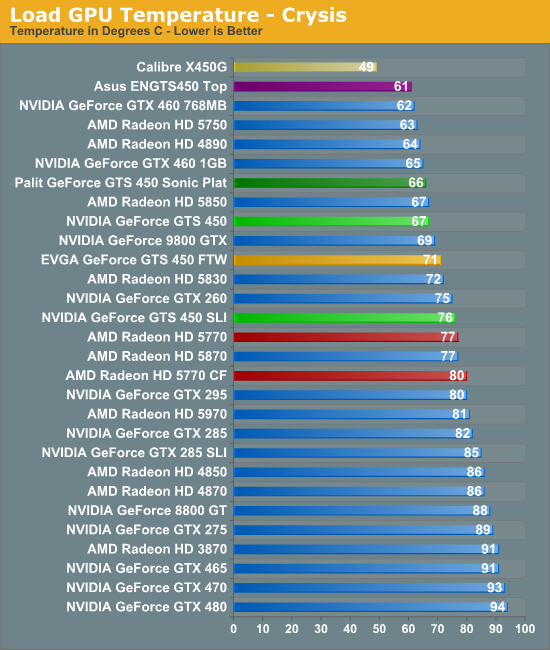
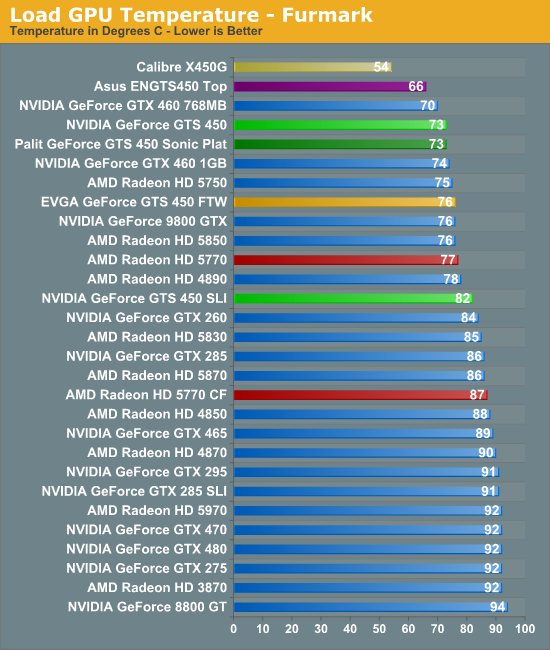
At idle, all of our cards hit roughly the same temperatures. The Calibre doesn’t get a chance to do much better here as 30C is already approaching room temperature. Meanwhile the Palit does slightly worse, perhaps as a result of it recycling more hot air in to the case.
At load however this is where we see the various cards shine. Toping our charts is the Calibre card with its massive cooler – it’s 12C cooler than the next coolest card under both Furmark and Crysis. In fact at 54C under Furmark it’s basically only lukewarm for a video card. As we said before the Twin Turbo Pro is entirely absurd for a card that only has a TDP a bit over 100W in the first place, but the results are hard to argue with.
Following the Calibre we have the rest of our cards with more traditional coolers. The Asus places second-best here and several degrees below a reference GTS 450, an unsurprising outcome given their more aggressive cooling policies. This is followed by the Palit card which manages to tie the reference GTS 450 in spite of its overclock, and finally the EVGA card which uses the same cooler as the reference card and gets a bit warmer as a result of the overclock. Even the warmest GTS 450 here is still cooler than the Radeon HD 5770 however, showcasing the high quality of the coolers used.
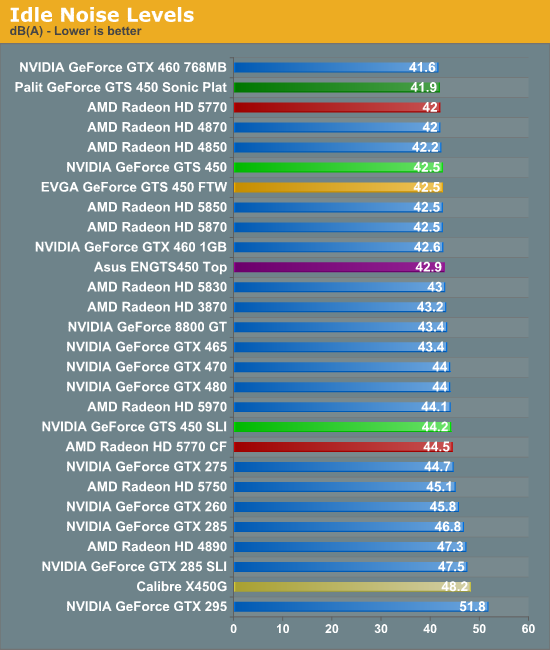
Last but not least we have noise. At idle most of our GTS 450 cards are close together as they all use similar cooler designs. The Calibre card is the lone standout, as the dual 92mm fans mean that it ends up being louder than almost all of the cards in our benchmark suite. Keep in mind that we’re talking about idle noise however, so even the “loud” X450G is still quiet enough for most cases.
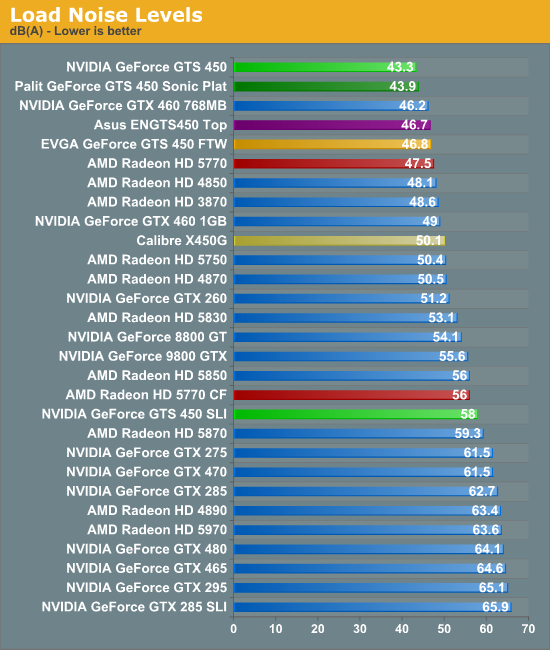
Under load, noise levels are roughly where we expect them. The GTS 450 is the card to beat, and nothing can do it although the Palit card comes extremely close, made all the more impressive by its factory overclock. If this specific sample didn’t have such a low load voltage, it likely would not have done as well. Interestingly this is followed by the Asus card; Asus’s aggressive cooling usually results in louader cards, but in this case it’s still quieter than half of the cards in today’s roundup and even the 5770. This is followed by the EVGA card right on the Asus card’s heels, and finally the Calibre card pushes 50dB(A) thanks to is dual 92mm fans. This makes the card distinctly louder than the other GTS 450 cards and the 5770, but it’s still quieter than the 5750 and more than half of the other cards in our benchmark suite. It’s certainly not whisper quiet, but it should be tolerable for a card with this level of performance.
Originally published at https://www.anandtech.com/show/3917/nvidia-geforce-gts-450-launch-roundup-asus-evga-palit-and-calibre-overclocked-and-reviewed (Wayback Machine).