
ASUS' N82Jv: Jack-Of-All-Trades
ASUS N82Jv-X2 Battery Life: Win Some, Lose Some
We've loved ASUS' idea of stuffing large 8-cell batteries into their U-series laptops. Unfortunately, the N82Jv we received for testing came with a standard 6-cell, 4400mAh battery. Given the use of Optimus, the only thing separating the N82Jv from the mobility results of the U30Jc is the battery, which means the U30Jc provides significantly more untethered usability. ASUS has a utility/feature called their Super Hybrid Engine (SHE) that drops the CPU multiplier down to 9x/10x instead of letting it float from 9x up to 20x, which can boost battery life a bit but not nearly so much as the decreased performance would lead you to expect. Then again, we use the Power Saver profile with maximum CPU set to 50%, so we've already limited CPU performance in the pursuit of battery life….
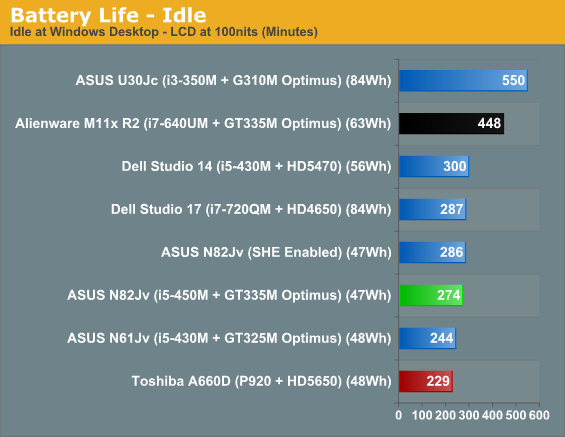
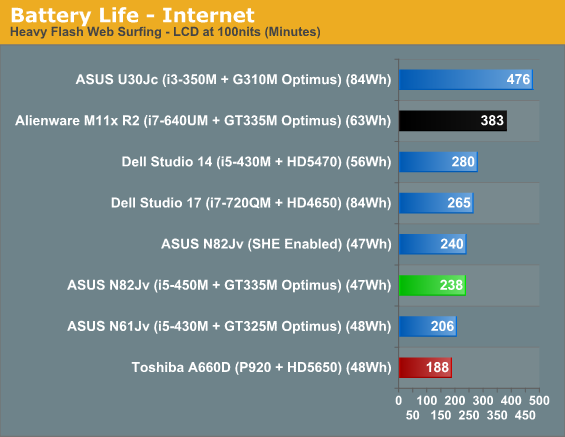
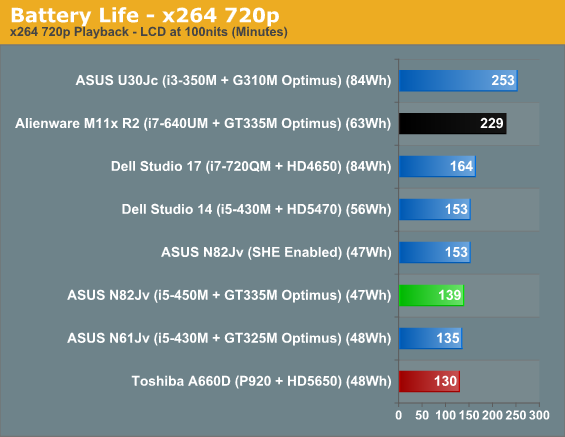
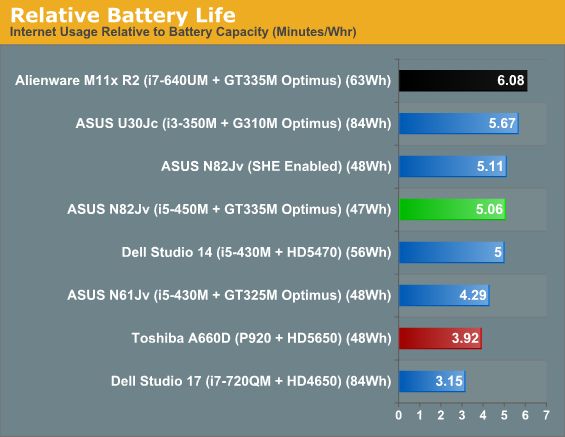
The N82Jv manages to best the larger N61Jv in each of the battery tests, mostly because of the smaller LCD. The lead is 12-15% in our first two tests, but it drops to just 3% in x264 playback—likely because of the higher CPU clock. Notice how SHE also helps the most in the x264 test, where battery life is improved 10% compared to just 1-4% in the other two tests. The results of the Dell Studio 14 are a bit higher thanks to its larger 56Wh battery; 19% more battery capacity results in 10-17% more battery life, meaning the ASUS N82Jv is actually more power friendly but it's hampered by the low capacity battery. If we look at the U30Jc we see what might have been. Yes, it has a smaller 13.3" panel, a slower i3-3350M CPU, and a 5400RPM hard drive, but it provides 80 to 100% more battery life from a 78% increase in battery capacity.
As a final comparison, look at what Intel i5 + Optimus (i.e. Intel HD on battery power) can do in comparison to AMD's P920 + HD 4250. We're looking at the same battery capacity, so this is really just Intel's mobile platform going up against AMD's platform—though the A660D does have a larger 16" LCD. The N82Jv is at its best in the Internet test, where it provides 27% more battery life than the A660D. AMD on the other hand appears to do quite well on the x264 test, coming within spitting distance of the smaller laptop—and very possibly, a 14" LCD would have made up the gap.
In the end, we're looking at just over two hours of battery life for HD video playback and up to four hours (4.5 with SHE enabled) maximum—if you shut down all extraneous services and applications, at least. While that's not terrible, neither is it stellar. ASUS' website lists an 8-cell battery option, and we really wish they—and all other midrange notebook manufacturers—would quit with the 48Wh batteries. We know they're cheaper, and a 6-cell battery weighs a bit less than an 8-cell, but rather than going for so many different product lines it would be nice to see ASUS focus on doing fewer models but getting them right in all areas.
Originally published at https://www.anandtech.com/show/3907/asus-n82jv-jackofalltrades (Wayback Machine).