
Toshiba Satellite A660D-ST2G01: AMD's Quad-Core Phenom II P920 Joins the Mobile Party
(Somewhat) Improved Battery Life
And now we come to the biggest change with Danube: better battery life. The Toshiba A660D isn't going to set any records, but considering it has a relatively small 48Wh battery and a quad-core processor it does well. We've optimized all of the laptops as much as possible to improve battery life, so keep that in mind—there's no AV or firewall software running, extraneous utilities are disabled, and we're using the Power Saver profile. We're also running off the integrated HD 4250 graphics for the battery results; if you choose to use the 5650, expect to lose at least 10-15% of the battery life. The LCD brightness is calibrated to ~100nits (58% in this case).
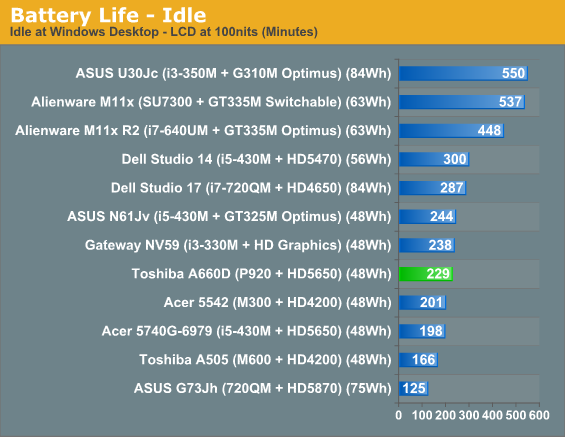
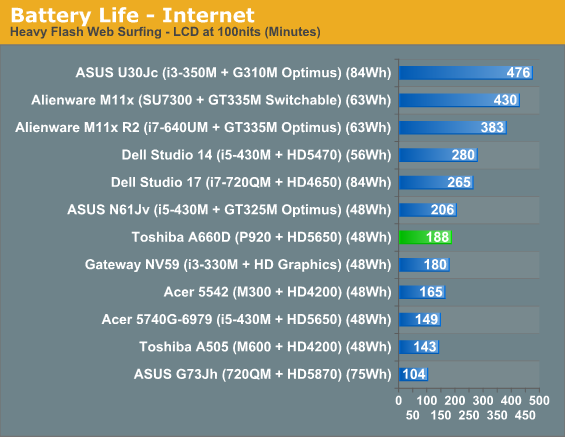
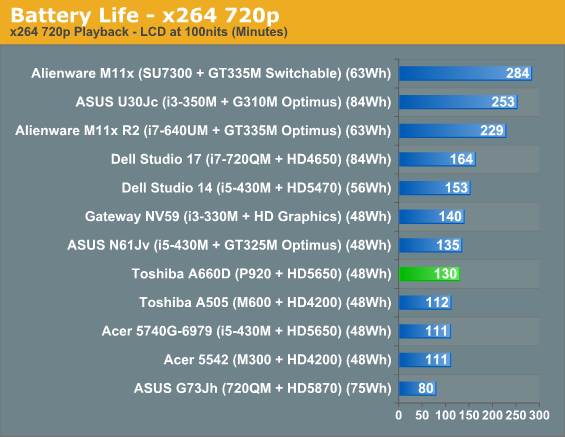
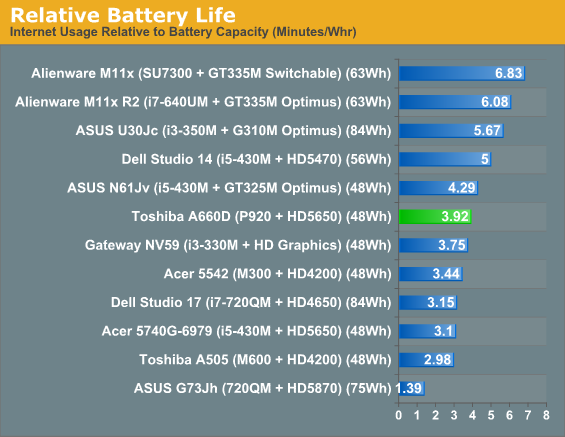
The A660D posts idle battery life just shy of four hours and Internet battery life of just over three hours. The x264 score is still pretty bad, lasting just long enough to get through a typical single movie, but again relative performance is important. Overall, battery life is up 16-38% over the Toshiba A505D, and 13-17% better than the Acer 5542 (M300). We're certainly curious as to how the dual-core P520 compares, given it has two fewer cores to power, but the P920 manages to beat the old M300 and M600 so that's already a clear win for the new Champlain parts.
What's not so rosy is the performance and battery life picture when we bring Intel results into the discussion. The quad-core Clarksfield cores deliver poor battery life, but considering i3-330M offers similar overall performance to the P920 in most tests (actually it's better performance overall) that's not really a good comparison. ASUS' N61Jv with Optimus and the Gateway NV59 are close to the A660D in terms of size and battery life. Intel still has a clear lead in overall performance, especially if you start including higher-end parts, but pricing and graphics performance generally favors AMD. At least it's no longer a 25% performance deficit with 25% worse battery life.
For the interested, the A660D consumes an average of around 15.3W during our Internet test, and just 12.6W at idle. The A505D consumes 17.4W idle and 20W in the Internet test, while the ASUS N61Jv uses 14W for Internet surfing and 11.8W at idle. Those results are on battery power using the test settings.
Originally published at https://www.anandtech.com/show/3883/toshiba-satellite-a660d-amd-phenom-ii-p920 (Wayback Machine).