
Intel's 50Gbps Silicon Photonics Link: The Future of Interfaces
- Posted in
- Trade Shows
- Intel
- Photonics
- Laser
Scaling up (bitrate) and out (WDM)
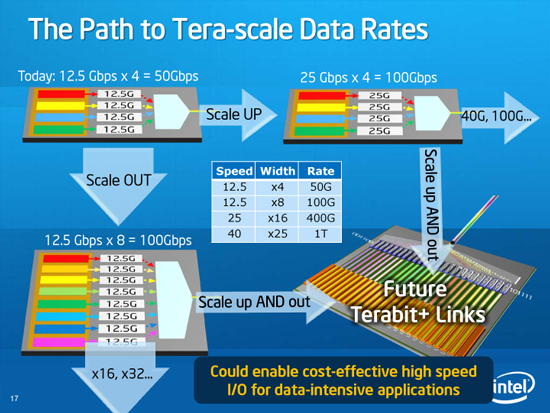
Intel demonstrated an effective speed of 12.5 gigabits/s per wavelength. Using wavelength division multiplexing (WDM), one can increase the number of wavelengths (or channels) in the fiber, effectively adding more bandwidth. Intel calls this 'scaling out.' This is what’s done in virtually every long haul fiber optic telecommunications network. Even though each wavelength in conventional teleco systems might only be 10 or 20 gigabits/s, the fiber itself can carry many wavelengths, resulting in much higher aggregate bandwidth for a single fiber.
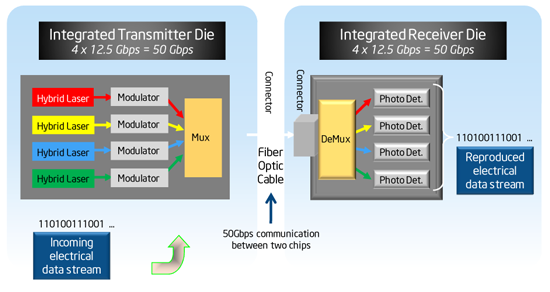
Wavelength Division Multiplexing (WDM)
One can also increase the bitrate of each channel, intel calls this 'scaling up.'
Intel’s demonstration is effectively a vastly miniaturized end to end fiber optic telecommunications system. Instead of cities, you’ve got CPUs and ICHs. Instead of a rack of modulators and optical multiplexers, you’ve got one chip on both ends. The links between components are inevitably going optical, the same way growing need for more and more bandwidth drove almost all terrestrial communications into fiber optic networks.
Both this 50G silicon photonics link and Light Peak are at the core of Intel’s overall I/O strategy for the future, one where copper data links are supplanted almost entirely by optical fibers. No doubt copper will still live on - one still needs to bring power to devices - but in a reduced capacity.
Light Peak is what Intel is calling its first consumer implementation of an external optical bus, and will start at 10 gigabits per second, and will start appearing in products sometime in 2010. The bus will support multiple protocols as well - in theory, you could send USB, ethernet, audio, and video at super fast rates over one unified optical connection. If you think about the same thing happening but on the motherboard, you’ll get a sense for the beginning of how optical data connections will supplant copper.
Hopefully some day we’ll be talking about replacing electrons in microprocessors with photons, and computing entirely with light. Optical computing poses a host of challenges before it can be fully realized, but eventually Intel might replace ICs with photonic equivalents entirely. That future is still decades away, but until then we’ll definitely be using optical busses for moving data around.
Originally published at https://www.anandtech.com/show/3834/intels-silicon-photonics-50g-silicon-photonics-link (Wayback Machine).