
Motorola Droid X: Thoroughly Reviewed
Years ago, before we hit the power wall, CPU innovation happened at a slow but steady pace. Every five years or so we’d get a new microprocessor architecture and every couple of years we’d get smaller transistors.
The smaller transistors made chips run cooler and at higher clock speeds. The shrink in die area also paved the way for new features, but between major architectural shifts those features normally came in the form of larger caches.
Texas Instruments’ move from the OMAP 3430, used in phones like the Palm Pre, to the OMAP 3630 used in the Droid X is reminiscent of this sort of steady progress I mentioned above.
The OMAP 3430 was built on a 65nm process (like Qualcomm's Snapdragon), while the 3630 is a 45nm shrink (like Apple's A4). Architecturally the two SoCs are very similar. They both use a standard ARM Cortex A8 CPU paired with an Imagination Technologies PowerVR SGX 530 GPU. The two SoCs fit in the same size package (12mm x 12mm BGA) and are ball compatible. If a customer wanted to, it could simply drop in a 3630 into an existing 3430 design with minimal engineering efforts.
Note that the most direct competitor to the 3630 is Qualcomm’s Snapdragon. While TI uses a standard Cortex A8 core from ARM, Qualcomm designed its own low power ARMv7 based core that is similar, but not identical to the Cortex A8. Both are dual-issue, in-order architectures - they’re like the original Pentium, but in your phone. Qualcomm also integrated the cellular modem into the Snapdragon SoC while TI’s OMAP 3 is a strict application processor - the modem is housed in a separate chip.
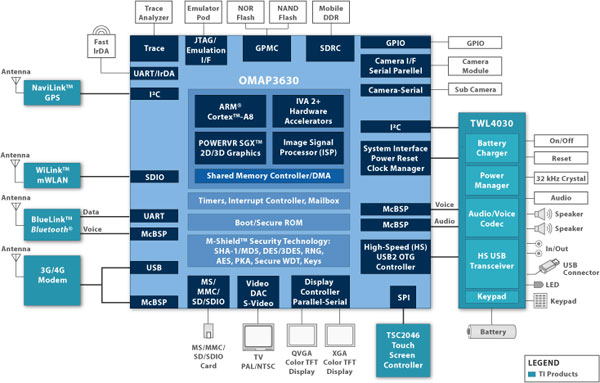
On the CPU side TI doubled the L1 cache of the 3430 to 64KB (32KB instruction, 32KB data). The L2 cache remains unchanged at 256KB. We won’t get a larger L2 until the OMAP 4, which will ship with a 1MB L2 shared among its two cores. There are the usual tweaks and bug fixes which may improve performance per clock a little bit over the 3430, but overall the 3630 just gets a larger L1 as a result of the die shrink - oh and a much higher clock speed.
The Cortex A8 now runs at up to 1GHz. The OMAP 3430 topped out at 800MHz in shipping configurations but most vendors ran it at sub-600MHz speeds to save power. The 3630 in the Droid X runs at a full 1GHz. It's worth pointing out that Qualcomm was able to hit 1GHz on a similar architecture at 65nm by designing its core from the ground up. There's clearly value in these custom designs from a performance and time to market standpoint. These advantages will only become more critical as the SoC performance wars heat up.
Power Consumption
The OMAP 3 as well as Qualcomm’s Snapdragon SoC support dynamic voltage and frequency scaling. Based on application demand and cues from the OS the CPU clock speed and voltage can vary. The Cortex A8 in the OMAP 3630 will drop down to the low 300MHz range when idle at the Android home screen and ramp all the way up to 1GHz when needed.
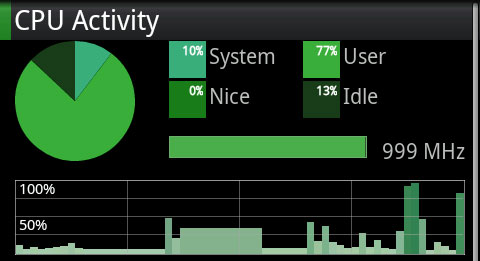
TI's OMAP 3630 running at full tilt
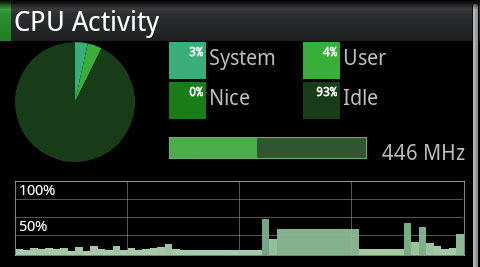
...and automatically underclocked to 446MHz under lighter load
This is nothing unique to the OMAP 3630, but it shows that frequency and voltage scaling is alive and well in Android.
TI supports full power and clock gating. All major IP blocks are placed on their own power islands, so based on input from the OS the CPU, GPU, video decoder, etc... can ramp down depending on the application needs at the time. The power and clock gating is no more granular in the 3630 than it was in the 3430. What has changed however are operating voltages.
While the 3430 needed 1.35V to hit 720MHz, the 3630 can reach 1GHz at around 1.26V. That still sounds a bit high to me but at the same clock speed, thanks to voltage scaling, you can drop power by around 30% compared to the 3430.
Coupled with the dynamic voltage/frequency scaling of all OMAP 3 parts this means that overall power efficiency should be better on the 3630 vs. the 3430. The added CPU performance in the form of larger L1 caches and a higher clock speed should make tasks complete quicker and allow the 3630 to get to a lower voltage state than the 3430 was ever able to reach.
Samsung has already shown off 1.2GHz+ versions of its Cortex A8 based SoC at 45nm, so I would expect to see higher clocked versions of the 45nm OMAP 3 family to follow at some point in time.
Originally published at https://www.anandtech.com/show/3826/motorola-droid-x-thoroughly-reviewed (Wayback Machine).