
Laptop Buyer's Guide: 14-inch and Smaller
Netbook: ASUS Eee 1001P
And now we get to the most technologically stagnant part of the market, in which not much other than the battery life numbers have changed in two years. Ah yes, the wonders of netbooks.
I’m not even exaggerating - just look at the ASUS EEE lineup. The 1000HA came out in October 2008 with the 1.60 GHz Atom N270 processor and was updated 1000HE in February 2009 (1.66 GHz Atom N280 plus an extended battery good for 10 hours of life). That got replaced by the 1005HA in June 2009, part of the new Seashell design language. The 1005HA had identical specs to the 1000HE, but a different chassis design that was sleeker and better looking. Spec-wise, the first (and, to date, only) big change was the switch to Pine Trail processors in December 2009. However, that really didn’t do a whole lot for performance, though it did increase battery life to 14 hours (under ideal conditions). We’re still on Pine Trail and the trusty old N450/GMA 3150 combo, so in just under 2 years, we’ve improved maybe 10% performance-wise and just about doubled battery life. Not that having twice the battery life is a bad thing, just that over 2 years, the lack of any significant performance gains is pretty disappointing for what was already a low performance platform. This is starting to change though, with a much-welcome 10% clock speed boost in the 1.83GHz N470 and the much awaited dual core N550 that is due to ship in Q3.
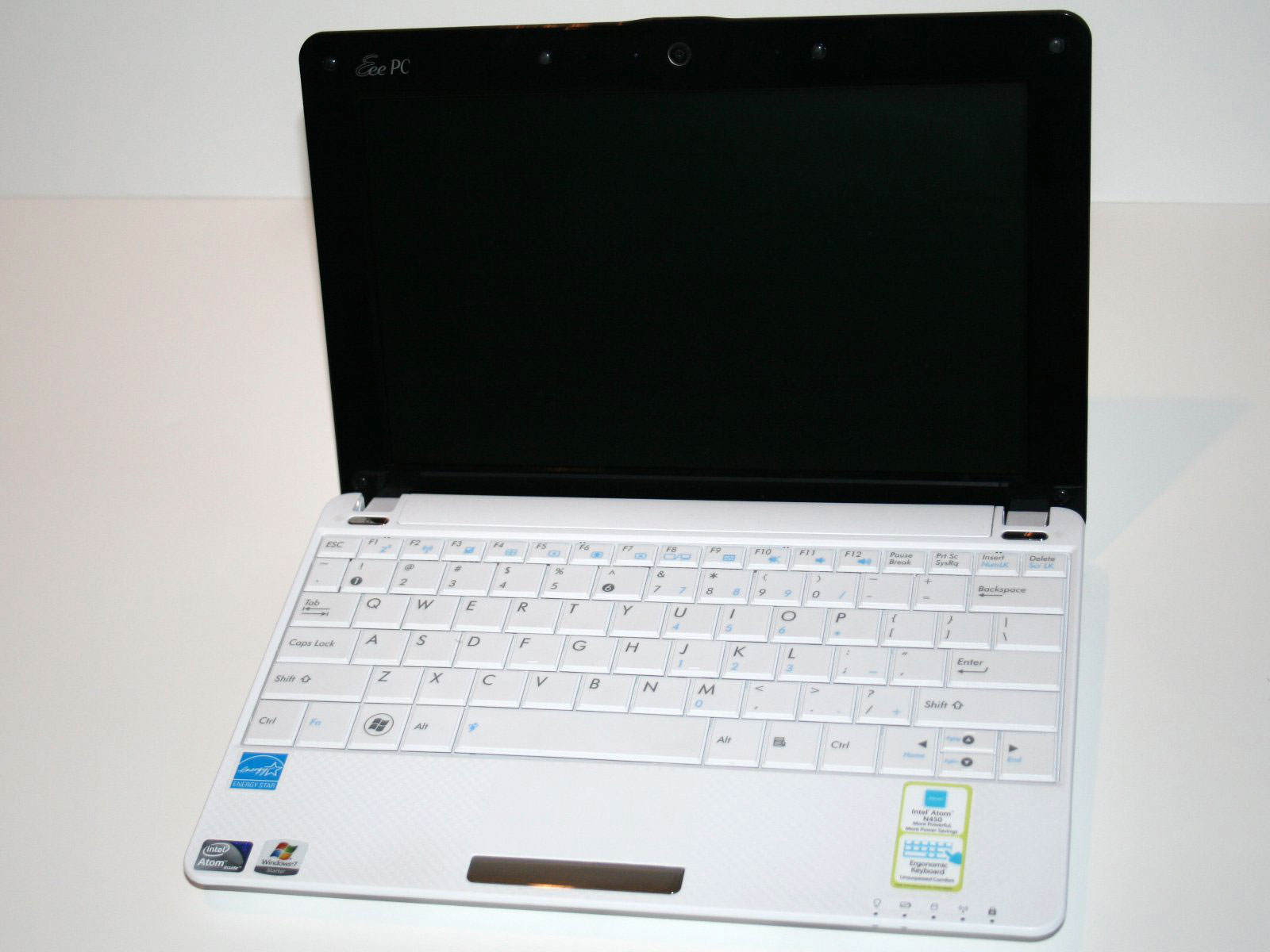
In the meantime though, we’ll work with what we’ve got. When we reviewed the Eee 1001P, we liked it quite a bit and gave it our Silver Editor’s Choice award. It earned that award on strength of the very good screen, which had matte finish and a superhigh contrast ratio, along with the good styling and build quality. Apart from that, there isn’t much to set it apart from the rest of the netbook pack; the 11 hour battery is on the better side, but still less than the mark set by the 1005PE, and performance is the same across all devices. With not a whole lot to differentiate between netbooks specwise, things like LCD panel and display quality do make a significant difference. With the netbook market not changing much since the last time we evaluated it, our recommendation of the 1001P stands as it was. And now that the street price has gone down to $305, it’s even easier to recommend.
However, there are some interesting choices if you’re looking for something non-standard. The ASUS 1018 comes to mind: it’s made completely of aluminum and is a very svelte 2.26lbs. The new Atom N455 adds support for DDR3 memory, and the battery is slightly smaller than the 1001P’s: 44 Wh and 10 hours of runtime. But it’s pretty pricey, at $429. Different is good, but the same specs for 40% more money? I’d rather get the Dell 11z I mentioned before.
NVIDIA’s ION platform is something that should also be mentioned here. The first generation of ION was never a huge hit in netbooks, coming late in Atom’s release cycle; the only really relevant system that got ION was ASUS’ Eee 1201N, which had a nettop-spec dual-core Atom 330 to go along with ION’s 9400M. Next-Gen ION has thus far been MIA, with one of the two announced devices being canned for unspecified reasons (Acer’s 532g) and the other being delayed until August (the ASUS 1215N, which will replace the 1201N). Given the cost it adds, unless you’re trying to lightly game on a $500 budget, I’d skip ION and go for a cheap CULV machine like the 11z or 1410 for the same price. They are equally capable of HD Flash video and 1080p playback over HDMI, and offer significantly faster processors than the Atom-based ION netbooks.
Originally published at https://www.anandtech.com/show/3822/laptop-buyers-guide-14inch-and-smaller (Wayback Machine).