
ASUS, EVGA, Gigabyte & MSI: Four Flagship X58 Motherboards Reviewed
Based upon everything we’ve seen in our testing to date, our advice to users that already have enthusiast level first generation X58 motherboards is to think very carefully before laying down dollar on anything new – there are very few reasons to upgrade. In fact, even if buying a completely new system based around Bloomfield or Gulftown, there’s no need to fork out extra for any of these updated motherboard models unless there is something specific about board layout or multi-GPU abilities that appeals to you.
As we have to give a verdict, out of the four motherboards tested, we’d probably stretch ourselves to opt for the Rampage III Extreme in almost every scenario. While ASUS did not clean the floor in all departments, the R3E is easy to use, has a good BIOS, decent feature set and overclocks reasonably well. This doesn't mean to say that we feel the board is priced fairly though for what it offers. We'd like to see ASUS sell the R3E around the $300 mark considering there are no NF200 bridge chips cutting into base part costs.
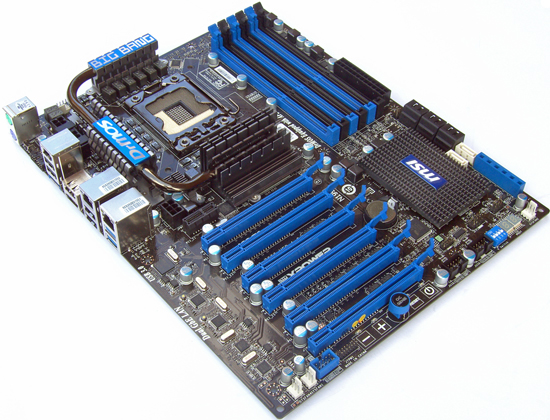
We’d love to give the MSI XPower a global recommendation, but unfortunately can’t until the overclocking disparity we experienced against other boards both in voltage and frequency improves. While the XPower is cheaper than the other three boards on test and fares a lot better in power consumption tests, there are a plethora of boards under the $300 mark that can overclock better on air and water cooling (models from ASUS, Gigabyte & EVGA). Okay, you give up some of MSI’s bundle, but the extra peripherals don’t add up to much when high frequency low voltage operation is preferred by most users who purchase high-end memory kits.
If by some bizarre twist of fate we happened to be running four-way SLI and chasing big 3D Mark Vantage numbers (which is never going to happen), then our choice goes to EVGA. Yes, there is work to be done, but, we can’t find good enough reason to opt for Gigabyte’s UD9 instead. Simply because we feel Gigabyte have priced themselves out of the market and aren’t offering anything that we deem worth the price hike.
Looking past SATA 6G and USB3, all this second wave of flagship motherboard releases boils down to for ASUS, Gigabyte and MSI is the re-designed PWM; earlier models lacked sufficiently engineered VRMs to handle Gulftown and keep up with the EVGA Classified boards when pushed hard by the benchmarking crowd when using LN2 cooling. And that’s why there’s no need to upgrade or jump on the bandwagon unless you fall into the category of a niche group of users.
Originally published at https://www.anandtech.com/show/3820/asus-evga-gigabyte-msi-four-flagship-motherboards-reviewed (Wayback Machine).