
Two OMAP 3430 Phones: Nokia N900 and Motorola Droid
Battery Life
The OMAP 3430 delivered an interesting mix of battery life conclusions. It's interesting to see how much of the battery savings is implementation, radio chipset, and OS. Thankfully, we have the opportunity to do so here with the N900 and Motorola Droid.
Of course, the Motorola Droid is on Verizon, meaning our call test uses a CDMA 1xRTT '2.5G' network for voice, and '3G'r EV-DO for data. Our N900 came with an AT&T SIM, and unfortunately I don't have any T-Mobile SIMs laying around, so the call test used '2G' GSM voice, and '2.75G' EDGE-GPRS for data. That makes direct comparisons a bit tricky - though in practice it's easy to get a feel for what 3G calling and data on the N900 will be - it will be less than what we measured here for the 2G case.
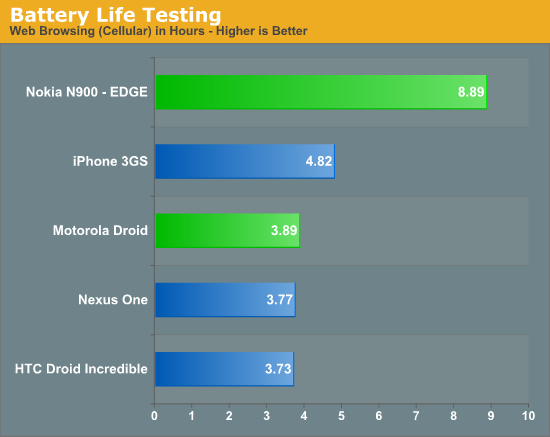
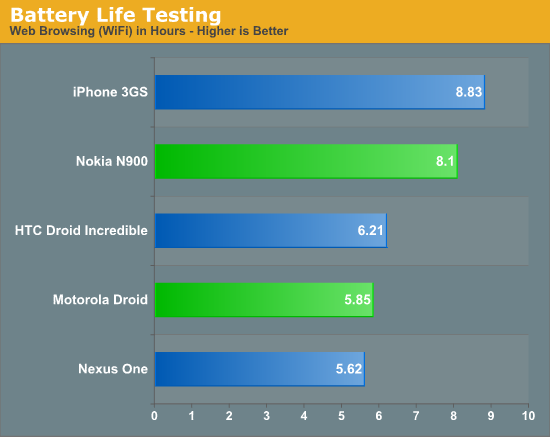
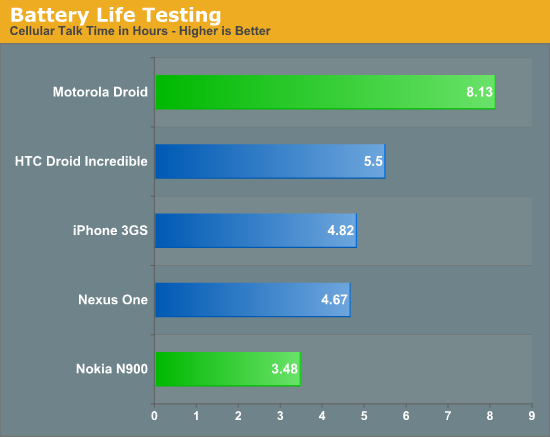
I was shocked when I saw the call time numbers for the Motorola Droid, and ran the test 2 more times - all with the same outcome. If call time is what's important to you, the choice is a no-brainer. On the other hand, the N900 easily bests the Motorola Droid for WiFi browsing time, though 3G web browsing isn't a good comparison because of the EV-DO versus EDGE difference.
It's clear that battery life is very much an OS stack and radio stack dependent problem, even though we're running the same SoC. Remember that the N900 is running the 3430 at 600 MHz, and the Motorola Droid is running at 550 MHz.
Originally published at https://www.anandtech.com/show/3764/two-omap-3430-phones-nokia-n900-and-motorola-droid (Wayback Machine).