
Two OMAP 3430 Phones: Nokia N900 and Motorola Droid
Screen - Display
Both the N900 and Motorola Droid use traditional LCD displays. Of course, the interesting comparison points are the HTC Incredible and Nexus One displays, which use AMOLED. Though they advertise the same resolution, they do so using a proprietary RGBG grid marketed under the trade name 'PenTile' while the traditional LCDs use an RGB bayer grid pattern.
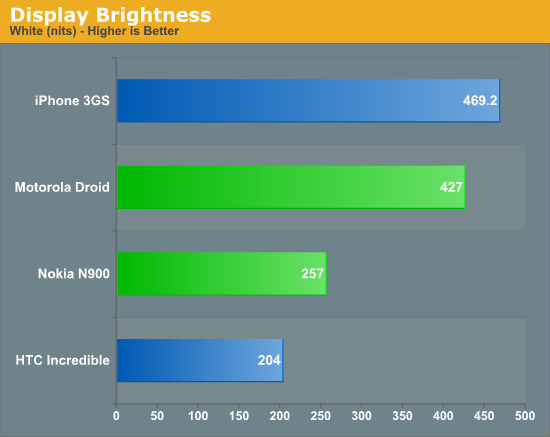
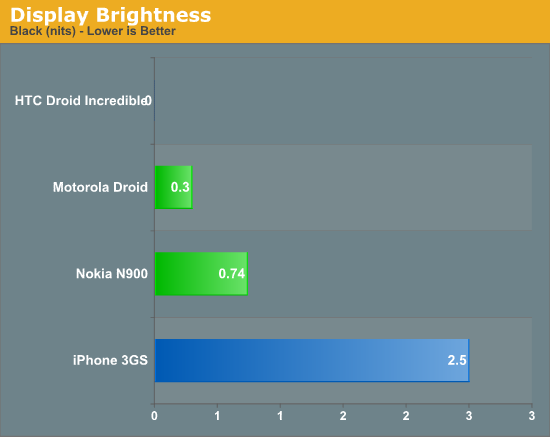
It remains an interesting point of contention whether the PenTile pattern offers superior spatial resolution than the traditional bayer grid pattern. Ultimately one needs to take into account the human eye system and subsequent response to really make a definitive answer. The AMOLED display is incredibly contrasty, so much so that I measured the black level as 0. That's right, 0 - meaning our contrast is effectively infinity. In fact, that makes sense - AMOLED subpixels are turned off when displaying black by nature of how they work. However, the white point I measured seems too low - interestingly, this is probably a result of the unique subpixel arrangement.

Personally, I can notice the difference in dithering and can discern the unique subpixel arrangement, but I know what to look for. For me, not being able to see the pattern or an offset screen door effect makes the Motorola Droid or N900 displays the better choice.
But if contrast and brightness are what matter, the AMOLED blows the competition away.

Side by side, the Motorola Droid and AMOLED display on the Incredible seemed just as bright, with the Incredible just edging out the Motorola Droid. Having played with two AMOLED displays, it appears like the displays are very oversaturated - perhaps at the expense of being accurate. Take a look at the yellows and oranges in the AnandTech webpage - it's easy to see that they're more saturated. I'm still trying to come up with a foolproof way to measure color accuracy, however.
The N900 isn't quite as bright or contrasty as either of the two phones. It's entirely possible that this is due to the resistive screen versus the two capacitive digitzers. Note that I'm positive the AMOLED display on the Incredible is causing some sort of measurement error to occur on my i1D2 colorimeter, as it definitely appears substantially brighter than the Motorola Droid. It's highly likely that the measurement is being skewed because of the unique PenTile arangement, or something inherent in the AMOLED display technology.
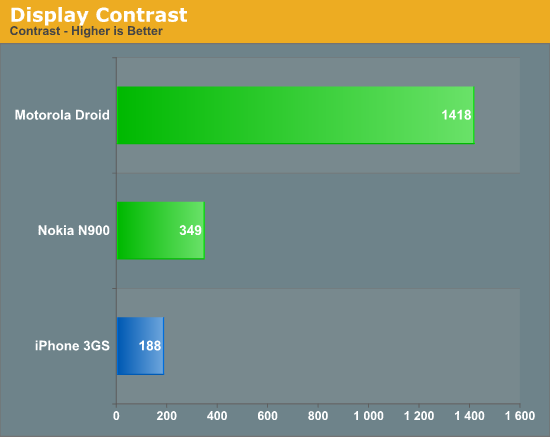
The HTC Droid Incredible is notably absent from the display contrast graph because contrast is... well... infinite in this circumstance. Or at least indeterminate. Whatever the case, AMOLED delivers the absolute best contrast possible. It's really amazing in person.
Outdoors, however, the N900 is an obvious winner - just look at the direct sunlight example down below. The AMOLED display on the Incredible is more difficult to read in indirect sunlight, and very challenging to look at in direct sunlight.


One last thing I'd like to note is that I've read in more than a few articles some claims that the AMOLED display is readable with polarized glasses - that there aren't any angles where there is complete extinction like with normal LCDs. This is false; rotate any AMOLED screen around, and brightness will still fall off following cosine squared like any other analyzing polarizer.
Originally published at https://www.anandtech.com/show/3764/two-omap-3430-phones-nokia-n900-and-motorola-droid (Wayback Machine).