
Intel’s Core i5-655K & Core i7-875K: Overclocked and Analyzed
i3-540 vs. i5-655K vs. i5-661
Next up, let’s take a look at the power scaling of the i5-665K against the more expensive albeit locked multiplier variant, the i5-661:

We’ve started the scale at 4GHz here, because any variance below this freqeuncy using water-cooling is negligible (around 2W in favour of the i5-655-K due to a lower VTT). The biggest gap we could find over 4GHz is 7 Watts which shows up between 4.1GHz and 4.2GHz where our i5-655K sample needs a rapid hike of VTT to scale. After that, there’s a 2~4W variance at equivalent frequencies favouring the i5-661 - not huge by any means over the frequency band of interest for overclockers using air or water cooling.
At this point, we’ll overlay the i3-540 power consumption figures using the same water-loop for cooling:
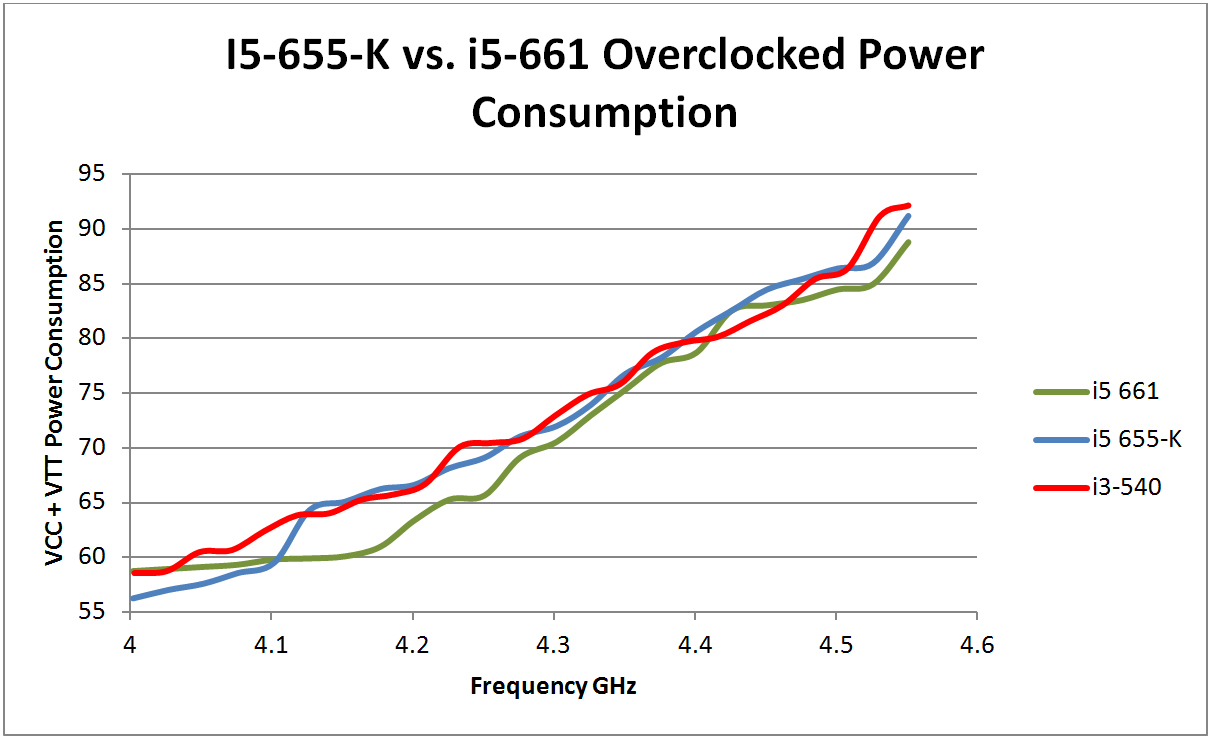
The i3-540 is at an “advantage” in this graph, as we’ve got no choice but to lower the memory multiplier ratio to 2:8 (giving a speed of DDR-3 1584 MHz at 4.554GHz). The i3-540 has a maximum core multiplier of 23x, and given the base clock needed to attain 4.55GHz, we’d be close to DDR3-2000 speeds which is a tall order for this particular CPU. Both the i5-661 and i5-655K are running the 2:10 memory multiplier ratio using a 25x CPU core mutliplier, giving a memory speed of DDR3-1820.
Before we have a quick look at the Lynnfield i7-875-K, one last thing we’d like to compare is how well the i5-655K handles sub-zero temperatures in comparison to the i5-661.
The capabilities of the i5-661 are well known to us, and we’ve already got a number of overclocking results on record to compare against. Given the i5-661 exhibits better frequency scaling relative to applied voltage, it’ll be interesting to see how the i5-655K fares…
Originally published at https://www.anandtech.com/show/3742/intels-core-i5655k-core-i7875k-overclocked-and-analysed- (Wayback Machine).