
System Buyer’s Guide: $1700 Performance Midrange
AMD Performance Midrange System
AMD recently launched their new six-core Thuban processors, the Phenom II X6 1055T and 1090T. With the same power requirements as previous Phenom II X4 processors, plus Turbo Core for boosting performance in situations where some of the cores are idle, the Thuban processors are generally better than the previous X4 series. In fact, our power tests show that despite having two additional cores, the new CPUs actually draw slightly less power than quad-core Phenom II thanks to process refinements. In something of a shocking break with tradition, our AMD Performance Midrange system actually ends up costing as much as the Intel setup, mainly because of the motherboard and CPU choices. We could certainly build a quad-core AMD system and save a lot of money, but the features offered by the newer CPU and motherboard are compelling.
At $205, the six-core Phenom II X6 1055T Thuban is a great bargain in its own right. While the 1055T is superior to the i5-750 in multithreaded applications, the i5 holds an advantage in gaming, so the decision as to which platform to adopt may boil down to your intended use. The 1055T also utilizes a turbo mode (AMD Turbo Core), and its 2.8GHz clock speed can increase to 3.3GHz on lightly threaded workloads (when half the cores are idle). Additionally, the 1055T is a fine overclocker out of the box, with sizeable increases in clock speed being attainable with the retail cooler. All in all, AMD’s 1055T deserves a serious look for those shopping around at the performance midrange level, especially for those users who do a great deal of video encoding.
Alternately, if you’re looking to save a few bucks, you might want to (re)consider the 965BE, an outstanding processor for $185. Though it gives up a couple of cores to the 1055T, it performs slightly better in gaming, and its unlocked multiplier will appeal to those who are looking for maximum flexibility in overclocking their AMD machine.
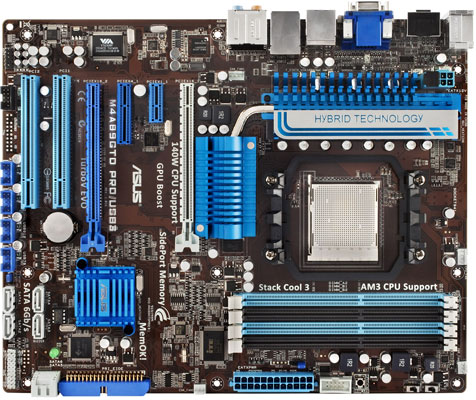
Like the Gigabyte board chosen for the Intel system, the ASUS M4A89GTD Pro offers a lot in the way of features and capabilities without breaking the bank. This board includes Realtek’s 8111E LAN (PCIe), six SATA 6.0 Gbps ports (as well as an eSATA 3.0 GB/s port), two USB 3.0 ports, 12 USB 2.0 ports, and Realtek’s ALC 892S – 7.1 Channel Audio – with DTS Surround Sensation Package. The board also features support for CrossFireX (not to mention an integrated ATI Radeon HD 4290 GPU, just in case). All in all, the M4A89 GTD Pro is worth a long look in the performance midrange segment.
We debated a bit about moving to an 890FX board, but the fact is the added $25 to $50 doesn't get you much beyond better overclocking support. If you're dead set on some serious overclocking, we'd recommend moving to the ASUS M4A89TD PRO, but for the vast majority of users it's not necessary. As another potentially interesting option, instead of our above recommended system, Newegg currently has a massive combo package that includes just about everything you need. You get the same 1055T CPU, Rifle cooler, a more expensive case, a 1.5TB HDD, value RAM, and a Cooler Master 700W 80Plus PSU. You lose the 5850 and drop to an ASUS overclocked 5830, and you also lose the Blu-ray reader and get a standard DVD-RW, but the total price of $1054 (with $40 in main-in rebates) is a pretty good chunk of change if you don't mind the slower GPU.
Originally published at https://www.anandtech.com/show/3723/system-buyers-guide-1700-performance-midrange (Wayback Machine).