
Acer Aspire 1410: Single-Core CULV Takes on Atom
Acer Aspire 1410: Performance
So now we hit the benchmarks, where we can really see where the SU3500 falls in comparison to the Atom N450 and the SU4100/SU7300. Does the added clock speed make any difference, and how much does it get hurt by the lack of both Hyper-Threading and a second core?
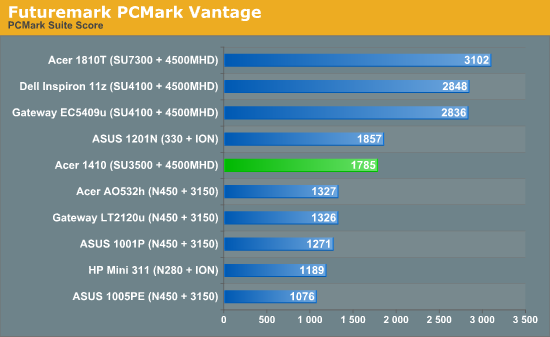
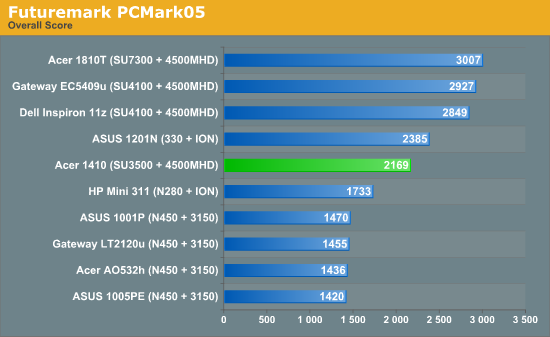
If you looking at the PCMark benchmarks, the answer is quite a bit. It gets hammered by being a single thread, single-core processor—it’s down 800 points in PCMark05 and a staggering 1300 points in PCMark Vantage compared to its Core 2 Duo brother, the 1810T. Even the Eee 1201N beats it in both benchmarks (though not by much) and that's just an ION netbook with a dual-core Atom. It’s worth noting that the ION part doesn’t make much of a difference in PCMark (based on results of the HP Mini 311), and that even the basic N450 netbooks actually aren’t that far off in either PCMark test. I’m going to put this down to the Hyper-Threading that the Atom relies on. The PCMark results seem to suggest that the Core 2 Solo is closer to the Atom performance class than the real notebook class.
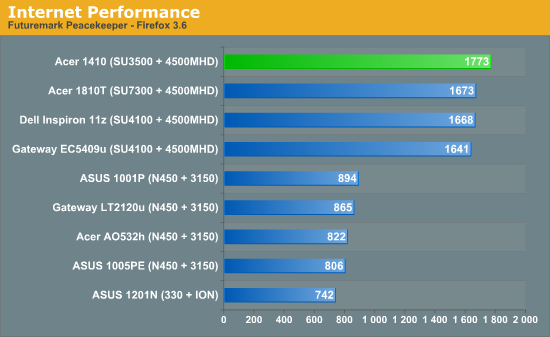
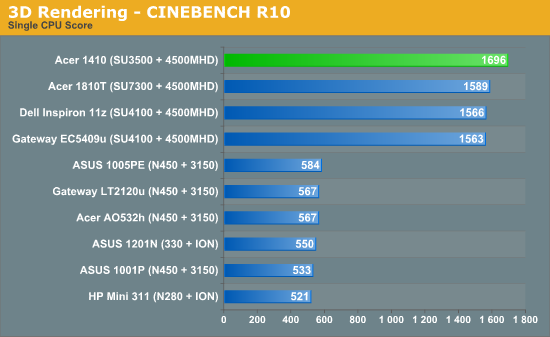
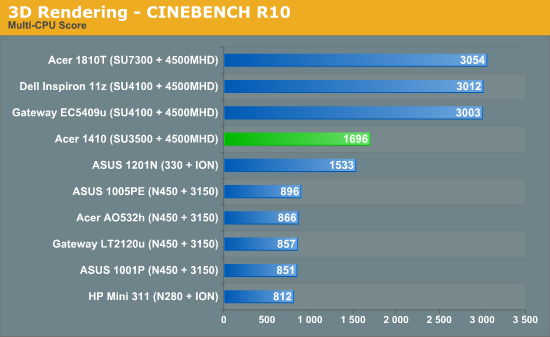
Now if we look at single-threaded benchmark and application performance, we see that even with just one logic processor, the Core 2 architecture will still blow Atom out of the water; it’s just useless for multithreaded benchmarks. In Cinebench R10 (single CPU only; we've used the same score in the multi-core chart) the 1410 absolutely wipes the floor with Atom, and because of the higher 1.40GHz clock speed it actually outdoes its dual-core brethren as well. What’s interesting to note is that the 1410’s single CPU result is faster than the Eee 1201N’s multi-CPU result, which really shows the horsepower difference between the Core 2 and Atom architectures. Peacekeeper paints much the same picture, with the 1410 obliterating Atom and slightly outperforming the SU7300/SU4100 machines.
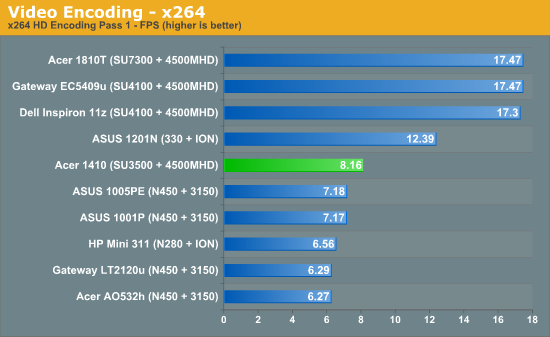
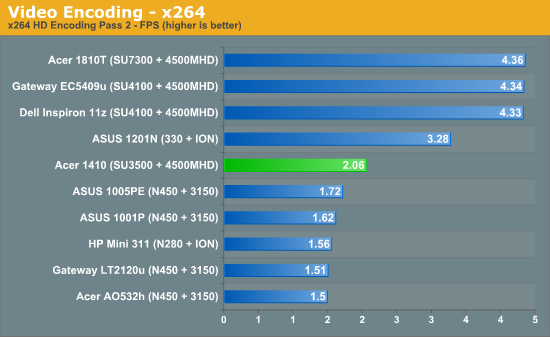
The HD x264 encoding test is another multithreaded benchmark, and again, the SU3500 gets hammered. It’s not significantly faster than the netbooks, and it's waaay behind the dual-core CULV systems. With that said, if you’re depending on a $400, 3.1lb ultraportable for media encoding purposes, maybe you’re looking at the wrong types of computers.
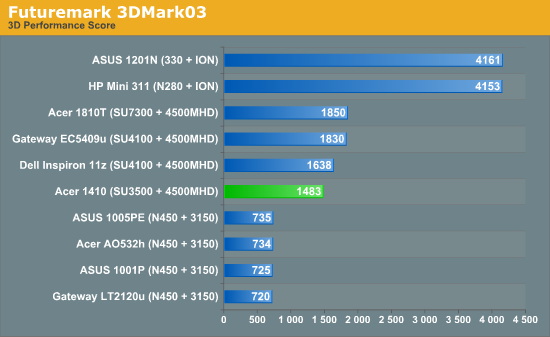
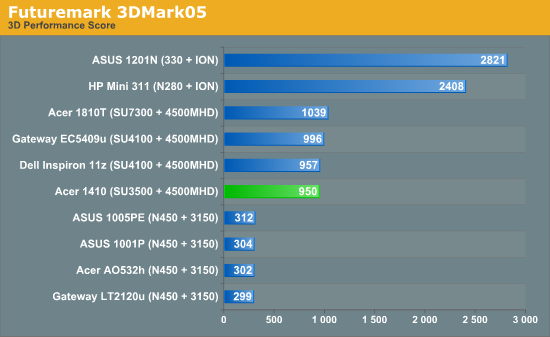
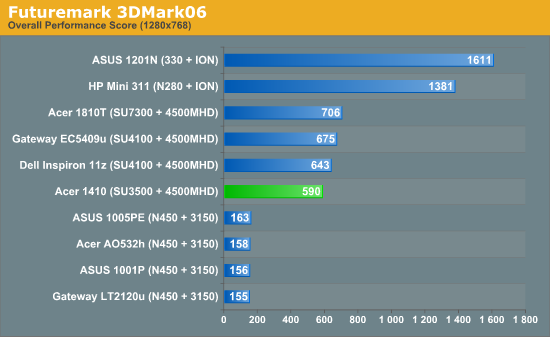
3DMark results show us that, yes, GMA 4500MHD, though a huge improvement over the packaged-into-Atom GMA 3150, is still a pretty useless gaming chip. But hey, at least it breaks the 200 mark in 3DMark06. Really, the 4500MHD is best for games released in the 3DMark03 time frame. The 1410 is in the same range as the other CULV/GMA machines, though the dual-core processors likely helped the others in the CPU tests. Fair enough.
What I would wager is that the 1410 will be slightly faster in whatever old titles you can manage to play on any of these systems due to the higher CPU clock speed. GMA 4500MHD isn’t going to be playing any newish titles, and without a CD drive it’s going to be a pain to get your games onto the system anyways. (We'd suggest Steam or GOG.com as easy, legal ways to put games on the 1410). Just don’t hope for a great gaming experience if you do make the effort.
Originally published at https://www.anandtech.com/show/3701/acer-aspire-1410-singlecore-culv-takes-on-atom (Wayback Machine).