
Intel Unveils Moorestown and the Atom Z600, The Fastest Smartphone Platform?
- Posted in
- Smartphones
- Intel
- Atom
- Mobile
- SoCs
Moblin/MeeGo: The Fastest Smartphone OS?
PC game developers often criticize Intel for holding back the whole industry by not shipping faster integrated graphics. Game developers have to target the least common denominator of graphics hardware, which happens to be Intel’s integrated graphics. So nearly all PC games suffer as a result.
Moorestown is a good bit faster than any ARM based SoC on the market today. Memory bandwidth limitations aside, if you look at our recent Apple A4 vs. Atom performance comparison you’ll see what sort of gap exists between what you get today in a smartphone and what Intel is trying to deliver:
Unfortunately for Intel, all smartphone OSes are optimized for the least common denominator in SoC performance. That is 400MHz - 1GHz ARM11 or Cortex A8 class hardware. Smartphone OS vendors need to make sure their OSes run on the majority of hardware, which just isn’t Moorestown. Intel needs something to take advantage of its added performance, so Intel had to go off and do some software work. Irony is hilarious.
Moorestown is useless if it doesn’t offer significantly better performance or user experience (or both) than its competitors. To ensure this, Intel did two things.
First, Intel bought a company called Wind River. A $400M company prior to acquisition, Intel snagged WindRiver back in July of 2009. Their mission statement? To take open source software and make it commercially viable.
Whether it’s stress testing or adding new features, Wind River takes open source software and improves it to the point where you can now sell it as a commercial product. This is similar to what Apple did with the base of much of OS X. You take some good open source projects and pay people to polish and harden the last 10 - 20% of them.
Wind River has a platform for Android. It incorporates Atom optimizations into Android, hardens the software stack and prepares it for use in Moorestown devices. Google has little incentive to dedicate a lot of support to Moorestown, so Intel had to internalize that.
The second thing Intel did to ensure Moorestown’s performance wouldn’t go to waste was the development of Moblin. A smartphone/tablet targeted Linux based OS, Moblin has been lurking in our minds for well over a year now. I never really got why Intel felt the need to support the development of a mobile OS until now.
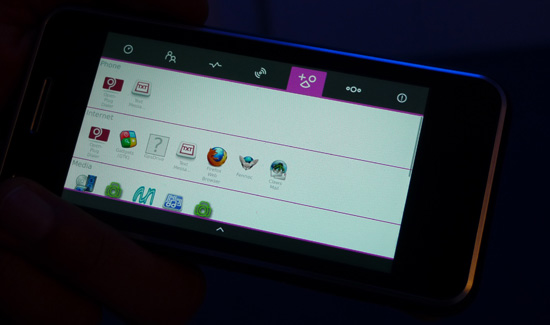
Moblin running on Moorestown
Moblin will be the highest performance OS for Moorestown to run on top of. Until a company like Apple or Google decides to embrace Moorestown, Intel needed a way to guarantee an optimized software stack for Moorestown. Moblin is that guarantee. It’s designed from the ground up to be Atom optimized, it’ll be faster than any other OS running on Moorestown and will also do the best integration of power management for Moorestown. Intel knows the architectures of its chips best, and Moblin effectively knows whatever Intel knows.
A Moorestown specific OS could also evolve to include more CPU intensive UIs and features just wouldn’t work well on the majority of ARM devices out there, which would in turn give Moorestown a tangible feature advantage in the smartphone market.
Earlier this year Intel and Nokia announced their cooperative efforts on an OS called MeeGo. Take one part Moblin and one part Maemo and you get MeeGo. The idea is to take Moblin and expand it to more platforms (particularly ARM based devices). Moblin will eventually go away and there will only be MeeGo, however there are currently smartphones and tablets based on both Moblin and MeeGo in development.
While Moblin and MeeGo are the best platforms for Moorestown, there’s a lot of reinventing the wheel that needs to be done. Thus the first Moorestown based smartphones will likely run Android.
The Neutral Role
Carriers aren’t very happy with Apple and Google. They’ve effectively wrestled power away from the carriers and left them as nothing but network providers. In my eyes this isn’t a bad thing. Over the past several years the major carriers have shown us nothing other than they can’t be trusted with too much power. Where there is frustration, there’s money to be made.
Intel wants to capitalize on that frustration by offering the carriers an alternative. Moblin won’t be branded, carriers could customize their own builds and do whatever they want with them. The carriers would ultimately limit what could run on their phones, much like Apple does today. It puts power back in the hands of the carrier, which is something they obviously like.
Whether or not that’s a good thing for the consumer is another question entirely. Intel tells me that the carriers have learned a lot from watching Apple and Google, and that they have no interest in making the same mistakes twice. I’m not sure I believe that just yet.
More OS Support if Needed
Intel made it clear that while it’s only focusing on Android, Moblin and MeeGo at the start, if a vendor were to express interest in doing a custom design around Moorestown the answer wouldn’t be no. In other words, if Apple wanted to move iPhone OS to Moorestown, Intel will make it happen.
Intel also mentioned that Moblin is an enabling necessity for Moorestown. If that need ever goes away, it has no issues handing the market over to Apple, Google or whoever wants to carry the torch. Intel doesn’t want to be in the mobile OS business, it’s simply participating because it is compelled to in order to build the best environment for Moorestown to succeed. If Intel’s plan works out, then all smartphones would eventually use some Moorestown derivative and they would be optimized for much higher performance CPU right off the bat. We’re not there today, so Moblin has a role to play.
There's also the question of Windows 7 support. Without a PCI bus, Moorestown can't run the popular desktop OS. However if Intel were to deliver a version of Moorestown with PCI support, that could solve that problem...
Originally published at https://www.anandtech.com/show/3696/intel-unveils-moorestown-and-the-atom-z600-series-the-fastest-smartphone-processor (Wayback Machine).