
AT&T 3G MicroCell: A Comprehensive Exploration
Performance - Data With Multiple Devices
In location 1, I used two iPhone 3GSes to show how easily that HSDPA 3.6 Mbps can get saturated:

Look at Download - This is location 1 right next to the microcell
If you add up the downstream speeds, you can see how close we are to that real-world 2.2 Mbps effective limit of 3.6 Mbps HSDPA. That's the performance limitation, not so much the internet connection. Both phones went on to reflect the capped 60 Kbps of upstream that's strictly enforced. Two devices is fair enough, but this is AnandTech, let's take it four devices - the MicroCell's limit - and see how things fare then.

A plethora of phones? Either way, it's enough to make AT&T sweat.
The MicroCell handles the limit of four devices perfectly fine, all four phones joined the femtocell in under a minute after moving into the coverage range. Simultaneous data across all four is doable, but not ideal. It's very obvious there's additional overhead. I did notice what I can only describe as occasional glitchiness, getting all four tests to run at the same time was just a bit challenging. This is likely the iPhone's tendency to break data connections and reestablish them only when needed to preserve battery rearing its head.
For these tests, I ran speedtest.net at the same time on all the phones and averaged the results across the phones. Again, we can see the very obvious upstream cap of around 60 Kbps.
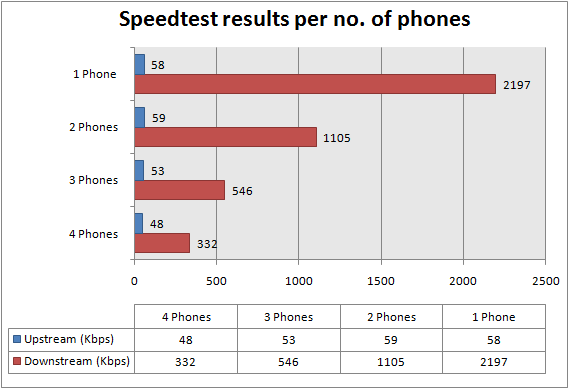
Performance doesn't scale linearly, and again in location 2 I wasn't in the room where the MicroCell was, I was a few rooms away. The biggest thing I can take away is that if you've got internet at your home or small office where you're installing the MicroCell, you've probably got WiFi too. At that rate, just use WiFi for data, and only tax the MicroCell with voice and SMS.
Originally published at https://www.anandtech.com/show/3626/att-3g-microcell-a-comprehensive-exploration (Wayback Machine).