
AMD's Radeon HD 5870 Eyefinity 6 Edition Reviewed
- Posted in
- GPUs
Power Consumption
AMD did list a slight increase in power consumption for the 5870 Eyefinity 6 cards. In real world usage it amounts to a 6 - 7W increase in power consumption at idle and under load. Hardly anything to be too concerned about.
It's worth mentioning that these power numbers were obtained in a benchmark that showed no real advantage to the extra 1GB of frame buffer. It is possible that under a more memory intensive workload (say for example, driving 6 displays) the 5870 E6 would draw much more power than a hypothetical 6-display 1GB 5870.
| Power Consumption Comparison | ||||
| Total System Power |
Radeon HD 5870 1GB
|
Radeon HD 5870 E6 2GB
|
||
| Idle | 179.1W | 186.0W | ||
| Load (Crysis Warhead) | 290.0W | 296.0W | ||
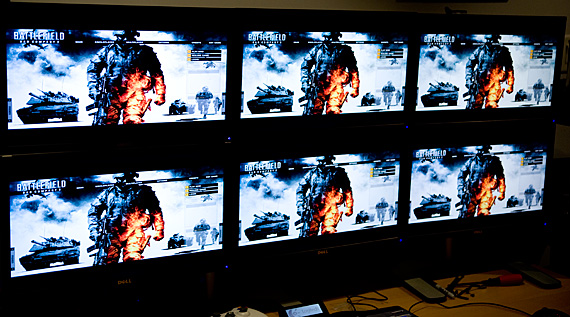
If you are power conscious however, then an Eyefinity 6 setup may not be right for you. Our six 22" Dell displays consumed 114W of power by themselves while playing Crysis. That's the power consumption of an entire Core i5 system under load, just for your displays!
Final Words
I spoke with Carrell Killebrew a few days ago (no, not for the RV970 story) and our conversation drifted over to future applications for GPUs. When Carrell first introduced me to Eyefinity he told me that this was the first step towards enabling a Holodeck-like environment in about 6 years.
Carrell envisions a world where when you want to watch a football game with your friends, or just hang out and play video games you'll do so in a virtual room inside of your home. You'll have a display occupying the majority if not all of your vision. Being displayed will be fully rendered, lifelike models of your friends, which you can interact with in real time. After all, sending model data requires far less bandwidth than exchanging high resolution encoded video between a dozen people in a room.
Sound will have to be calculated on a per person basis. Existing surround sound setups work well for a single user, but not for multiple people spread out all over a virtual room. The GPU will not only have the task of rendering the characters in the room, but also calculating the phase and position accurate sound for everyone.
Today we play games like Rockband or Guitar Hero facing a screen. In Carrell's world, 6 years from now we'll be facing a crowd of fans and it'll look, feel and sound like we're on stage performing. There's a lot that has to be solved between now and then, but in Carrell's eyes this is the beginning. And like most beginnings, this one has its rough patches.
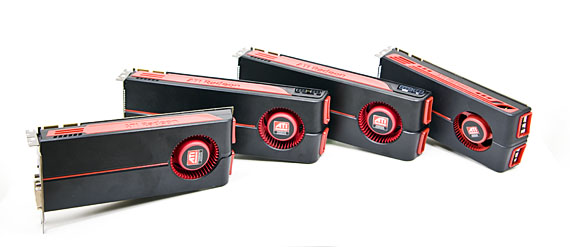
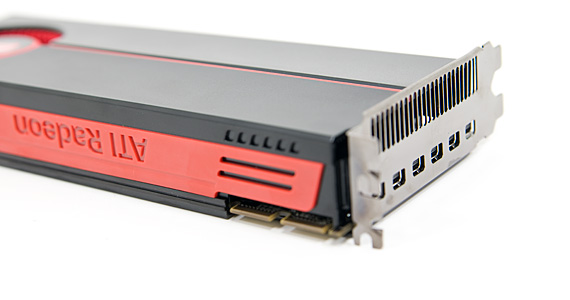
The good news is that a single Radeon HD 5870 Eyefinity 6 Edition card can drive a total of six displays. That's something that we couldn't have imagined from a consumer card even just a couple of years ago. If you've ever found yourself wanting 6 monitors for a particular application, workload or even game - this is your solution.
As a general gaming card however, there are definite issues. In existing titles, with 3 or fewer screens, we just didn't see a tremendous performance advantage to the 5870 E6. The larger frame buffer did help raise minimum frame rates, but not enough to positively impact the average frame rates in our tests. Even in triple display setups we didn't see any reason to get the E6 card.
If you are looking to make the jump to six displays however, the issues then stop being with the card itself and are more about what you want to do with the setup. Having two 3x1 groups makes sense. It's a bit pricey, but it makes sense if you like mixing work and pleasure on your desktop. The single 3x2 group is the problematic configuration. For games you play in the third person, it's great. For first person shooters however, playing on an Eyefinity 6 setup puts you at a disadvantage due to crosshair problem. What AMD really needs to do here is enable a 5x1 configuration for folks serious about FPSes.
The bigger problem is simply the state of game support for Eyefinity. The majority of titles, even new ones coming out today, often ship with gross incompatibilities with Eyefinity setups. AMD is hard at work to make this better, but it means that you can't plop down $1500 for six monitors and two stands, drop another $900 on a pair of video cards and have it work perfectly in everything you'd ever want to play. It's a tough pill to swallow.
If you want to have an immersive gaming experience and if you've got the wall space you're better off buying a 720p projector, building a screen (or painting one on the wall) and calling it a day. On the other hand, of you just need more desktop resolution then a 30" monitor is probably in your future. If you must combine the two needs and have them serviced by a single setup, that's where Eyefinity 6 can offer some value.
Originally published at https://www.anandtech.com/show/3621/amds-radeon-hd-5870-eyefinity-6-edition-reviewed (Wayback Machine).