
Intel X25-V in RAID-0: Faster than X25-M G2 for $250?
Missing TRIM - Does it Matter?
Clearly the performance of two X25-Vs in RAID 0 is great, but you do lose TRIM - isn't that a dealbreaker? Honestly, it depends. For sequential accesses, TRIM isn't necessary on the Intel drives. The X25 controller does a good job of aggressively cleaning and recycling NAND blocks and you'll pretty consistently write at peak performance if your workload is almost all sequential.
The more random your access pattern is, the more you'll miss TRIM. Thankfully desktops don't spend too much of their time randomly writing data across the drive, but I'd say a good 30% of most desktop writes are random to an extent. Over time, these random writes will build up and bring down the overall performance of your RAID array until you either secure erase the drives or write sequentially to all available free space.
There is one other option for curbing the performance degradation before it happens. Remember the relationship between spare area and write amplification:
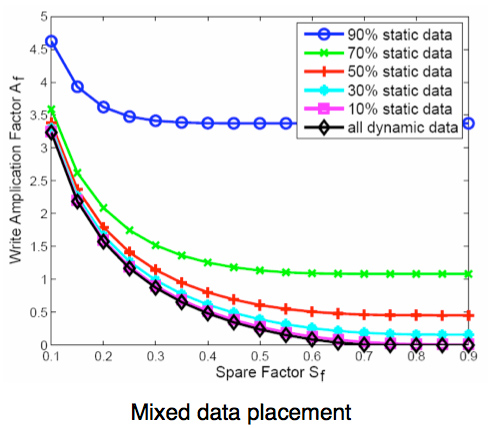
The more random your workload, the higher your write amplification (and thus the lower your performance, shorter your NAND lifespan). Increasing spare area can go a long way to reducing write amplification. While it can't eliminate it, it can definitely make a dent.
If you're looking to keep performance as high as possible with a pair of X25-Vs in RAID, you can always allocate more NAND as spare area. Secure erase each drive, create your RAID array, and then create your partition on the drive smaller than max capacity (try 10 - 20% smaller). The unpartitioned space should automatically be used by the controller as spare area. To test the effectiveness of this approach I took an X25-V, filled it with garbage data, and then wrote random data across the drive as fast as possible for 20 minutes. I then ran HD Tach to get a visualization of write latency (expressed by sudden drops in bandwidth) vs. LBA:
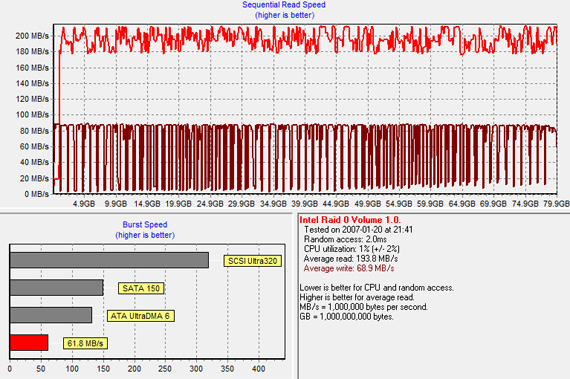
A standard 80GB X25-M wouldn't be this bad off, the X25-V gets extra penalized by having such a limited capacity to begin with. You can see that the drive is attempting to write at full speed but gets brought down to nearly 0MB/s as it has to constantly clean dirty blocks. Constant TRIMing would never let the drive get into this state. It's worth mentioning that a desktop usage pattern shouldn't get this happen either. Another set of sequential writes will clean up most of this though:
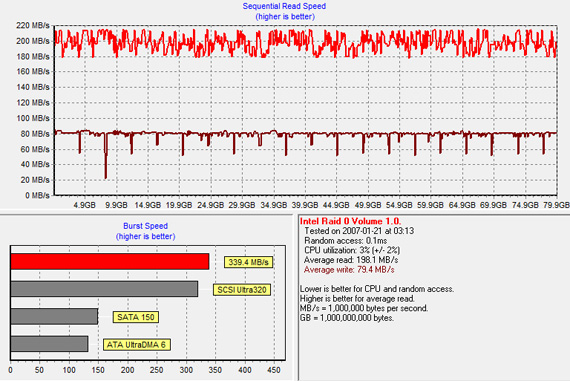
Intel's controller is very resillient. Even without TRIM, as long as your access pattern has some amount of a sequential component you'll be able to eventually recover performance.
Now look at what happens if we only use 60GB of the 74.5GB RAID 0 array upon creation and run the same test:
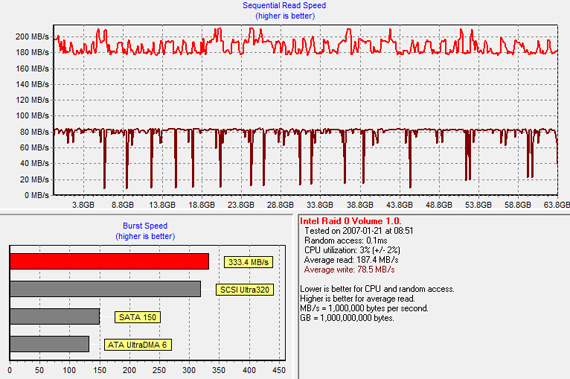
Performance isn't nearly as bad. That added spare area really comes in handy. Of course another pass corrects nearly everything:
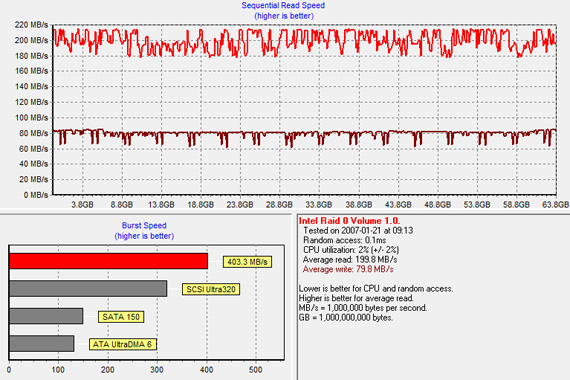
If you don't need the added space, using a smaller partition is a great way to ensure high performance for as long as possible. The effectiveness of this approach is a difficult thing to benchmark given that it's only after months of normal use that you get enough random writes to the drive to be a problem. The good news is that even if you bombard the X25-Vs with random writes, the drives can quickly recover as soon as they're hit with some sequential data.
Originally published at https://www.anandtech.com/show/3618/intel-x25v-in-raid0-faster-than-x25m-g2-for-250 (Wayback Machine).