
Intel X25-V in RAID-0: Faster than X25-M G2 for $250?
Random Read/Write Speed
This test reads/writes 4KB in a completely random pattern over an 8GB space of the drive to simulate the sort of random access that you'd see on an OS drive (even this is more stressful than a normal desktop user would see). I perform three concurrent IOs and run the test for 3 minutes. The results reported are in average MB/s over the entire time.
I've had to run this test two different ways thanks to the way the newer controllers handle write alignment. Without a manually aligned partition, Windows XP executes writes on sector aligned boundaries while most modern OSes write with 4K alignment. Some controllers take this into account when mapping LBAs to page addresses, which generates additional overhead but makes for relatively similar performance regardless of OS/partition alignment. Other controllers skip the management overhead and just perform worse under Windows XP without partition alignment as file system writes are not automatically aligned with the SSD's internal pages.
First up is my traditional 4KB random write test, each write here is aligned to 512-byte sectors, similar to how Windows XP might write data to a drive:
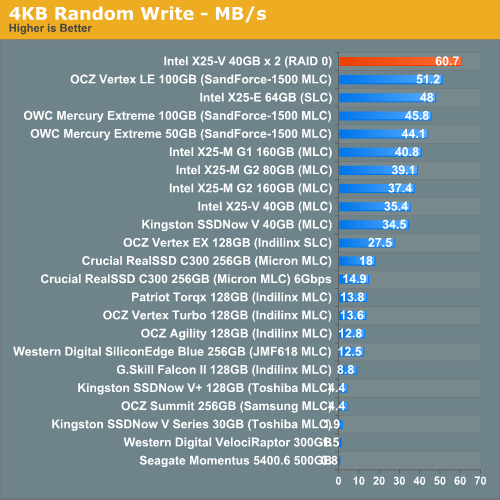
In sector-aligned 4K random writes, nothing is faster than our X25-V RAID 0 array. We're talking faster than Intel's X25-E, faster than SandForce...you get the picture.
Our 4K aligned test, more indicative of random write performance under newer OSes puts a damper on the excitement:
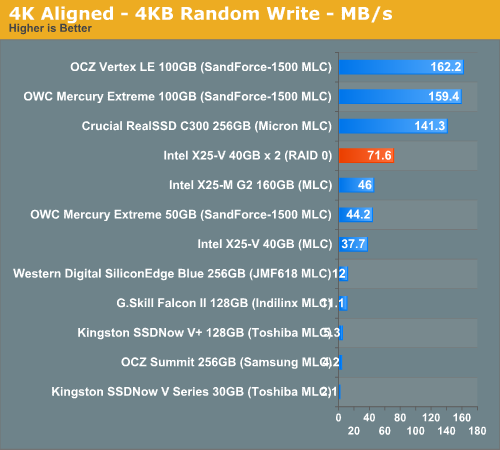
At 71.6MB/s we're definitely faster than any other Intel drive here, as well as the 50GB SandForce offerings. But still no where near as fast as the C300 or OCZ Vertex LE.
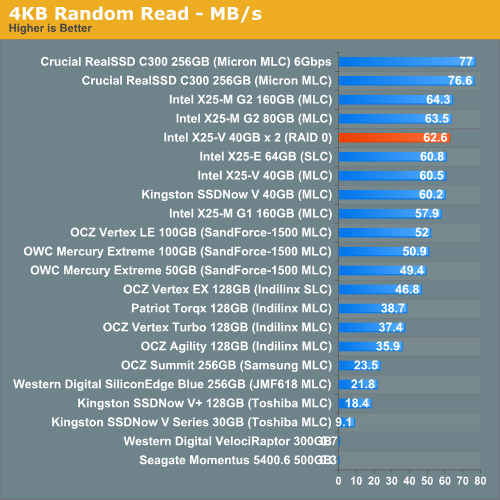
Random read performance didn't improve all that much for some reason. We're bottlenecked somewhere else obviously.
Originally published at https://www.anandtech.com/show/3618/intel-x25v-in-raid0-faster-than-x25m-g2-for-250 (Wayback Machine).