
6Gbps SATA Performance: AMD 890GX vs. Intel X58/P55
- Posted in
- Storage
Final Words
AMD’s ATI acquisition was about bringing graphics to the portfolio with the eventual goal of integration into the CPU itself. We’ll see the first of that early next year with Llano. But as AMD goes down this integration route, it needs to make sure that its chipsets are at least up to par with Intel’s. Many have complained about AMD’s South Bridges in the past, but with SB850 we’ve actually seen some real improvement. There still appear to be some strange behaviors and I don’t like that there’s any discrepancy between AMD’s reference board and retail 890GX boards, but these results look very promising.
AMD’s native 6Gbps implementation manages to outperform both Marvell and Intel’s controllers in the 4KB random write test by a substantial margin. AMD’s sequential read speed is lower than the Marvell controller, and random read speed is lower than Intel’s 3Gbps controller. With a bit of work, AMD looks like it could have the best performing SATA controller on the market.
Intel’s X58 still has a few tricks left up its sleeve - it manages to be a very high performing 3Gbps SATA controller. Other than in sequential read speed, it’s even faster than Marvell’s 6Gbps controller with a 6Gbps SSD - although not by much.
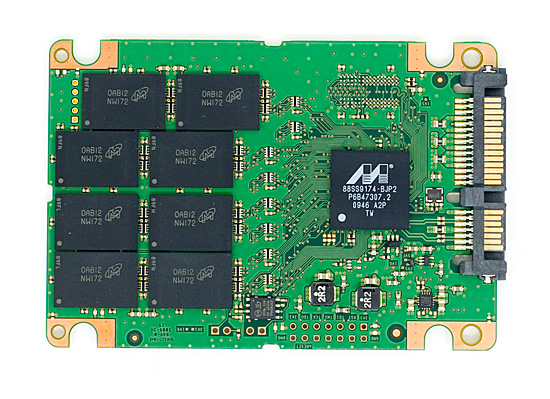
Marvell makes the only 6Gbps SSD controller today. By next year that will change.
The P55 and H55 platforms are far less exciting. Any 6Gbps controller connected off the PCH is severely limited by Intel’s use of PCIe 1.0 slots. Unfortunately this means that you’ll have to use the 16 PCIe 2.0 lanes branching off the CPU for any real performance. That either results in you limiting your GPU to only 8 lanes or dropping back down to PCIe 1.0 if you have two graphics cards installed. ASUS’ PLX solution is an elegant workaround for the specific case of a user having two graphics cards and a 6Gbps SATA controller on-board. Our tests show that it does work well.
We have to give AMD credit here. Its platform group has clearly done the right thing. By switching to PCIe 2.0 completely and enabling 6Gbps SATA today, its platforms won’t be a bottleneck for any early adopters of fast SSDs. For Intel these issues don't go away until 2011 with the 6-series chipsets (Cougar Point) which will at least enable 6Gbps SATA.
Originally published at https://www.anandtech.com/show/2973/6gbps-sata-performance-amd-890gx-vs-intel-x58-p55 (Wayback Machine).