
OCZ’s Vertex Limited Edition Review & SSD State of the Union
- Posted in
- Storage
Random Read/Write Speed
This test writes 4KB in a completely random pattern over an 8GB space of the drive to simulate the sort of random writes that you'd see on an OS drive (even this is more stressful than a normal desktop user would see). I perform three concurrent IOs and run the test for 3 minutes. The results reported are in average MB/s over the entire time.
I've had to run this test two different ways thanks to the way the newer controllers handle write alignment. Without a manually aligned partition, Windows XP executes writes on sector aligned boundaries while most modern OSes write with 4K alignment. Some controllers take this into account when mapping LBAs to page addresses, which generates additional overhead but makes for relatively similar performance regardless of OS/partition alignment. Other controllers skip the management overhead and just perform worse under Windows XP without partition alignment as file system writes are not automatically aligned with the SSD's internal pages.
First up is my traditional 4KB random write test, each write here is aligned to 512-byte sectors, similar to how Windows XP might write data to a drive:
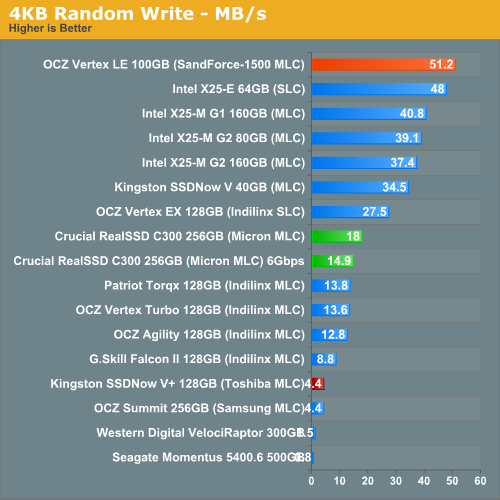
The OCZ Vertex LE does ridiculously well here, outperforming even Intel's X25-E. The Crucial RealSSD C300 does ok, a bit better than the Indilinx drives but no where near as good as the Intel based offerings. The reason being that the C300's controller doesn't actually attempt to reorganize unaligned writes on the fly. Look at what happens to 4K random write performance if we only write to 4K-aligned addresses:
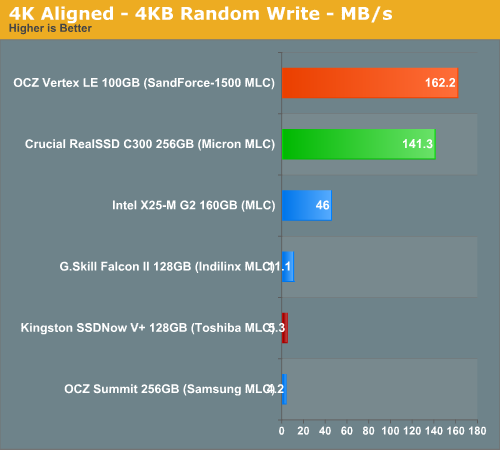
Not only does the Vertex LE jump in performance to over 160MB/s, but so does the RealSSD C300. The Intel and Indilinx drives also get a small boost, but nothing huge by comparison. Modern 4K-aware OSes write data in 4K aligned addresses, which matches up perfectly with the 4K page size on all of these SSDs. You can also guarantee higher performance in older OSes like Windows XP by re-mapping the LBAs on the fly but that requires additional overhead. These newer drives forgo performance under Windows XP, for significantly better performance under Windows Vista/7 and Mac OS X 10.5/6. It makes sense given that Intel's X25-M was designed back in 2005 - 2007 while these newer controllers were more recent endeavors.
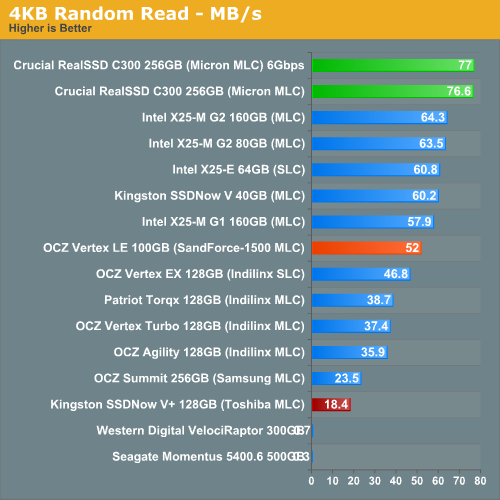
Random read performance is great on the C300 but a bit lower on the Vertex LE. None of these drives are posting bad figures here though. For the price the Kingston SSDNow V+ doesn't appear to deliver its worth.
Originally published at https://www.anandtech.com/show/2944 (Wayback Machine).