
Dynamic Power Management: A Quantitative Approach
- Posted in
- IT Computing
More Performance Please!
Now let's push the processor cores to their best performance.
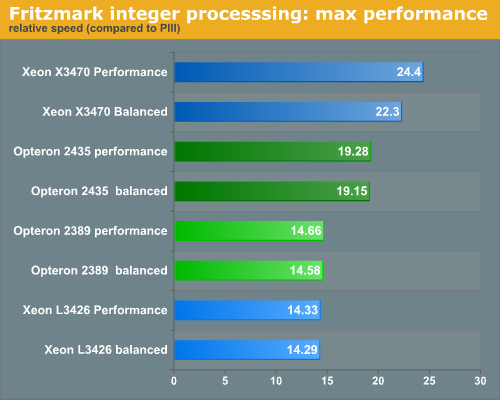
When the going gets tough, the tough get going. The L3426 has a very tight TDP limit with no headroom for any extra Turbo Boost action. The X3470 has a TDP limit with a large margin, and as a result it's still capable of boosting the clock speed a bit higher (3.066GHz) when running eight threads.
At the same time, this graph shows how superior the integer engine of the "Nehalem" based cores is over AMD. A 1.9GHz quad-core offers about the same performance as a 2.9GHz quad-core. It also shows that for - well multi-threaded - integer applications, AMD's six-core was a decent countermeasure.
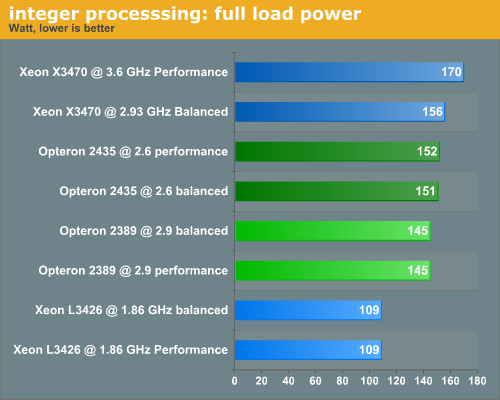
Turbo Boost delivers better performance, but comes with a power price. The influence is not really shocking at the system level - 9% higher power - but it is significant if you only look at the processor power level. We are still working on our methodology to measure power at the component level, but looking at the idle power and the spec sheets we can estimate CPU power rather well. Looking at the CPU level, Turbo Boost probably needs from 15% to 17% more power to the CPU VRMs.
Originally published at https://www.anandtech.com/show/2919 (Wayback Machine).