
ASUS UL80Vt and G51J: Going for the Gold
- Posted in
- Laptops
ASUS G51J Application Performance
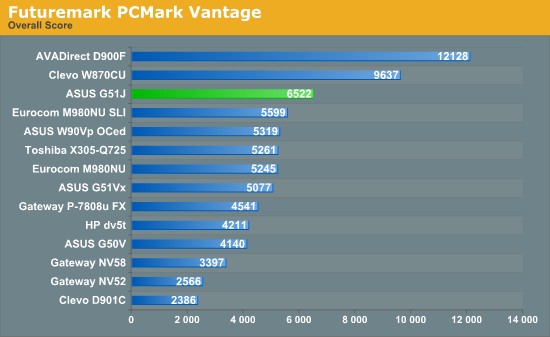
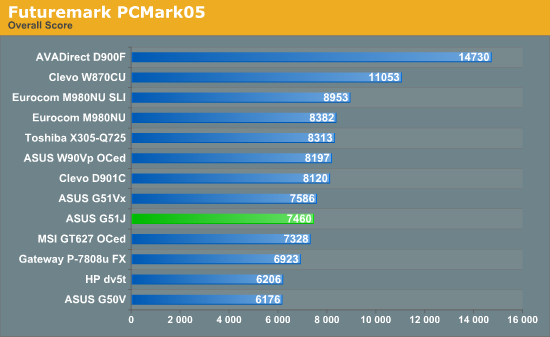
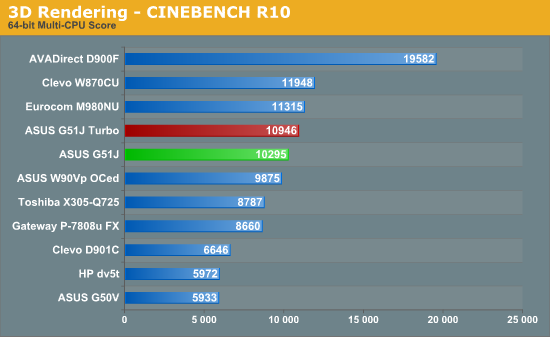
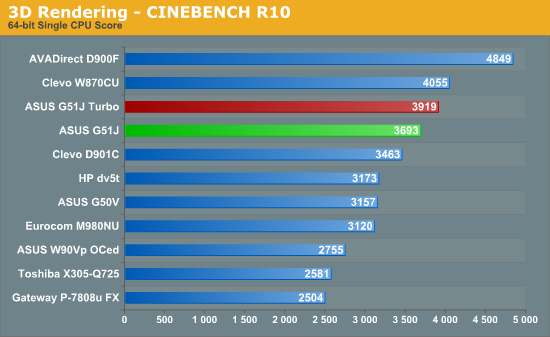
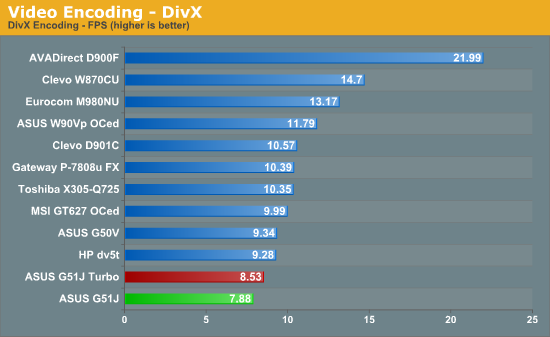
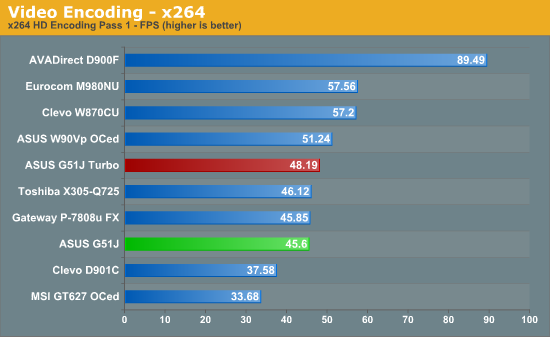
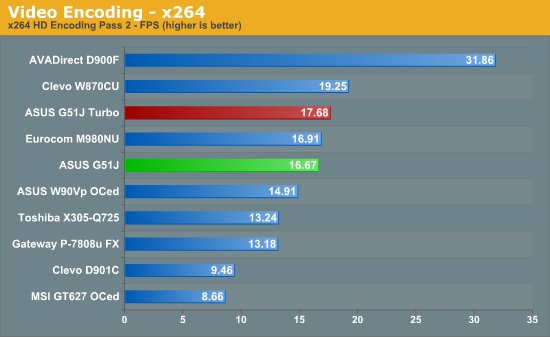
Application performance is basically what you would expect of the Core i7-720QM, with the exception of the DivX encoding result. We're not quite sure why the G51J scored so poorly in that test (possibly a software issue due to the switch to Win7), but the x264 and CINEBENCH results show that the gap shouldn't be that large.
PCMark05/Vantage also show a large advantage to the other high-end notebooks, but the Clevo and AVADirect systems have SSDs and that accounts for a large part of the difference. We've shown in other articles that Win7 tends to improve scores in PCMark Vantage by a noticeable amount, and it's a difference you can feel when using a PC. This results in the G51J actually beating the M980NU by a decent amount, though here the i7-720QM is already on par with the QX9300.
Finally, we have a few results from the ASUS G51Vx-A1 (Q9000 system) in PCMark. The older 2005 version has the G51 laptops essentially tied, while PCMark Vantage gives the G51J a large 28% lead. However, the G51Vx also shipped with Vista, so much of that difference is due to the change in OS.
Overclocking of the G51J shows the expected 5% increase in performance in the multi-threaded tests. As noted elsewhere, we actually saw lower performance in PCMark (and games) with the Turbo mode enabled, so most users will be best to leave that setting off.
If you need a fast mobile computer, the G51J will get the job done, but we can say the same of virtually any high-end laptop with a quad-core CPU. If you're doing tasks that really stress the CPU and can benefit from a ~25% reduction in the amount of time required to render images or process videos, something with an i7-920XM might be a better idea. Then again, upgrading to the D900F with its desktop CPU would be the best bet for maximum performance: it's nearly twice as fast as the G51J in x264 and CINEBENCH.
Originally published at https://www.anandtech.com/show/2886 (Wayback Machine).