
ASUS UL80Vt and G51J: Going for the Gold
- Posted in
- Laptops
ASUS UL80Vt Application Performance
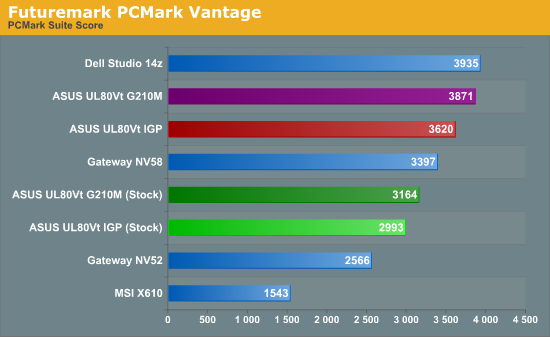
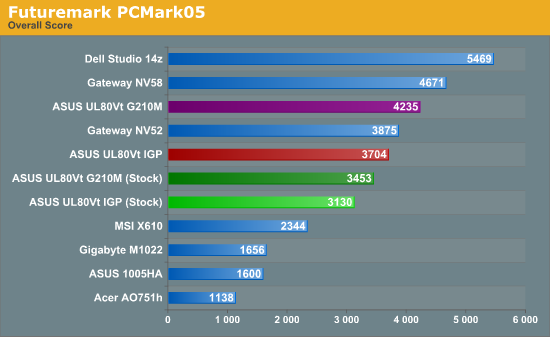
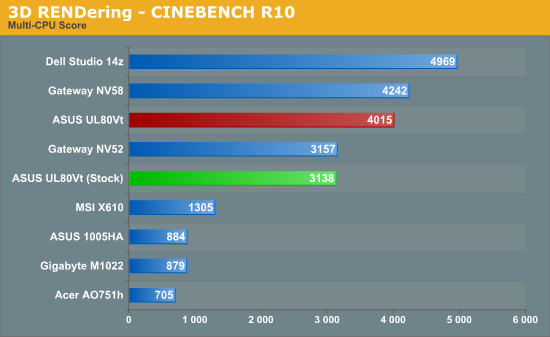
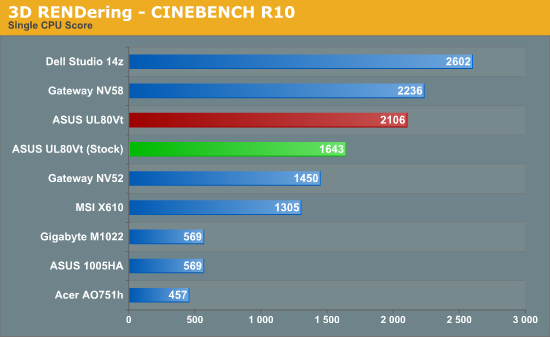
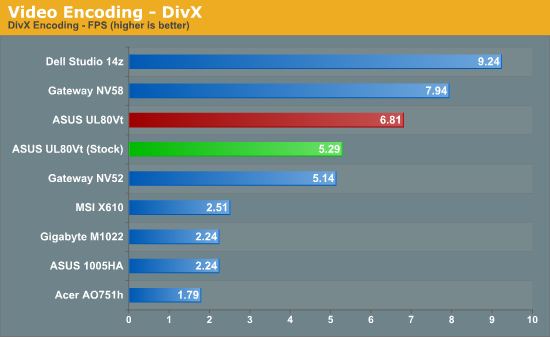
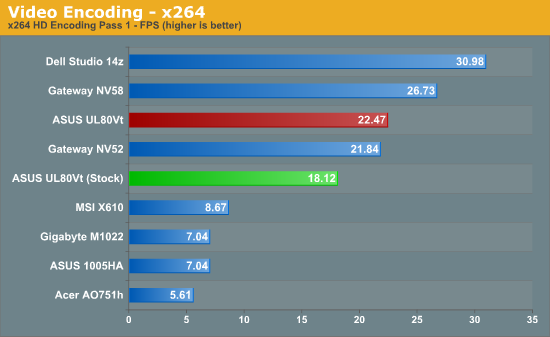
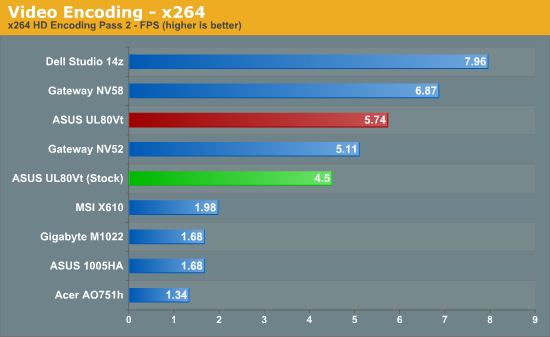
With Turbo33 and the G210M enabled, the UL80Vt is neck-and-neck with the Dell Studio 14z in PCMark Vantage, the most comprehensive picture of general application performance. PCMark05 places more of an emphasis on CPU clocks, so the 14z with P8600 ends up around 30% faster. That ~30% advantage holds when we move to CPU intensive applications like video encoding and 3D rendering where the 14z is 38% and 23% faster, respectively.
If you prefer battery life and want to disable the G210M and run the CPU at stock speed, the gap between the UL80Vt and the 14z grows substantially. PCMark Vantage shows a 31% advantage, PCMark05 75%, CINEBENCH 58%, and video encoding around 75% - not that you're likely to try doing video encoding or 3D rendering while unplugged on this sort of laptop.
If you want a different comparison that shows exactly why we're so keen on CULV laptops, take a look at the stock IGP configuration of the UL80Vt and compare that with any of the netbooks. In that case, the UL80Vt is over twice as fast in PCMark05 and 2.5 to 3.5 times faster in CPU intensive tasks like video encoding and 3D rendering. Sure, the UL80Vt costs over twice as much as a typical Atom-based netbook, but there are plenty of other CULV laptops with prices starting at $400 for the Acer 1410. The PCMark figures are a good indication of our experience: dual-core CULV is dramatically faster than Atom, to the point where if price is similar we wouldn't even consider Atom.
Originally published at https://www.anandtech.com/show/2886 (Wayback Machine).